


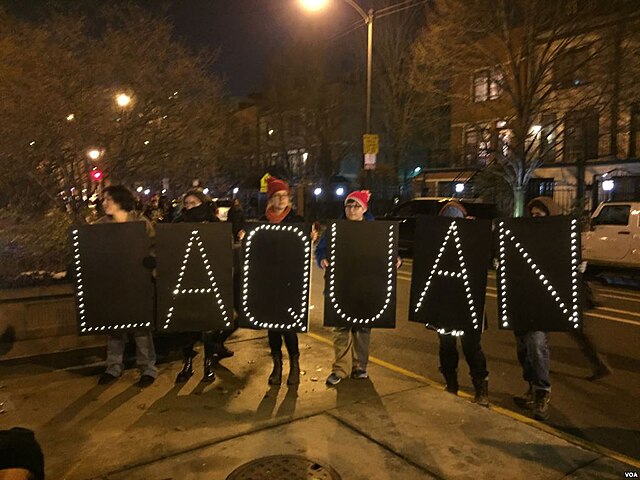
A court order, a Freedom of Information lawsuit, and more than thirteen months of official resistance stood between the public and dashcam footage showing a Chicago police officer firing sixteen shots at a 17-year-old walking away from him on a residential street — and it was only when a judge forced the city’s hand that the full extent of the cover-up began to unravel.
Laquan McDonald was shot and killed by officer Jason Van Dyke on the evening of 20 October 2014 on South Pulaski Road. Police had been called to reports of a teenager carrying a knife and breaking into vehicles. When officers arrived, McDonald — who had a small folding knife — ignored instructions to put it down and walked away from the group of officers on the scene. Van Dyke exited his patrol car and, within approximately six seconds, opened fire. He discharged all sixteen rounds his weapon could hold, continuing to shoot as McDonald lay on the ground. Not one of the other eight officers present fired their weapons. The first responding officer later stated he had seen no need to use force.
The initial police account told a very different story. Departmental reports described McDonald as having lunged at officers and raised the knife toward Van Dyke — a version that led supervisors to classify the shooting as a justifiable use of force. On that basis, no charges were filed and Van Dyke remained on the force, albeit stripped of his police powers.
Behind the scenes, the city moved quickly to settle. McDonald’s family received a $5 million payout from the Chicago City Council in April 2015 — before any wrongful death lawsuit had even been filed. The settlement was approved in roughly five seconds during a nearly three-hour council meeting. It also contained a condition that the dashcam video remain sealed until investigations were complete, a clause that could have kept the footage from public view indefinitely.
The video’s existence became known to journalists and lawyers through a whistleblower who contacted reporter Jamie Kalven shortly after the shooting, describing what it showed as horrific. The city denied at least fifteen subsequent requests for its release. It took a Freedom of Information Act lawsuit, filed by freelance journalist Brandon Smith, to force the issue into court. In November 2015, a Cook County judge ordered the footage released within days. The city did not appeal.
When the video was published on 24 November 2015 — the same day Van Dyke was finally charged with first-degree murder — it contradicted the official narrative entirely. McDonald was walking away when the first shot struck him. Nine of the sixteen bullets hit him in the back. The knife found at the scene was folded, not open as one police report had claimed. Audio was missing from the dashcam footage in Van Dyke’s vehicle, later found to have been intentionally damaged. Microphones in other police cars present that night were also found to have been disabled or tampered with.
Protests erupted across Chicago for weeks. The police superintendent was fired. The Cook County State’s Attorney, who had waited until hours before the court-ordered video release to bring charges, lost her reelection bid the following year. Three officers — including Van Dyke’s partner and the lead detective on the case — were subsequently charged with conspiracy to cover up the circumstances of the shooting. All three were acquitted in January 2019.
Van Dyke was convicted in October 2018 of second-degree murder and sixteen counts of aggravated battery with a firearm. He was sentenced to just under seven years and released in February 2022 after serving 39 months, having been granted early release for good behaviour.
A US Department of Justice civil rights investigation, completed in January 2017, found the Chicago Police Department had a systemic culture of excessive force, particularly against minority residents, and that training and oversight had been chronically inadequate. The city and federal government subsequently signed a consent decree committing to a programme of reforms, to be overseen by the courts.
