


A preliminary US military inquiry has concluded that American forces were responsible for a Tomahawk missile strike that killed at least 175 people — the majority of them children — at an elementary school in southern Iran on 28 February.
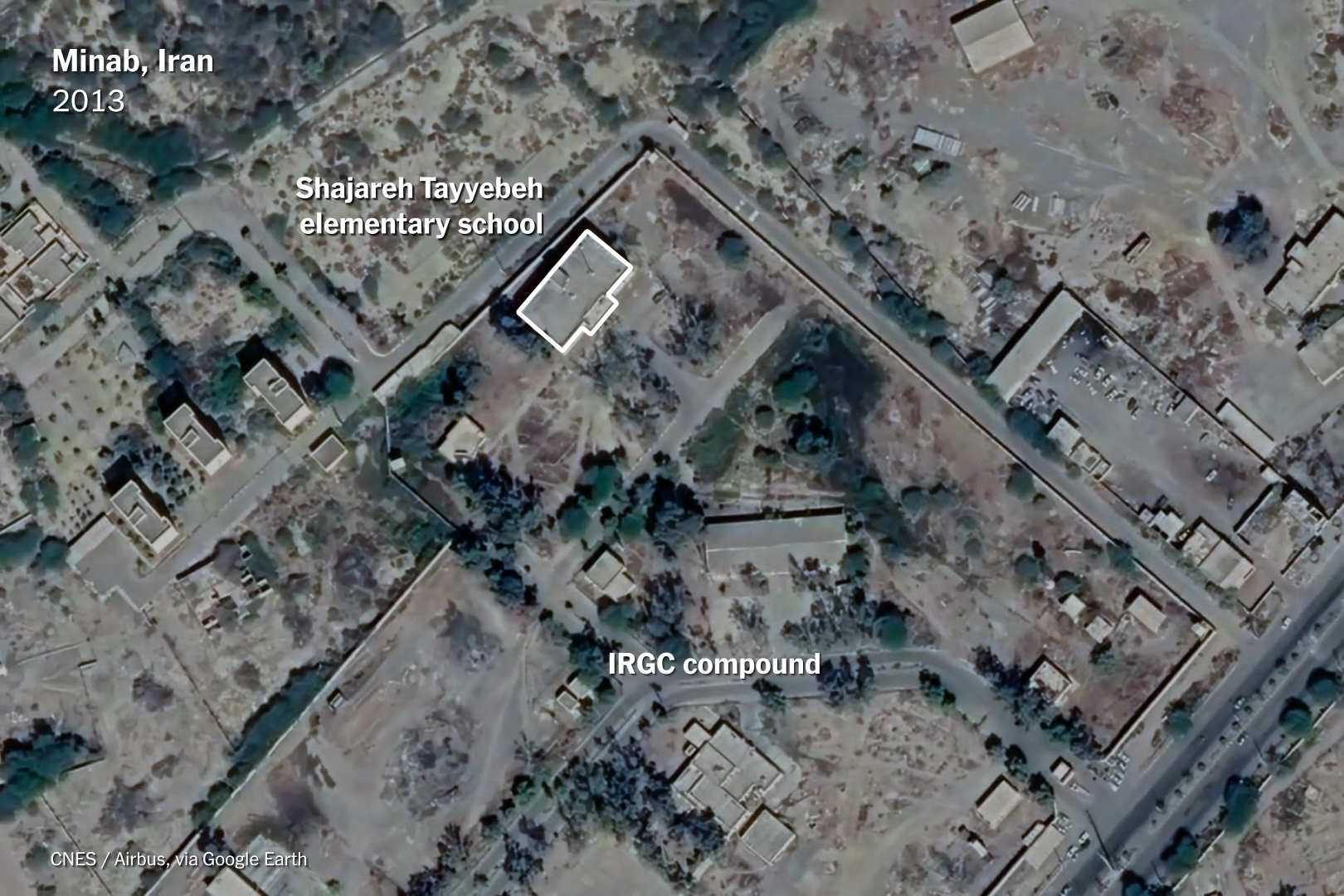
The school in the town of Minab sat on land that was originally part of an Iranian Revolutionary Guards Navy base. When US Central Command drew up strike coordinates targeting that base, it relied on targeting data provided by the Defense Intelligence Agency that had not been updated to reflect the building’s current use as a school. By the time the missile hit, the site had been operating as an elementary school for years — separated from the adjacent military compound by a fence installed between 2013 and 2016.
Satellite imagery reviewed by journalists showed the transformation clearly: watchtowers removed, public entrances opened, play areas and sports markings painted onto asphalt, and walls repainted in blue and pink.
The targeting label attached to the building by the Defense Intelligence Agency still classified it as a military structure. That designation was passed to Central Command without being cross-checked against more recent imagery or data. Investigators are now examining the roles of multiple agencies in the failure, including the Defense Intelligence Agency, Central Command itself, and the National Geospatial-Intelligence Agency, which is responsible for supplying and verifying satellite imagery of potential targets. Officials have also looked at whether artificial intelligence tools used in the targeting process played any role, though investigators consider a straightforward human error to be the more likely explanation.
The inquiry is still ongoing, and officials say significant questions remain unanswered — most pressingly, why the outdated information was never double-checked before the strike was carried out.
The findings place President Donald Trump in a difficult position. In the days following the strike, he told reporters aboard Air Force One that he believed Iran was responsible, citing the inaccuracy of Iranian munitions. He repeated a claim — which officials have since contradicted — that Iran might also possess Tomahawk missiles. On Monday, when asked why he was the only member of his administration pointing the finger at Tehran, Trump acknowledged he did not know enough about the situation, while still stopping short of accepting US responsibility.
White House press secretary Karoline Leavitt said Trump would accept the results of the investigation when complete. The Defence Secretary and other senior administration officials have declined to comment beyond confirming the inquiry is underway.
The episode carries echoes of one of the most consequential intelligence failures of recent decades. In 1999, during the Kosovo war, the CIA provided targeting coordinates based on outdated maps that misidentified the Chinese Embassy in Belgrade as a Yugoslav arms facility. Three Chinese citizens were killed in the resulting airstrike. The then-CIA director George Tenet told Congress that database maintenance had suffered as the intelligence workforce was stretched too thin — a concern that investigators are now revisiting in the context of the Iran strikes.
The investigation is expected to determine not only how the error occurred but which officials and agencies bore responsibility for failing to verify the data before the strike was authorised. Its conclusions are likely to shape how the US military reviews its targeting procedures for the remainder of the conflict.
