


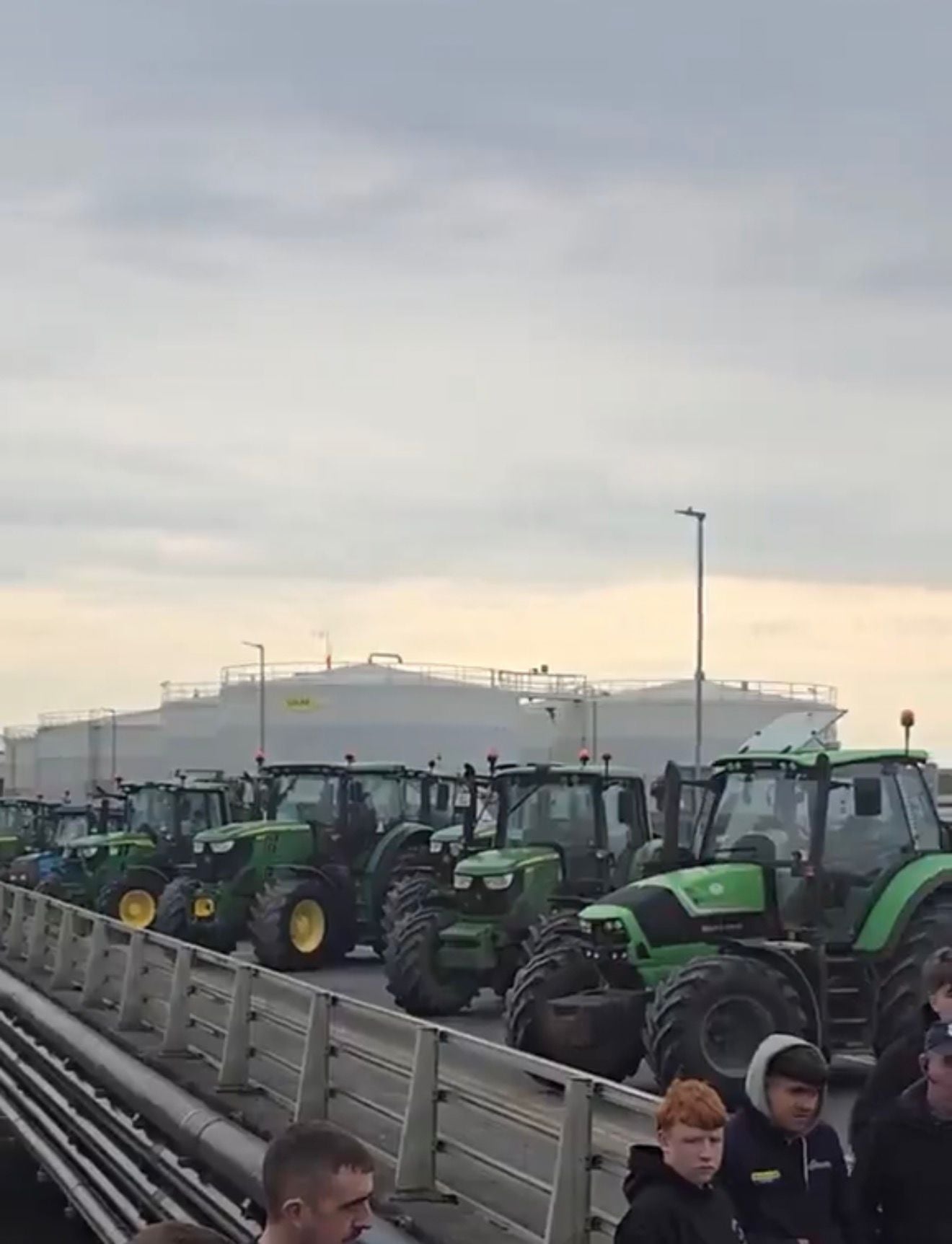
What travellers and hauliers are facing on the ground
Passengers heading to and from Dublin Airport have been urged to set out well ahead of schedule, after a fourth consecutive day of rolling fuel protests brought large sections of the Irish road network to a near standstill. On Thursday, travellers were photographed abandoning their cars and trudging along the motorway with suitcases in tow as traffic heading for the terminal ground to a halt.
In a social media post on Friday morning, the airport advised anyone flying out to build extra time into their journeys “due to protest activity”. Live updates on disruption across the country are being published by Transport Infrastructure Ireland.
The slow-moving convoys, which began earlier this week, are being led largely by farmers and hauliers angered by the surge in petrol and diesel prices. Gardaí said on Friday that they “continue to engage extensively with those taking part in fuel protests across the country”, but have warned that patience is running thin.
Why drivers are taking to the roads
At the heart of the unrest is the spike in fuel costs triggered by the war between the United States, Israel and Iran. Roughly a fifth of the world’s oil trade has been choked off by the closure of the Strait of Hormuz, and Irish forecourts have felt the squeeze sharply. According to RTÉ, diesel has climbed from around €1.70 a litre to as much as €2.17, while petrol is up to 25 cents dearer at many pumps.
Mark Maguire, a farmer from the Monaghan–Fermanagh border, told BBC Radio Ulster’s Good Morning Ulster that the economics had become impossible for those on the land. “There’s not one farmer in Ireland or Northern Ireland that wants to be out protesting. They have enough to do,” he said, calling on Dublin to cut fuel duties.
Eugene Drennan, deputy vice-president of the Irish Road Haulage Association, argued that recent environmental policies had been “too big” and “too quick”. While his organisation is not urging protesters to stand down entirely, he said the blockades themselves should end because they were “hurting people”. The association will attend Friday’s government meeting without protesters alongside them.
A supply chain under strain
The industry body Fuels for Ireland said around 100 garage forecourts had already run dry, with shortages concentrated in Munster and the west. Its chief executive, Kevin McPartlin, told RTÉ the figure could rise fivefold by the end of Friday, and warned that half of the country’s fresh supply was currently stuck behind protest lines.
Gardaí, who are now treating demonstrations at fuel depots as “blockades”, said in a statement on Thursday that the force was “moving to an enforcement phase” unless those obstructing critical infrastructure “desist and disperse”. The army was called in on Thursday to help clear vehicles from affected routes. The Health Service Executive has meanwhile appealed for access roads to hospitals and clinics to be kept clear so that patients can still reach treatment.
The political fallout in Dublin
The government’s tone has hardened as disruption has spread. Taoiseach Micheál Martin told RTÉ on Thursday that blocking roads and key infrastructure was “not a fair form of protest”, while Defence Minister Helen McEntee said some of the behaviour on display was “now crossing into criminal behaviour”.
Justice Minister Jim O’Callaghan went further, warning of “legal consequences” for those involved in the more disruptive demonstrations. “It might not arise today or tomorrow but people have licences to drive vehicles, those licences will be affected,” he said.
The opposition has taken a different line. Sinn Féin leader Mary Lou McDonald urged the taoiseach and the tánaiste to “pick up the phone” to protesters rather than escalate. Agriculture Minister Martin Heydon and Minister of State Timmy Dooley are due to meet representative bodies on Friday. Speaking to RTÉ, Dooley said invitations had been extended to the relevant organisations, but that the decision on who accompanied them was a matter for those groups themselves.
For now, with forecourts emptying, queues lengthening and ministers sharpening their language, there is little sign that the standoff on Ireland’s roads is close to resolution.
