


After nearly three years in pre-trial custody and more than three decades after his first known killing, the Long Island architect accused of being the Gilgo Beach serial killer admitted in a Riverhead courtroom on Wednesday to the murders of eight women — a confession that brings to a close one of the most haunting cold-case investigations in the United States.
What Happened in the Courtroom
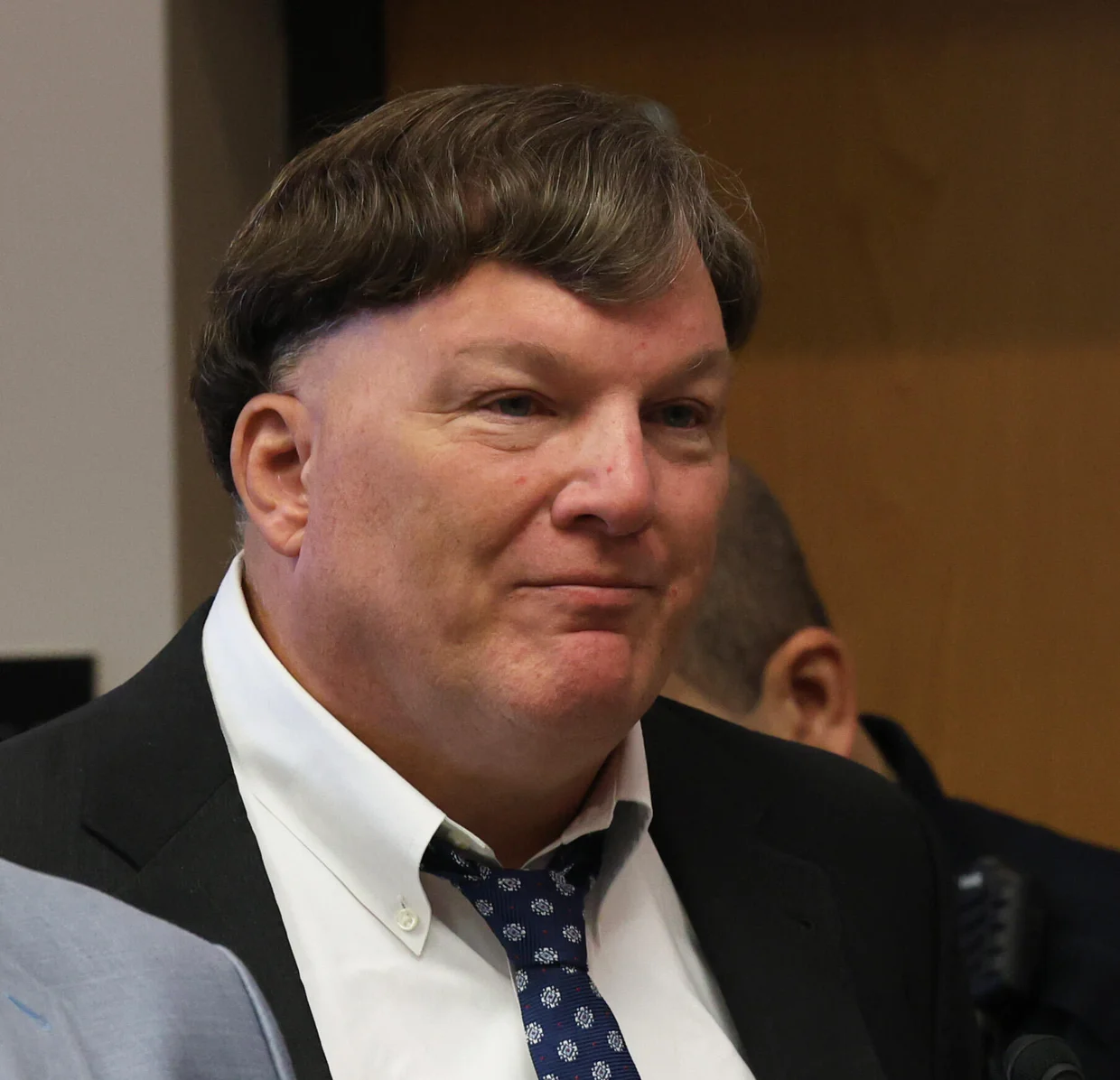
Rex Heuermann, 62, entered the Suffolk County courthouse shortly before 11am Eastern time wearing a dark suit. Cameras were briefly permitted in the courtroom as the judge began preliminary questioning, capturing Heuermann answering in what CBS News New York reporters present described as a loud, confident voice with no visible emotion.
The judge announced at the outset that there had been a change in the case. Heuermann would plead guilty to seven counts in the indictment and would additionally admit guilt to a killing with which he had never formally been charged. Asked whether he felt it was in his interest to plead guilty, Heuermann replied simply: “Yes, your honor.” He was then sworn in.
What followed was a methodical sequence of admissions. Heuermann pleaded guilty to three counts of murder in the first degree and four counts of murder in the second degree, covering the deaths of Melissa Barthelemy, Megan Waterman, Amber Costello, Maureen Brainard-Barnes, Jessica Taylor, Valerie Mack and Sandra Costilla. Asked how he had caused the death of Melissa Barthelemy in 2009, he answered with a single word: “Strangulation.”
The same word applied to each of the others. Carolyn Gusoff, the CBS reporter who has covered the case for over a decade, described the moment: “I was struck by how matter of fact he just rattled off the guilties in court. One after the other, seven guilties, as the judge asked him how do you plead. It sounded like he could’ve just been in an architecture meeting. It was really no emotion, confident, loud and ready to be done with this.”
Heuermann then made an additional admission. Under questioning, he acknowledged killing Karen Vergata in April 1996 — a crime for which he had never been charged. Legal expert Richard Schoenstein explained that Heuermann could not technically plead guilty to a charge that did not exist, but the courtroom admission will be covered by the plea agreement and will ensure no future prosecution on the matter.
The Eight Victims and a Seventeen-Year Killing Spree
The scale of what Heuermann admitted to on Wednesday stretches across seventeen years and eight lives.
His first known victim was Sandra Costilla, killed in November 1993. She was 28 years old and had a five-year-old son. Heuermann strangled her and left her remains in North Sea, in the Town of Southampton, where hunters discovered them roughly a week later.
Karen Vergata was murdered in April 1996. She was 34 and the mother of two sons. Heuermann strangled her, dismembered her body and distributed her remains across multiple locations. Her legs were found in Brookhaven within weeks. Her skull was not recovered until nearly fifteen years later, near Tobay Beach.
Valerie Mack was killed between September and November 2000. She was 24 years old and had a son. She too was strangled and dismembered. Some of her remains were discovered in November 2000; more emerged more than a decade later.
Jessica Taylor was murdered in July 2003. She was 20. Her dismembered remains were recovered in two separate discoveries, in 2003 and 2011.
Maureen Brainard-Barnes was killed in July 2007. She was 25 years old and the mother of two children. Her remains were found in 2010.
Melissa Barthelemy was killed in July 2009 at the age of 24. Her remains were found more than a year later.
Megan Waterman was murdered in June 2010. She was 22 and the mother of a daughter. Her body was found six months after her death.
Amber Costello, 27, was killed in September 2010. Her remains were recovered in December of that year.
Why the Case Took So Long to Crack
The Gilgo Beach investigation originated with a different victim altogether. On 1 May 2010, Shannan Gilbert, a 23-year-old escort, made a frantic 911 call saying she believed someone was after her. She then vanished. An exhaustive search followed, but her body was not immediately recovered.
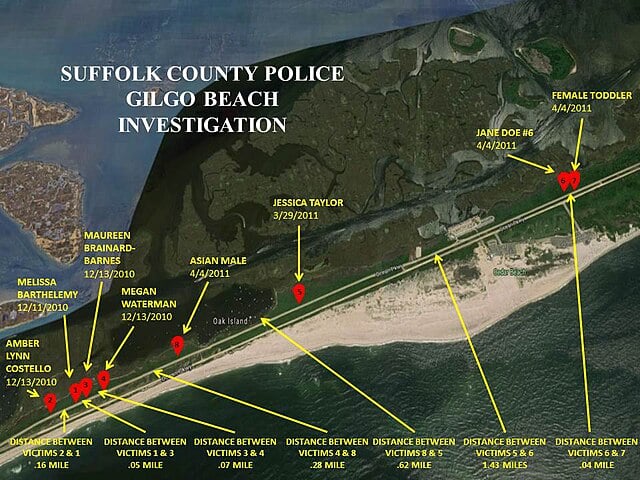
In December 2010, officers searching for Gilbert discovered four bodies near Gilgo Beach. They became known as the Gilgo Four: Maureen Brainard-Barnes, Amber Costello, Megan Waterman and Melissa Barthelemy. Three were wrapped in burlap. All four had worked as online escorts. Six more sets of remains were discovered in May 2011. The investigation that followed would stretch across more than a decade, marked by false leads, political turnover within the Suffolk County Police Department, and a growing public frustration that a killer — or killers — remained at large.
The breakthrough came in 2022, when newly-appointed Suffolk County Police Commissioner Rodney Harrison, a former NYPD chief, promised the victims’ families he would “bring those accountable to justice.” Harrison formed a dedicated task force combining the Suffolk Police Department, the FBI and the New York State Police, applying what he described as “a fresh set of eyes” to the investigation.
The decisive moment came when a state officer tracked down the roommate of Amber Costello. The officer established that one of Costello’s clients had driven a green Chevrolet Avalanche. That detail, previously known but never pursued to completion, became the thread that unravelled everything. Police began cross-referencing the vehicle against registration records and identified Heuermann as the owner. Cell phone tower analysis then placed Heuermann’s phone, and a burner phone prosecutors say he used to contact victims, in close proximity to the women on the days they disappeared.
Prosecutors documented one such pattern in court filings relating to Melissa Barthelemy. On 10 July 2009, the last day she was seen alive, both the burner phone and Heuermann’s personal phone were in the Massapequa area and travelled together toward New York City. They then travelled back eastbound toward Massapequa.
The final piece of evidence came in the form of a discarded pizza crust. Investigators retrieved it from a Manhattan trash can near Heuermann’s office at 36th Street and Fifth Avenue, and the DNA recovered from it matched hairs found on belts, tape and burlap recovered from the victims’ remains. Hairs linked to Heuermann’s former wife Asa Ellerup and their daughter Victoria were also reportedly identified on the evidence — though prosecutors have been clear that neither was involved in the crimes.
Heuermann was arrested in July 2023. He has been held in near-solitary confinement ever since, spending 23 hours a day in protective custody.
The Architect With a Blueprint
The portrait of Heuermann that has emerged from prosecutors’ filings is disturbing in its clinical precision. A Massapequa Park resident who grew up on Long Island and attended Berner High School, Heuermann worked as an architect in Midtown Manhattan, running a company called RH Consultants and Associates. A neighbour once described him as “very quiet, dark, kept to himself and extremely intelligent, very smart.”
Court documents released during the pre-trial phase revealed what prosecutors described as a “blueprint” Heuermann allegedly used to plan his murders with, in their words, “excruciating detail.” The document was structured in four columns labelled Problems, Supplies, DS and TRG. Under “problems” were listed the forensic traces a killer might need to consider: DNA, tire marks, blood stains, fingerprints and more. Under “supplies” were rope, cord, cutting tools, police scanners, hair nets and medical gloves. The document was further divided into sections for pre-preparation, preparation and post-event — the last of which included entries such as “change tires,” “burn gloves” and “have story set.”
Prosecutors also alleged that Heuermann had conducted thousands of internet searches for violent pornography and more than 100 searches related to serial killers and the Gilgo Beach investigation itself. Former prosecutor Vinoo Varghese argued that such material would demonstrate “an absence of mistake” — evidence that Heuermann was deliberately studying how to commit the crimes he is now admitting to.
At the time of his arrest, Heuermann owed more than $425,000 in taxes, according to Nassau County records, and had filed several personal injury lawsuits alleging he had been hurt in car accidents. Three of those cases had been settled or discontinued.
What the Sentence Will Look Like
Sentencing is scheduled for 17 June. The Suffolk County District Attorney’s Office has outlined the expected outcome: three consecutive sentences of life imprisonment without the possibility of parole for the murders of Barthelemy, Waterman and Costello, followed by a consecutive sentence of 100 years to life for the murders of Brainard-Barnes, Taylor, Costilla and Mack. The Vergata case will be covered by the plea agreement without a separate sentence.
Legal expert Richard Schoenstein summarised the practical effect in a single sentence: “He’s going to spend the rest of his life in jail. There’s no question about that.”
New York Law School professor Anna Cominsky explained that the coming weeks will involve the preparation of a pre-sentence report for the judge, with both prosecution and defence permitted to make arguments before the final sentence is handed down. The sentencing hearing is also expected to provide an opportunity for the victims’ families to address the court.
The Defence, the Family and the Cooperation Agreement
Heuermann’s attorney Michael Brown explained the reasoning behind the plea change. “When Rex decided that he wanted to accept responsibility and he didn’t want to proceed to trial, from a defence standpoint, we then pivoted and did our best to protect his interest,” Brown said. That includes an agreement by Heuermann to cooperate with the FBI and, specifically, its Behavioral Analysis Unit — the specialist team that studies serial offenders in order to inform future investigations.
Brown praised the prosecutors and investigators who built the case. “They deserve all the accolades,” he said. “They did a great job. They really did a great job of gathering the evidence. They went down hundreds of rabbit holes. And when you look at the amount of evidence, and you connect the dots, they really did a great job. This was an unprecedented case.” Brown said he believes Heuermann will have “something to say” at his sentencing in June, and suggested that the act of admitting the killings may have been “cathartic to some extent” for his client.
Heuermann’s ex-wife Asa Ellerup and their daughter Victoria were present in the courtroom on Wednesday. Her attorney Robert Macedonio said before proceedings began that Ellerup had always wanted to hear any admission of guilt directly from her ex-husband’s own mouth, rather than through media reports. “She has never claimed he’s not guilty,” Macedonio said. “She just consistently stated she doesn’t believe he was capable of this, the man she knows.”
In a statement released after the hearing, Ellerup said: “My thoughts and prayers are with the victims and their families. Their loss is immeasurable and the focus should be on them in this time, and moment. I ask that you give some privacy to my family as they navigate through this very difficult time.” Macedonio emphasised that Ellerup and her daughter had “no knowledge, no involvement, or any connection to these heinous acts.”
Macedonio also criticised a wrongful death lawsuit filed by the son of victim Valerie Mack, which named Ellerup and Victoria as defendants alongside Heuermann. He noted that Victoria had been three years old at the time of Mack’s murder. “How could any attorney and or plaintiff assume any liability on the part of a three-year-old?” he asked. “It’s just so reckless.”
A Case That Haunted Long Island for Fifteen Years
For the reporters who have followed the Gilgo Beach story since the first remains were found along Ocean Parkway in December 2010, Wednesday’s hearing carried the weight of an unexpected ending. CBS News New York’s Jennifer McLogan reflected on the day from outside the courthouse: “It’s been a very dramatic day here. It’s a huge case. It has haunted Long Island for so long, since the bodies of the first so-called Gilgo Four were discovered in Ocean Parkway 2010, buried in those shallow graves. And of course, on the fourth floor of this courthouse behind us, Rex Heuermann finally giving some resolution, admitting to seven, and then eight, of these victims.”
Her colleague Carolyn Gusoff struck a similar note. “Really, an incredible day for me and for Jennifer McLogan. We have been covering this case literally for decades.” McLogan added: “And our shock the first day, when he was arrested, up ’til the shock again, when we find out he’s pleading guilty.” Gusoff observed that even after the guilty pleas, the deeper questions would remain unanswered. “The questions will linger as to why he did it.”
Rodney Harrison, the former police commissioner whose task force finally cracked the case, described Wednesday as a bittersweet moment. “Being able to bring some type of comfort, knowing that this case is behind him, knowing that he will never see the day of light again, he’ll be behind bars for the rest of his life, there’s a level of gratification,” he told CBS News New York.
For the families of Sandra Costilla, Karen Vergata, Valerie Mack, Jessica Taylor, Maureen Brainard-Barnes, Melissa Barthelemy, Megan Waterman and Amber Costello, the verdict closes one long and painful chapter. It does not answer the question of why. It does not return the children who lost mothers, or the years of not knowing what happened to daughters who went missing. But it establishes, for the first time in the formal record, that the man responsible has admitted to what he did. Sentencing on 17 June will offer the families an opportunity to speak. Heuermann, his attorney has suggested, may also choose to address the court. Whether anything he says on that day provides the answers that have eluded Long Island for more than thirty years is impossible to know in advance.
