


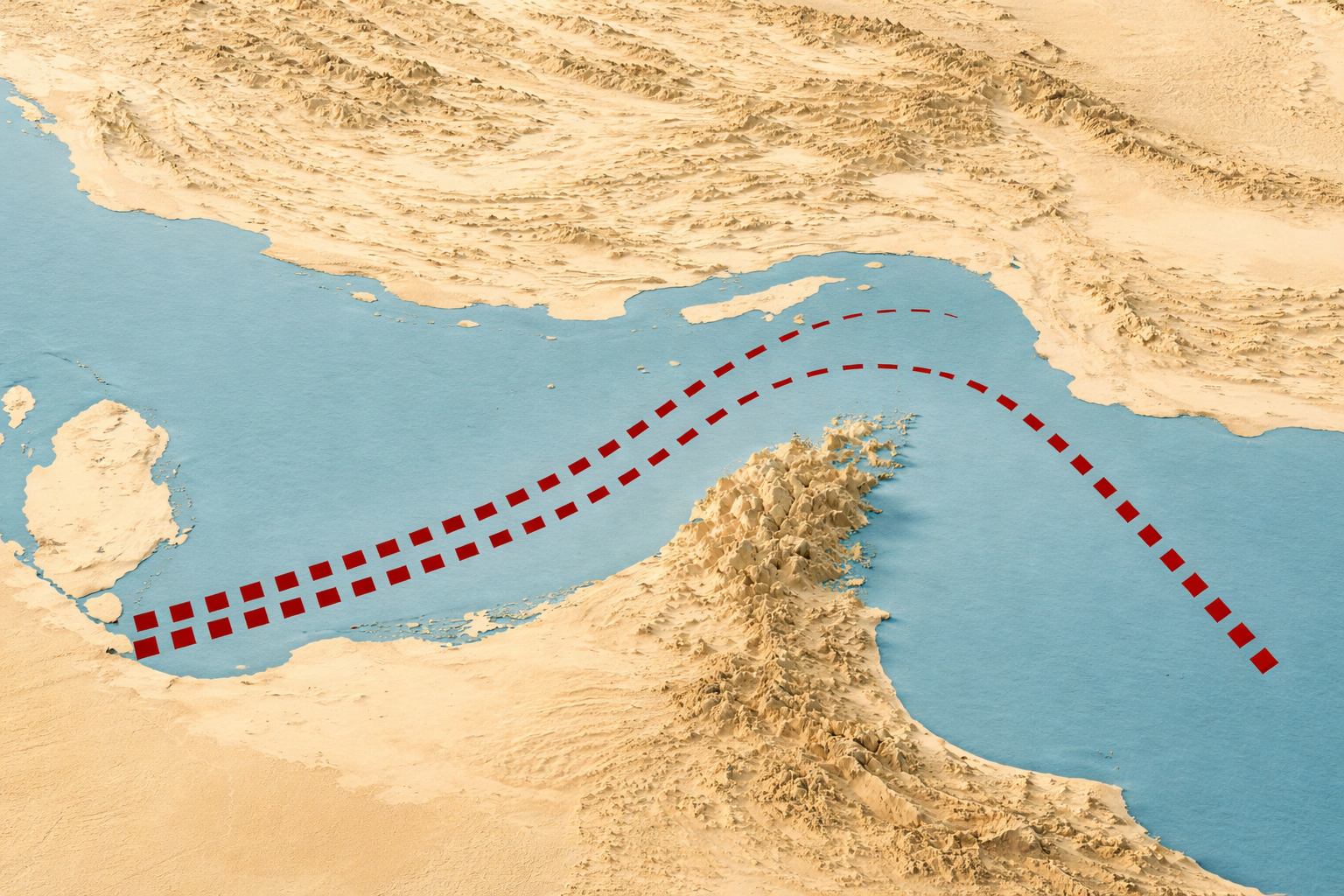
Despite the two-week truce announced on Tuesday night, only three ships had transited the world’s most strategically vital waterway by the following afternoon — a striking gap between the diplomatic language of “safe passage” and the reality confronting vessels still weighing whether the risks of crossing are worth taking.
The Warning That Is Keeping Ships at Anchor
The slow pace of shipping activity through the Strait of Hormuz has a direct explanation. Iran’s navy has issued a warning, confirmed to BBC Verify by shipping brokerage firm SSY, that any vessel attempting to cross without permission “will be targeted and destroyed.” The message has been transmitted to ships operating in the Gulf, and its effect has been immediate: captains and shipping companies are holding position, unwilling to commit to a crossing until the terms of authorised passage are understood.
This is the central paradox of the ceasefire agreement reached on Tuesday. The deal explicitly requires “safe passage” through the strait as a condition of the two-week truce, and Iranian Foreign Minister Abbas Araghchi confirmed that transit would be possible through coordination with Iran’s armed forces. But the practical mechanism by which ships obtain that coordination remains undefined, and the warning from the Iranian navy suggests that Tehran retains every intention of exercising tight control over who crosses and on what terms.
Lars Jensen of Vespucci Maritime told the BBC that most shipping lines would want detailed reassurances about what it actually takes to transit the strait — and that those details are not currently available. “Nothing has really changed yet,” he said, arguing that time would be needed before crews felt confident enough to cross safely.
Three Ships in Twenty-Four Hours
The numbers tell their own story. By 14:00 BST on 8 April, BBC Verify’s analysis of ship-tracking data from MarineTraffic showed that only three bulk carriers — the NJ Earth, Daytona Beach and Hai Long 1 — had passed through the strait since the ceasefire was announced late on Tuesday night. That compares to a pre-conflict average of 138 vessels per day.
Even these three crossings come with caveats. It is not clear whether the transits reflect the impact of the ceasefire or whether the ships had previously obtained authorisation to cross. Ana Subasic of the shipping analyst company Kpler noted that it was too soon to tell whether the movements reflected “a broader ceasefire-driven reopening or a previously approved exception.”
The route taken by the three vessels is itself revealing. BBC Verify’s path analysis shows the ships transiting through the northern portion of the strait, hugging Iran’s coastline and entering Iranian territorial waters. Before the conflict, the conventional route ran through the middle of the waterway. The shift suggests that Iran is directing traffic through corridors it controls directly — an arrangement that underlines Tehran’s determination to turn its effective command of the strait into a permanent feature of any settlement.
Why the Commercial Calculus Remains Deeply Uncertain
For ship owners, the decision to attempt a crossing involves a set of considerations that go beyond the headline announcement of a ceasefire. Richard Meade, editor-in-chief of Lloyd’s List, described the situation as “very dangerous” for operators still facing enormous uncertainty. “We know Iran is essentially still in control of the strait,” he said, “and the assumption is that ship owners will still need to seek permission from the IRGC — and how that’s going to work is still not clear.” A Ceasefire Snatched From the Brink: How Washington and Tehran Stepped Back From the Abyss — and What They Actually Agreed
The reference to the Islamic Revolutionary Guard Corps is significant. The IRGC is a US-designated terrorist organisation, and any formal interaction with it carries legal and reputational consequences for companies operating under Western regulatory regimes. The practical question of who, exactly, a shipping agent contacts to obtain Iranian authorisation — and whether that contact itself constitutes engagement with a sanctioned entity — has no clear answer.
Niels Rasmussen, a shipping analyst with BIMCO, identified a further disincentive: the time-limited nature of the ceasefire itself. “I doubt there will be a large influx of ships into the Gulf,” he said, “because they do not want to risk being trapped after the two-week window closes.” A vessel that enters the Gulf now, picks up cargo, and fails to exit before the deadline could find itself stranded indefinitely if hostilities resume.
The possibility of sea mines presents another layer of concern. Thomas Kazakos, secretary general of the International Chamber of Shipping, told BBC Verify that clear confirmation was needed regarding the safety of navigation for ships and seafarers. The risk is not theoretical. Mines can remain hazardous long after the political conditions that prompted their deployment have changed, and the process of verifying that a waterway is clear requires time, expertise and cooperation from all parties.
The Toll Question and the Sanctions Problem
One of the most consequential details emerging from the ceasefire discussions concerns the possibility that Iran will require ships to pay a toll in exchange for safe passage. Reports have suggested that such payments may form part of the broader arrangement, with figures of around $2 million per vessel circulating in earlier accounts of Iran’s ten-point plan.
The implications for shipping lines are serious. “The Iranian negotiation position seems to be that you need to pay a toll to go through the strait,” Jensen told the BBC, “and shipping lines will also be hesitant in going down the path of paying that toll.” The hesitation is not commercial reluctance alone. As Jensen noted, any such payment “might actually be in violation of some of the US sanctions on Iran, which would have other repercussions on shipping lines.”
James Turner, a shipping lawyer at Quadrant Chambers, set out the legal position clearly. Sanctions, he explained, operate by criminalising payments to specified individuals, companies and organisations. A violation occurs when payment is made to anyone on the sanctions list, meaning that a toll paid to Iranian authorities — or to the IRGC — would constitute a breach unless the United States issues a specific exemption.
This creates a dilemma that cannot be resolved by the shipping industry alone. A company that pays to transit the strait risks prosecution under American sanctions law. A company that refuses to pay cannot cross. The only way out is a formal carve-out from Washington, and whether such an exemption will be forthcoming depends on the progress of the diplomatic talks due to begin in Islamabad on Friday.
Some countries have already negotiated their own arrangements. India, Malaysia and the Philippines are reported to have secured safe passage for their vessels in recent weeks through bilateral understandings with Tehran. Such deals may offer a template for future arrangements, but they also underscore the fragmented, country-by-country nature of the current situation — the opposite of the uniform international navigation regime that existed before the war.
The Eight Hundred Stranded Ships
Beyond the immediate question of new crossings lies the problem of the vessels already trapped inside the Gulf. According to Meade, nearly 800 ships have been stuck in the region for several weeks. Most are now loaded with cargo and waiting for permission to leave. If crossings do resume in any volume, Meade expects these stranded tankers to be the first to move — not new arrivals seeking to enter the Gulf, but cargo-laden ships desperate to exit before the ceasefire window closes.
The distinction matters for the global economy. Clearing the backlog of stranded vessels would restore some of the stalled oil and gas shipments that have been absent from international markets for more than five weeks. But it would not represent a return to normal flows. Once the existing ships have left, whether new tankers will be willing to enter the Gulf to collect fresh cargo remains an open question — and the answer depends on factors that the ceasefire alone cannot resolve.
The Broader Supply Chain Exposure
The disruption over the past five weeks has exposed a dependence on the Strait of Hormuz that extends far beyond oil. The waterway is roughly 33 kilometres wide at its narrowest point, and through it passes approximately a fifth of the world’s oil and liquefied natural gas. But the Gulf is also a critical artery for the movement of chemicals used to manufacture microchips, pharmaceuticals and fertilisers — products whose absence from global supply chains has already begun to affect manufacturing, agriculture and healthcare in ways that are only now becoming visible.
The shock wave has spread unevenly. Energy-importing economies have been hit fastest and hardest, with countries such as Sri Lanka announcing emergency relief packages as fuel prices have surged. Manufacturers dependent on specialty chemicals face lengthening production delays. Fertiliser shortages are beginning to raise questions about the next agricultural cycle in several regions. Each of these effects compounds the others, and a two-week ceasefire — particularly one whose operational terms remain unclear — is unlikely to reverse them quickly.
The Market Response and Its Limits
Financial markets delivered a positive verdict on the ceasefire announcement, with Brent crude falling by about 13 per cent to $94.80 a barrel and US-traded oil dropping more than 15 per cent to $95.75. Equity markets recorded similar relief, with S&P 500 futures rising sharply in initial trading.
But Meade urged caution against reading too much into the movements. “Oil prices responded because it is a positive directional move,” he said, “but I don’t think it in any way suggests that we’re going to see that 20 per cent of global energy flowing back through at normal levels any time soon.” The market reaction reflects the removal of a worst-case scenario — the apocalyptic escalation Trump had threatened on Tuesday — rather than confidence that Hormuz will reopen in any meaningful sense.
Prices will likely remain elevated relative to pre-war levels for as long as uncertainty persists. The structural factors driving the premium — the risk of resumed hostilities, the unresolved sanctions issue, the lack of clarity on toll payments, the continuing Iranian naval warning — cannot be priced out until the operational details of safe passage are published and honoured.
What Would Need to Change
For the Strait of Hormuz to function as a genuine international shipping lane again, several things need to happen in quick succession. Iran would need to withdraw or clarify its targeting warning, replacing it with a formal protocol setting out how vessels obtain authorisation to cross. The United States would need to issue guidance on whether toll payments are permissible under sanctions law, or to negotiate exemptions that allow shipping lines to comply without legal exposure. Insurance markets would need to recalibrate war-risk premiums to reflect the new regime, a process that typically lags behind political developments by days or weeks. And the Islamabad talks scheduled for Friday would need to produce at least a framework agreement that extends beyond the immediate two-week window, giving ship owners confidence that they will not be trapped if hostilities resume.
None of these steps is impossible. None of them can be taken unilaterally. All of them depend on diplomatic progress that has not yet occurred.
For now, the strait remains largely closed despite the ceasefire that was supposed to reopen it. Three ships have crossed. Nearly 800 remain stuck. And the captains of vessels still considering whether to enter the Gulf are doing what shipping professionals always do when confronted with ambiguous risk: waiting for someone else to go first.
