


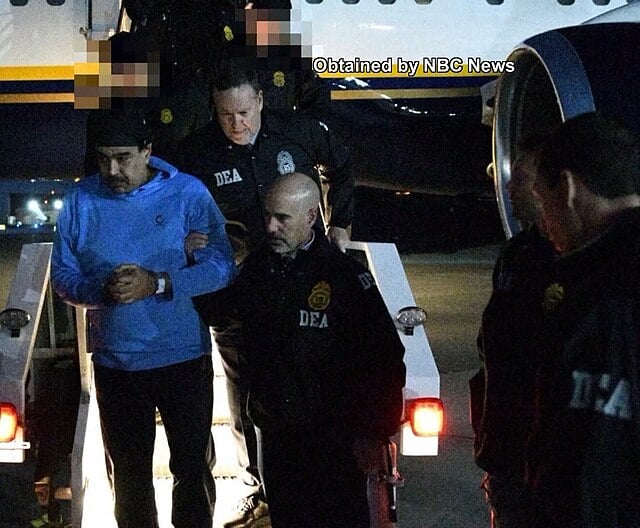
A federal court hearing in New York for former Venezuelan leader Nicolás Maduro ended without a trial date on Wednesday, with much of the ninety-minute session consumed by a dispute over who is permitted to pay his legal bills — a question that could shape the entire course of the case.
Maduro and his wife Cilia Flores, both dressed in khaki prison uniforms and listening through headphones to simultaneous translation, sat quietly throughout proceedings before Judge Alvin Hellerstein at the Southern District of New York. The couple face charges of narco-terrorism, which they are seeking to have dismissed.
At the centre of Wednesday’s hearing was a funding dispute rooted in US sanctions. Washington has blocked the Venezuelan government from covering the couple’s legal costs, after the Treasury Department’s Office of Foreign Assets Control granted and then revoked a licence permitting such payments — describing the original approval as an administrative error. Defence attorney Barry Pollack argued that without access to state funds, his clients cannot afford counsel of their choosing, and that this alone should be sufficient grounds to dismiss the case.
Judge Hellerstein declined to dismiss the charges on that basis, but signalled he was sympathetic to the defence’s position on funding. He stated that the right to legal representation was paramount and suggested that, with the defendants now in US custody, national security arguments against releasing the funds carried less weight. He asked both sides repeatedly what the practical remedy should be — a question neither was able to resolve on the day. The matter is expected to return to court, though no follow-up date has yet been scheduled.
The prosecution countered that the court cannot compel OFAC to issue a special licence and that constitutional rights to counsel of choice were outweighed by national security considerations. Prosecutors also alleged that Maduro and Flores had already extracted Venezuela’s wealth for personal gain.
The narco-terrorism charges themselves face scrutiny from legal analysts. Christopher Sabatini, a senior fellow at Chatham House, noted that the charges sit uneasily with most international definitions of terrorism, which typically require an immediate threat to civilians. He also questioned whether the alleged coordination of Venezuela’s so-called Cartel of the Suns constituted a structured criminal organisation in the conventional legal sense.
Maduro’s team is also expected to raise the question of head-of-state immunity, though legal precedent offers limited comfort. In the early 1990s, Panamanian leader Manuel Noriega made the same argument when facing federal drug charges in the United States, and a federal appeals court rejected it.
Outside the courthouse, rival groups of protesters clashed in scenes that required a significant police presence, with at least one physical altercation breaking out before officers intervened. Pro-Maduro demonstrators framed the proceedings as an act of US imperialism, while opponents celebrated his detention.
Speaking at a White House Cabinet meeting on Wednesday, President Donald Trump described Maduro as a “very dangerous man” and said he anticipated further charges and trials ahead.
A follow-up court date is yet to be confirmed.
