


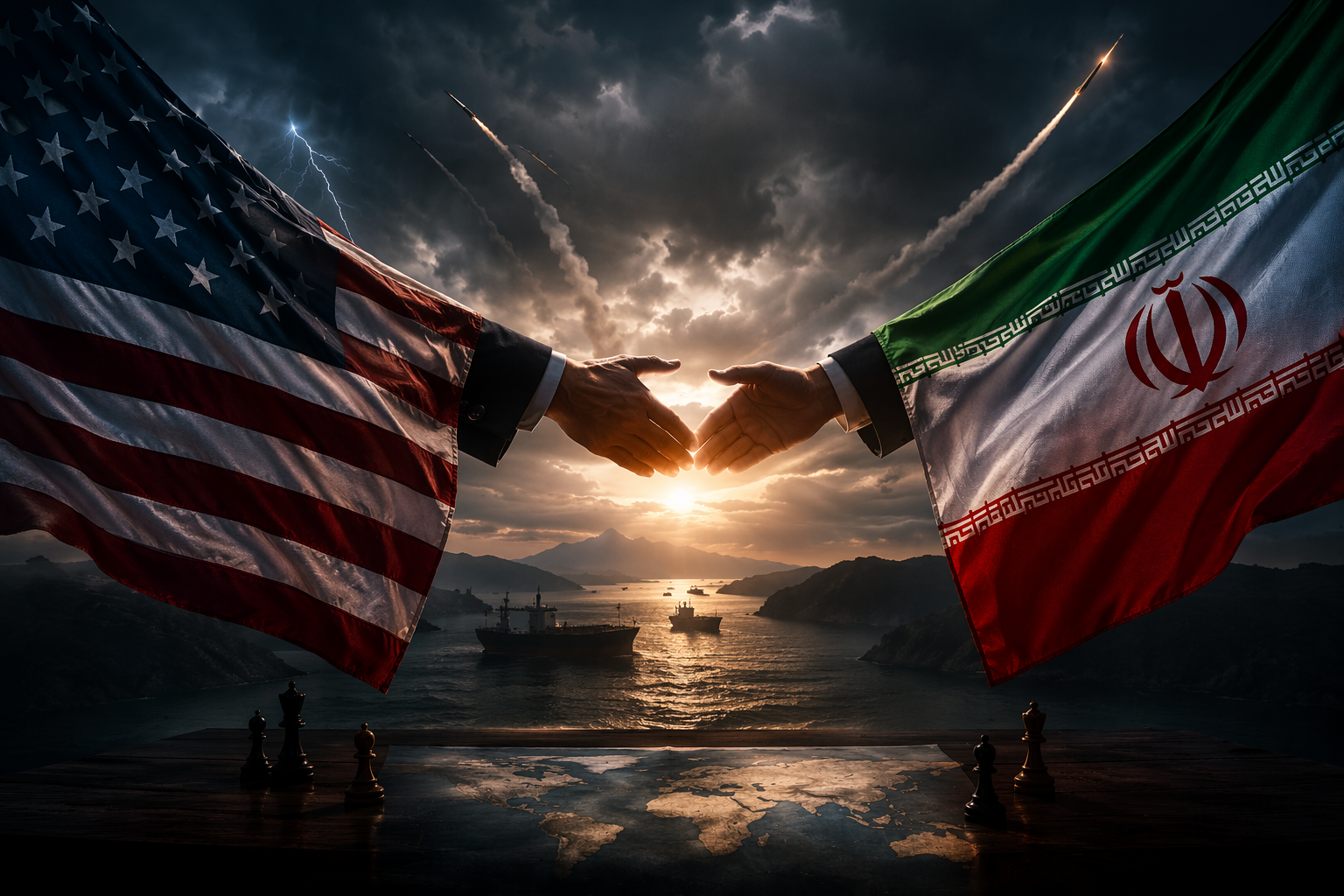
Less than two hours before the deadline President Donald Trump had set for the obliteration of Iranian infrastructure, the United States and the Islamic Republic announced a two-week ceasefire that brings an immediate halt to a conflict which, by Tuesday afternoon, had appeared to be racing toward catastrophic escalation. Brokered by Pakistan in extraordinary diplomatic circumstances, the agreement is fragile, riddled with ambiguity, and disputed in its details — but it is the most significant pause in a war that has now consumed six weeks, killed thousands and triggered a global energy crisis.
How the Deal Came Together in the Final Hours
The day began with rhetoric of apocalyptic intensity. Donald Trump took to Truth Social to warn that “a whole civilization will die tonight, never to be brought back again” if Iran failed to meet his demands by 8pm Eastern time — 01:00 BST on Wednesday. The president had already authorised fresh strikes on military targets at Iran’s Kharg Island earlier in the day, and Israeli forces had hit two of Iran’s main petrochemical hubs at Mahshahr and Assaluyeh. The Sharif University of Technology in Tehran lay damaged from an overnight strike. Operational plans for a massive US-Israeli bombing campaign against Iran’s energy infrastructure were, according to multiple sources, ready for execution.
Then, in a sequence of events that unfolded over the course of perhaps five hours, the trajectory reversed. Pakistani Prime Minister Shehbaz Sharif and Field Marshal Asim Munir, the country’s highest-ranking military officer, had been working as intermediaries between Tehran and Washington for several days. On Sunday, Iran had rejected a 45-day ceasefire proposal advanced through Pakistani channels, insisting on a permanent end to hostilities rather than a temporary pause. By Tuesday afternoon, with Trump’s deadline approaching, Sharif made a public appeal to both sides on social media, urging Iran to reopen the Strait of Hormuz “as a goodwill gesture” for a corresponding two-week period.
Trump’s announcement came shortly afterwards. “Based on conversations with Prime Minister Shehbaz Sharif and Field Marshal Asim Munir, of Pakistan, and wherein they requested that I hold off the destructive force being sent tonight to Iran, and subject to the Islamic Republic of Iran agreeing to the COMPLETE, IMMEDIATE, and SAFE OPENING of the Strait of Hormuz, I agree to suspend the bombing and attack of Iran for a period of two weeks,” the president wrote on Truth Social. He framed the agreement as a “double sided CEASEFIRE” and claimed the United States had “already met and exceeded all Military objectives.”
Iran’s Supreme National Security Council confirmed acceptance shortly afterwards, presenting the agreement domestically as a victory and stating that “nearly all war objectives have been achieved.” Iranian Foreign Minister Abbas Araghchi confirmed that for two weeks, safe passage through the Strait of Hormuz would be possible “via coordination with Iran’s Armed Forces and with due consideration of technical limitations.” The US Defense Department subsequently confirmed that all American offensive operations had been ordered to cease.
What Iran’s Ten-Point Plan Actually Demands
The substance of the agreement remains disputed in critical respects, and the gap between what Tehran says was accepted and what Washington has confirmed is substantial. Iran’s ten-point peace proposal — which Trump described as “a workable basis on which to negotiate” — represents an extraordinarily ambitious attempt by Tehran to extract long-sought concessions from the United States in exchange for ending the war.
According to statements released through Iran’s Supreme National Security Council and reported by NBC News, Bloomberg, Foreign Policy and other outlets, the plan includes the following central demands:
On the Strait of Hormuz, Iran proposes “controlled passage coordinated with Iran’s armed forces” and the establishment of “a secure transit protocol ensuring Iran’s control under the agreed framework.” Crucially, this is not a return to free international navigation — it is a system in which Iran retains effective sovereignty over the waterway, granting Tehran what its statement described as “a unique economic and geopolitical position.” Reports suggest a transit fee of around $2 million per ship is envisaged, providing Iran with a revenue stream to fund reconstruction.
On sanctions, the plan demands “the removal of all primary and secondary sanctions and relevant resolutions of the Board of Governors and the U.N.” This would constitute a complete dismantling of the maximum pressure architecture built by successive US administrations over more than a decade.
On the US military presence, the proposal calls for “the withdrawal of United States combat forces from all bases and positions in the region” — a demand of historic significance that would fundamentally reshape the American security posture across the Middle East.
On regional conflicts, Iran demands “an end to the war against all components of the resistance axis” — a reference to Hezbollah in Lebanon, Hamas in Gaza, the Houthis in Yemen and other Iran-aligned militant groups designated as terrorist organisations by the United States.
On compensation, the plan calls for “full payment of Iran’s war-related damages” by the United States and Israel.
On uranium enrichment, the proposal reportedly preserves Iran’s right to continue enriching uranium — a red line that previous American administrations have refused to cross.
On guarantees against future attack, Iran has demanded binding assurances that the ceasefire will hold and that Washington and Tel Aviv will not resume hostilities at a time of their choosing. Senior Iranian officials told mediators they are determined not to be caught in what one described as a “Gaza or Lebanon situation,” in which a paper ceasefire is repeatedly violated.
On reconstruction, the plan includes provision for international support in rebuilding Iranian infrastructure damaged during the war, with Trump himself stating in a follow-up Truth Social post that “Iran can start the reconstruction process. We’ll be loading up with supplies of all kinds.”
On Bushehr, the proposal reportedly seeks US support for electricity generation at Iran’s Bushehr nuclear power plant — a striking inclusion given the parallel demand for sanctions relief.
On the resistance axis, the plan extends the proposed cessation of hostilities to Lebanon, where 1.2 million Lebanese have been displaced by Israeli strikes during the conflict.
The full text of the ten clauses has not been published, and certain details remain reported only through Iranian state media or through anonymous officials. The Trump administration has been careful in its public framing: White House Press Secretary Karoline Leavitt stated that the president’s words “speak for themselves” and that the proposal represents “a workable basis to negotiate” rather than an agreement on substance.
Why the Two Sides Tell Different Stories
The most striking feature of the announcement is the gap between American and Iranian descriptions of what has been agreed. Trump’s statement emphasised the suspension of bombing in exchange for the reopening of the Strait of Hormuz, framing the ten-point plan as something to be negotiated over the coming fourteen days. Iran’s statement, by contrast, presented the plan as having been broadly accepted and described the entire framework as a victory for Iranian diplomacy.
The reality lies somewhere in between, and the next two weeks will determine which interpretation prevails. Several factors explain the divergence.
For Tehran, the imperative is domestic. The Islamic Republic has absorbed six weeks of devastating air attacks. Its nuclear infrastructure has been damaged. Its petrochemical facilities have been struck. Its universities have been hit. Iranian leaders need to present any pause in the fighting as a triumph to maintain political cohesion at home, particularly given the ideological commitments the regime has made over decades. The framing of the ceasefire as Iran having forced the United States to accept its proposal serves that purpose, regardless of what Washington has actually committed to.
For Washington, the calculation is different. Trump has spent weeks issuing threats of escalation, and his political base includes both hawks who wanted Iran’s nuclear programme destroyed and isolationists wary of another Middle Eastern war. By framing the deal as a successful application of pressure that produced Iranian concessions on the Strait of Hormuz — without committing publicly to the more far-reaching elements of the Iranian plan — the president can claim victory without locking himself into compromises he cannot deliver.
The result is an agreement in which both sides retain maximum flexibility to walk away if the other refuses to honour their preferred interpretation. This is not necessarily a flaw. In diplomacy, ambiguity sometimes serves as the lubricant that allows opposing parties to coexist within a single framework. But it also means that the genuine work of negotiation has barely begun.
The Israeli Complication
Perhaps the most immediate threat to the ceasefire’s durability comes from Israel. Prime Minister Benjamin Netanyahu’s office issued a statement on Wednesday morning supporting Trump’s decision to suspend strikes against Iran for two weeks, but explicitly stated that the ceasefire does not extend to Lebanon — directly contradicting Pakistani Prime Minister Sharif’s announcement that the agreement covers “Lebanon and elsewhere.”
This is not a minor detail. Iran’s ten-point plan is explicit that the cessation of hostilities must apply to “all components of the resistance axis,” including Hezbollah. If Israel continues operations in Lebanon while Iran observes the ceasefire on its own territory, the basis for Iranian compliance disappears. Tehran’s leverage — its missile arsenal, its ability to disrupt Gulf shipping, its proxies across the region — remains intact and can be reactivated within hours.
Netanyahu has additionally indicated that Israel “supports U.S. efforts to ensure Iran no longer poses a nuclear or missile threat” — a formulation suggesting that he views the ceasefire as a tactical pause rather than a step toward a comprehensive settlement. Saudi and Emirati leaders, along with American hawks such as Senator Lindsey Graham, had urged Trump to reject any proposal unless Iran made major concessions. The Israeli prime minister’s office has signalled scepticism that Iran will honour the Hormuz commitment, with one source close to internal deliberations telling reporters that Israeli officials believed the apparent breakthrough could unravel.
The fact that Israel has reportedly agreed to “the contours” of the deal, according to a White House official cited by CBS News, is significant — but the contours leave considerable room for divergent interpretations of what constitutes compliance.
The Markets Speak
If the political response has been mixed, the financial markets delivered an unambiguous verdict. International oil prices fell sharply on the news, with the benchmark dropping as much as 16 per cent in the immediate aftermath of the announcement before settling at a decline of around 13 per cent by Tuesday night. S&P 500 futures rose more than 1 per cent in initial trading and were indicating an opening rise of more than 2 per cent on Wednesday.
The scale of these movements reflects the depth of the anxiety that had built up over the previous days. Markets had been weakening throughout Tuesday on fears that Trump would follow through on his threats. The relief was correspondingly intense — but it should not be mistaken for confidence in long-term stability. Traders are pricing in a temporary pause, not a resolution. If the next two weeks produce a breakdown in talks, the gains will reverse just as quickly.
What Happens Next: The Islamabad Talks
The immediate diplomatic focus shifts to Islamabad, where formal negotiations between American and Iranian delegations are scheduled to begin on Friday, 10 April. Pakistan will host the talks, having earned considerable diplomatic capital from its role as broker in the final hours before the deadline. Vice President JD Vance is expected to lead the US delegation, according to two sources cited by Axios — although the White House has not yet formally confirmed American attendance.
The talks face an extraordinarily compressed timetable. Two weeks is a brutally short period in which to negotiate a comprehensive settlement of issues that have defied resolution for nearly half a century. The agenda includes:
∙ The technical mechanisms for reopening the Strait of Hormuz, including Iran’s coordination requirements and any transit fee structure.
∙ The fate of Iran’s enriched uranium stockpile, parts of which remain unaccounted for following the strikes on Natanz, Fordow and Isfahan in 2025 and the renewed campaign that began in February 2026.
∙ The scope and pace of any sanctions relief — a process complicated by the role of UN Security Council resolutions and the snapback mechanism triggered by France, Germany and the UK in 2025.
∙ Guarantees against future attacks, which Iran insists must be binding and verifiable.
∙ The status of the resistance axis, including Hezbollah and the war in Lebanon, where Iran’s red lines diverge sharply from Israeli demands.
∙ The American military presence in the region, which Iran wants withdrawn but which forms the backbone of the security architecture that protects US allies in the Gulf.
Each of these issues, in isolation, has historically required years of negotiation. The notion that all of them can be resolved within a fortnight is, on its face, implausible. The realistic best-case outcome is that the Islamabad talks produce a framework agreement on the most urgent matters — Hormuz, an extended ceasefire, perhaps a partial sanctions roadmap — while deferring the harder questions to subsequent rounds. The realistic worst-case is that the talks collapse over Iranian insistence on demands the United States cannot accept, and the bombing resumes.
Why This Moment Matters Beyond the Region
The ceasefire arrives at a moment when the consequences of the war have rippled far beyond the Middle East. Oil prices have surged from around $70 a barrel in late February to roughly $110 in early April, placing severe strain on import-dependent economies from Sri Lanka to Britain. Middle Eastern airspace closures have disrupted global aviation, forcing major carriers to suspend routes and reroute long-haul traffic through congested alternative corridors. UNESCO has documented damage to multiple World Heritage sites, including Tehran’s Golestan Palace and Isfahan’s Chehel Sotoun Palace, where restoration is expected to take fifteen years. Thousands have been killed, hundreds of thousands displaced.
The agreement also represents a significant moment in the diplomatic role of Pakistan. Islamabad’s emergence as the indispensable mediator between Washington and Tehran reflects its unique combination of relationships: a strategic partnership with the United States, a working relationship with Iran rooted in shared geography and Shia-Sunni complexities, and a military leadership under Field Marshal Munir that is willing to engage at the highest levels. Whatever the long-term outcome of the talks, Pakistan has established itself as a power broker in a region where Saudi Arabia, the United Arab Emirates and Qatar have traditionally held that role.
The Unresolved Questions
Several elements of the agreement remain genuinely unclear, and the next 48 hours will be critical in clarifying them.
Will the Strait of Hormuz actually open? Iran has promised “safe passage” but only “via coordination with Iran’s Armed Forces.” This is not the same as a return to free navigation. Shipping companies, insurers and energy traders will be watching closely to see whether vessels can transit without harassment, and on what terms.
Will Israel hold its fire in Lebanon? Netanyahu’s denial that the ceasefire applies in Lebanon is the single most dangerous outstanding issue. If Israeli operations against Hezbollah continue, Iran will face enormous internal pressure to respond — and the entire framework could unravel within days.
Will Iran honour its commitments on enrichment? The status of Iran’s highly enriched uranium stockpile remains one of the central concerns of American and Israeli intelligence agencies. The IAEA’s ability to monitor Iranian facilities has been severely compromised. Without verification, any commitment Iran makes on this front will be difficult to trust.
Will Trump’s domestic coalition hold? The president faces pressure from hawks who believe he has accepted too little, and from his isolationist base which wants the war ended at any cost. The political space within which he can operate is narrower than it appears.
What about the Iranian people? Iranian Foreign Ministry spokesman Esmail Baqaei said earlier this week that Iranians “are not going to be subdued” by American deadlines, citing the regime’s 48-year history of resistance. The leadership in Tehran has its own internal politics to manage, including hardline factions deeply suspicious of any accommodation with Washington.
A Pause, Not a Peace
What was agreed on Tuesday night is best understood not as the end of the war, but as a window — a fourteen-day breathing space during which two sides whose mutual hostility has shaped the geopolitics of the Middle East for nearly half a century will attempt to find a basis for something more durable. The window is real. The relief, particularly for civilian populations in Iran, Lebanon, Israel and the Gulf states, is genuine. The economic benefit to the global economy is already visible in the markets.
But the window is also narrow, and the gap between what Iran believes it has secured and what the United States is prepared to deliver remains enormous. The Islamabad talks beginning on Friday will confront decades of accumulated grievance, mistrust and incompatible strategic objectives. Diplomats will be working against the clock, against the doubts of their own political establishments, and against the constant risk that a single incident — a missile strike, a tanker seizure, an unauthorised raid — could collapse the entire arrangement.
For now, the bombing has stopped. For now, the markets are calmer. For now, there is at least the possibility of a different outcome than the one Trump described in his apocalyptic Truth Social post just hours before the deal was announced. Whether that possibility becomes a reality depends on choices that will be made in Tehran, Washington, Tel Aviv and Islamabad over the coming fourteen days. The history of the Middle East suggests caution. The exhaustion of all parties suggests, perhaps, hope. Both will be tested.
A Ceasefire Snatched From the Brink: How Washington and Tehran Stepped Back From the Abyss — and What They Actually Agreed

Lucas Bennett
Politics & Economy Ronan Walsh is a freelance journalist covering politics and the economy. He reports on UK and international political developments, public policy, and economic trends, with a focus on clarity, accountability, and real-world impact.
Keep Reading
Add A Comment
Subscribe to Updates
Subscribe to our newsletter and stay updated with the latest news and exclusive offers.
© 2026 Dispatch Times. All rights Reserved.