


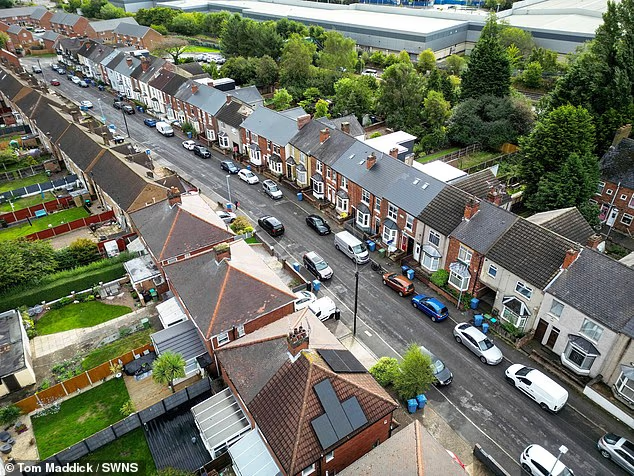
Residents of a street in Mansfield say the expansion of houses in multiple occupation (HMOs) is putting pressure on parking, rubbish collection and community life, after a three-bedroom terrace was approved to accommodate up to ten people.
Princes Street was once largely home to local families, but residents estimate that at least 15 of its roughly 42 properties have now been converted into HMOs or flats. They say the changes have brought more cars, overflowing bins, noise and anti-social behaviour.
The latest dispute centres on number 13, a three-storey property which was originally built with three bedrooms. It is already licensed for six tenants, but its owners sought permission to increase occupancy to ten. The application has since been approved with conditions.
Plans show that the property has been remodelled to contain six bedrooms, with two on each floor. Four rooms are due to be adapted to accommodate couples, while five will have their own hob cookers.
The garden is also set to contain nine wheelie bins. The owners described the property as “underutilised” in their planning application, a characterisation that angered residents.
“That sounds like a hotel, not a home,” one resident said.
Cynthia Leveridge, 75, has lived on Princes Street for 47 years. She said the area had changed dramatically, alleging that drinking, swearing, shouting and drug use had become problems.
“It used to be lovely here. Everyone knew everyone. It used to be quiet. Children could play in the park. That’s all changed now,” she said.
Residents say the number of HMOs recorded officially does not reflect the scale of the changes. Mansfield Council lists three licensed HMOs on the street, but only properties housing five or more tenants require a licence under the council’s current arrangements.
Under the legal definition, an HMO is a property occupied by at least three people from more than one household who share facilities such as a kitchen or bathroom. The council does not collect or release figures for properties below its five-person licensing threshold, meaning the total number on Princes Street is unknown.
Arthur, 36, who rents on the street, said: “There are definitely more than they’re saying. Whether it’s because they don’t need a licence or just haven’t bothered and the council won’t do anything, I don’t know.”
He said rents were also becoming difficult to justify, with some tenants paying as much as £800 a month for a room he believed should cost about half that amount.
Demand for shared accommodation has increased as single renters and couples struggle to afford homes of their own. Landlords can charge separately for each room rather than letting a property to one household, creating an incentive to convert family homes into HMOs.
Figures from a Freedom of Information request show that applications to convert homes into HMOs rose from 41,162 in 2018 to 57,725 in 2024. There were an estimated 472,823 HMOs across the UK in 2025.
Residents warn of pressure on Princes Street
Lucy Bell, 57, said the street’s infrastructure was not equipped for the number of occupants now living in converted properties.
“There’s no infrastructure for this. We’ve got pavement parking, noise and mess. Bin day is horrendous,” she said.
Overflowing bins and rubbish left on pavements were repeatedly raised by residents, who also complained about pet mess and fly-tipping.
Ms Bell said an older resident remembered when the street had a butcher’s shop and a fish-and-chip shop, and described it as a close-knit area where neighbours supported one another.
“We used to help each other and look after each other’s kids, but now there’s no community. It’s transient. They’re here for a short period,” she said.
Michael, 60, who has lived on Princes Street for 52 years, said the community had been “100 per cent” lost. He alleged that residents had only discovered some of the HMO conversions through builders rather than information on the council’s website.
Tom Miles, 38, said he had seen houses converted into flats and complained that glass recycling bins were being filled with general rubbish. He said he believed the council was failing to address the issue.
Florence, 71, who said she was born in the house next to her current home, also criticised the changes. She said cars were making access difficult for refuse workers and claimed some occupants struggled to understand the council’s waste rules.
There is no evidence that asylum seekers are being housed in the HMOs on Princes Street. Some residents have nevertheless raised concerns about new arrivals, including alleged difficulties with English and following local rules.
The growth of HMOs has partly been linked to efforts to move asylum seekers from hotels into accommodation in communities. Matthew Pennycook, the Housing and Planning Minister, told the Commons that dispersed accommodation, including HMOs, was an important option for councils while asylum claims were assessed.
More than 72,000 asylum seekers are currently living in non-hotel accommodation, including flats and HMOs. In 2023, 28,000 asylum seekers were housed in 6,000 HMOs, a figure thought to have increased over the past three years.
However, the concerns on Princes Street extend beyond the question of who is living in the properties. Residents say the concentration of shared accommodation is placing pressure on services and changing the nature of a street originally designed for family homes.
Property prices may also be encouraging conversions. The average price on Princes Street is now about £143,000, while semi-detached homes are valued at an average of £181,000. The area is close to a railway station, Nottingham University and a hospital, making it attractive to students and healthcare workers.
Three licensed HMOs on the street were approached for information about their occupants. Two declined to comment, while people at a third said healthcare workers were living there.
Mansfield Council considers tighter HMO controls
The number of licensed HMOs across Mansfield is 173, although that figure excludes properties which fall below the council’s licensing threshold. Three more Princes Street properties have applied for large-HMO status, while about half a dozen homes have already been divided into flats.
Residents want the council to introduce an Article 4 Direction. Such a measure could remove permitted development rights and require all HMOs to obtain planning permission, giving the authority greater scope to control their spread.
Steve Yemm, the Labour MP for Mansfield, said the council should consider the move alongside a review of its licensing arrangements.
“I believe the council should seriously consider introducing an Article 4 Direction, alongside reviewing current licensing arrangements, to give local communities a greater say over the spread of HMOs and ensure development is properly managed,” he said.
Mr Yemm said residents had told him that parking, overflowing bins and the loss of community cohesion were affecting neighbourhoods across Mansfield.
“HMOs have a legitimate role to play in meeting housing need, but in some areas the concentration has gone too far,” he said. “When too many are clustered together, the impact on local communities and services can be significant.”
Mansfield Council said it understood residents’ concerns and was reviewing the number and distribution of HMOs across the district as part of its assessment of housing needs and local communities.
A council spokesman said officials were considering planning powers, including whether an Article 4 Direction would be appropriate. Any decision, the spokesman said, would need to be based on robust evidence and a thorough assessment of local circumstances.
For some residents, the changes have already gone too far. Justin, a father of two who moved to Princes Street 17 years ago, said the street had become dominated by conversions and building work.
“Seventeen years ago, it was completely different,” he said. “Now half of the street seems to be HMOs.”
