


Australia’s Labor government has announced a sweeping migration overhaul that will restrict international students from bringing family members, limit repeat working holiday visas and make it harder for temporary migrants to remain by moving between visa categories.
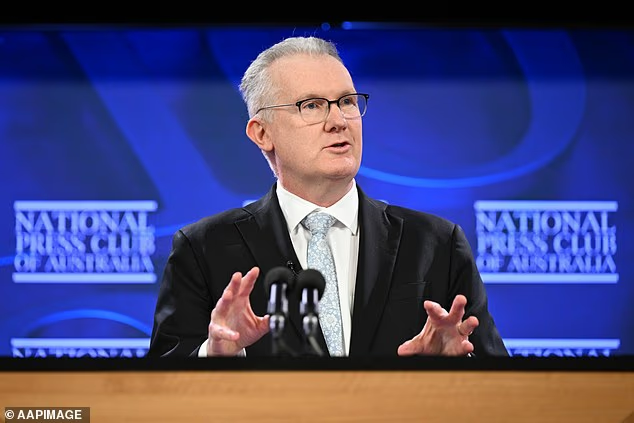
Home Affairs Minister Tony Burke unveiled the measures at the National Press Club in Canberra, saying the system needed a clearer divide between temporary and permanent migration while warning that excessive cuts could damage the economy.
“If you want to come on a temporary basis to Australia, apply for a temporary visa. If you want to come to Australia permanently, apply for a permanent visa. And if you no longer have a valid visa, you should leave Australia,” he said.
International students and backpackers face tighter rules
New international students and graduate visa holders will generally no longer be able to attach family members to their visas. The change will not apply retrospectively to partners or relatives already in Australia on an existing visa.
Some exceptions will remain, including for students from Pacific and ASEAN countries and certain higher-level courses such as PhDs.
The government will also target students who repeatedly enrol in courses at the same or a lower qualification level to prolong their stay. Students will generally be expected to progress upwards, such as moving from a bachelor’s degree to a master’s.
Mr Burke said the government was addressing cases in which migrants moved between cheaper courses with limited attendance requirements while using their student visas to continue working in Australia.
Working holiday-makers will face a ballot for places on second- and third-year visas, even if they have completed the required regional work. The second-year scheme will be capped at 45,000 places, compared with about 57,000 people who qualified last year.
Third-year access will be reduced to 5,000 places, against about 31,000 qualifying applicants last year. Applicants will still need to complete 88 days of regional work for a second year and six months for a third year before entering the ballot.
British backpackers will also see their applications processed more slowly as the government responds to a sharp rise in their numbers. Mr Burke said the number of UK working holiday-makers in Australia had grown from about 17,000 when the Australia-UK Free Trade Agreement was signed in 2023 to just under 80,000.
Crackdown on visa-hopping and overstayers
Visitor visas will carry tougher “no further stay” conditions, aimed at stopping people entering Australia as tourists before applying for another visa while they are in the country.
Mr Burke said the current process had contributed to “visa-hopping”, in which some temporary migrants move between visas and appeals despite having little realistic prospect of permanent residency.
The government plans to increase enforcement against people who remain after their visas expire. A further 100 compliance officers and 250 detention beds are to be provided, with existing facilities near airports and a former Melbourne quarantine centre being examined for additional capacity.
Mr Burke said the government wanted to restore an approach used before 2015, under which overstayers who refused to leave could be detained for a short period while their departure was arranged.
Labor will also seek to deter weak protection claims lodged after other visa options have been exhausted. Mr Burke said some migrants were being advised to submit asylum applications with little prospect of success so they could remain in Australia while appeals and court proceedings continued.
Migration agents who encourage non-meritorious claims will face possible sanctions or deregistration under proposed changes to their professional code.
Government defends targeted migration
Despite the measures, Mr Burke rejected claims that Australia was experiencing mass migration. He said net overseas migration was 47 per cent below its 2023 peak of 556,000 and argued that the post-pandemic surge had been unusually high but temporary.
He warned that deeper cuts could harm regional communities and cities, as well as industries reliant on overseas workers and international students. Construction, agriculture, fisheries and teaching will receive greater priority in skilled visa processing, while trade qualifications will be given more weight in the points system.
Mr Burke said close to two-thirds of plasterers in Sydney and Melbourne were born overseas, arguing that immigration was needed to help build more homes. He also disputed claims that migration was primarily responsible for Australia’s housing shortage, pointing instead to the decline in average household size.
“We need immigration. We just need to make sure that it is targeted to Australia’s needs, both in terms of numbers and across the different categories that work for our economy,” he said.
