


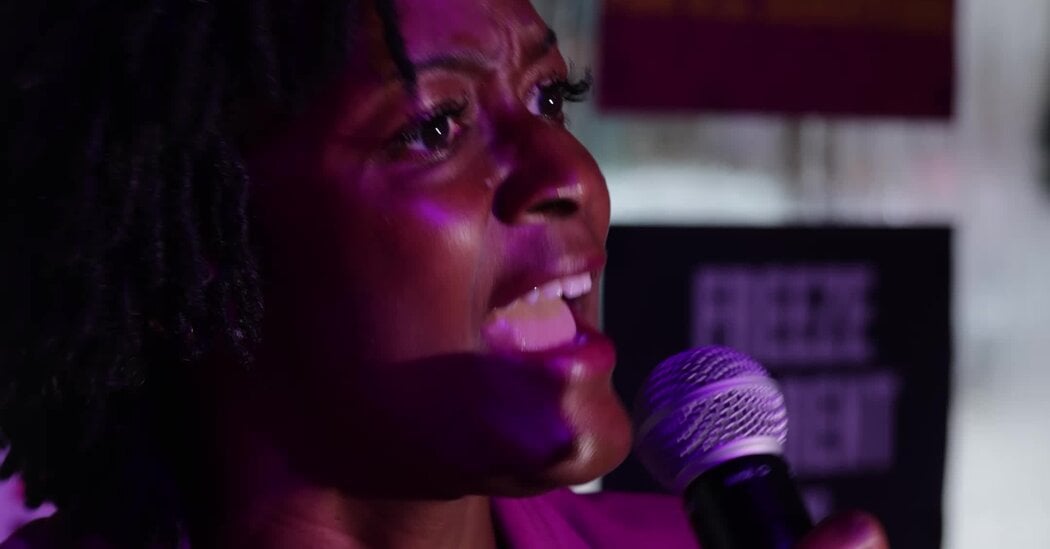
Angie Nixon’s Florida Senate campaign has shaken up a Democratic Party that had largely written off the Republican-leaning state, after her insurgent primary victory propelled her into a general election contest against Republican incumbent Ashley Moody.
Ms Nixon, a 42-year-old state representative from Jacksonville, defeated Alex Vindman, a former national security official with establishment ties, by double digits last month. Her win has revived Democratic hopes of mobilising voters in a state that President Trump has carried three times, although Republicans remain confident that Ms Moody will prevail in November.
If elected, Ms Nixon would become Florida’s first Black senator. She is also seeking to become the state’s most prominent progressive candidate, despite facing attacks over her membership of the Democratic Socialists of America and her outspoken opposition to the Republican governor, Ron DeSantis.
President Trump branded her a “card-carrying member” of the organisation at a Republican midterm convention last week. Ms Moody has declined to debate her, saying she would not give “a stage or any attention” to someone she considers “truly anti-American”.
Ms Nixon’s campaign is built around direct confrontation. Her protests against Republican-backed congressional maps have included marching through the Florida House with a pink bullhorn and staging a sit-in in Mr DeSantis’s office, where she was arrested after refusing to leave.
She is awaiting trial next month on trespassing charges. The protests have been dismissed as stunts by some Republicans and Democrats, but they have helped define her as an energetic opponent of the governor’s policies.
Florida Senate campaign built on confrontation
Ms Nixon has challenged Mr DeSantis over his “war on woke”, including changes to the teaching of slavery, restrictions on diversity initiatives and the removal of books from school libraries. Her book and coffee shop, Cafe Resistance, displays banned books.
In 2022, she and fellow state representative Travaris McCurdy interrupted a legislative session over redistricting maps that they said diluted Black representation. The pair sat on the House floor wearing T-shirts bearing the words “STOP THE BLACK ATTACK”.
This spring, Ms Nixon returned to the issue after Republicans prepared a new set of congressional maps that eliminated four Democratic seats. She marched down the centre aisle of the House in a matching pink jumpsuit and later occupied the governor’s office.
Her tactics have sometimes unsettled Democrats. A unity rally planned on the assumption that her more moderate primary rival would win was cancelled after her victory, while some Jewish Democrats criticised a 2023 ceasefire resolution she filed in the Florida legislature. The measure referred to “the State of Israel and occupied Palestine” and was defeated by 104 votes to two.
Ms Nixon has since sought to repair those relationships and has been quick to condemn antisemitic incidents. Her campaign also presents her as a practical organiser rather than simply an ideological figure.
A longtime union and community organiser, she has worked on restoring voting rights for people convicted of felonies, expanding Medicaid and unionising adjunct college professors. She has also campaigned on childcare and confronting price gouging.
Joe Garcia, a former Miami congressman who co-hosted a fundraiser for her, said some Democrats might dislike her style but found her authenticity compelling. “You may not like what she’s saying, but you know it’s what she feels,” he said. “It’s very powerful.”
Ms Nixon’s political career began in Jacksonville’s historically Black Moncrief neighbourhood, where she was raised by a mother who worked two jobs to support her and her brother. She entered politics after asking a city councilwoman, while visibly pregnant, for an internship that did not yet exist.
She first ran unsuccessfully for Jacksonville’s city council in 2008 as a single mother. In 2016, she worked as deputy field director for national Black outreach on Bernie Sanders’s presidential campaign, and in 2020 won a seat in the Florida House while pregnant with her younger daughter.
During the coronavirus pandemic, when many Democratic campaigns had curtailed canvassing, Ms Nixon insisted on knocking on doors. She contracted Covid before the election but won decisively.
Her supporters say that determination remains central to the Senate campaign. Daniel Henry, first vice chairman of the Florida Democratic Party, said: “The people that usually underestimate her end up losing.”
Ms Nixon is campaigning in a van known as the Vangie, stocked with snacks, a clothes rack and a pillow, while often staying with friends and family to reduce costs. Her events are designed to recruit canvassers and phone bankers as much as to attract crowds.
In Miami’s Little Havana, she led supporters in call-and-response chants before visiting voters at home. She has defended her DSA membership while describing herself as a progressive rather than accepting a fixed political label, and has denounced authoritarian leaders in Cuba and Venezuela.
The task ahead remains difficult. Republicans now substantially outnumber Democrats in Florida, and the race is not regarded as competitive nationally. But Democrats say a strong performance by Ms Nixon could increase turnout among Black voters and help candidates further down the ballot.
