


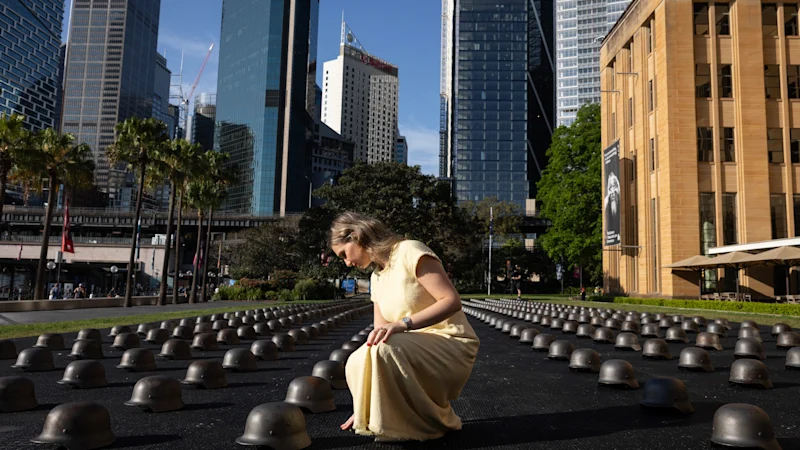
Five hundred cast-iron combat helmets have gone on display on Sydney Harbour in a monumental outdoor installation by Ai Weiwei, who is using the work to prompt reflection on war, peace and human resilience.
Mushrooms, a 40-metre sculpture arranged on Tallawoladah Lawn beside the Museum of Contemporary Art Australia, was unveiled after the surrounding fence was removed overnight. Visitors can walk between the 10 rows of helmets along a central passageway.
Each helmet weighs five kilograms and was made in a Chinese foundry from a single mould, including a detailed reproduction of the original interior cushioning. Together, the objects transform military equipment into a public artwork about conflict and its human consequences.
“In the era we live in, the 21st century, wars have not ceased,” Ai said. “We continue to exist in a time where war and peace interchangeably assume each other’s roles, shaping the identity of our age. I hope this work prompts people to reflect on war and peace.”
Ai Weiwei’s Sydney Harbour installation
The idea for the installation followed Germany’s 2022 decision to donate 5,000 helmets to Ukraine, a gesture that was widely mocked as symbolic and inadequate to the realities of modern warfare. Ai’s work is not focused solely on that conflict, but uses the helmets to consider war more broadly.
Its title carries several meanings. Mushrooms refers to fungi’s ability to turn decay into new life, the shape of nuclear explosions and a Chinese idiom associated with endless bureaucratic delays.
Helmets have appeared repeatedly in Ai’s work. He has previously recreated construction hard hats in fragile materials including marble and glass, honouring miners killed in industrial disasters and workers who tried to rescue victims of the 2008 Sichuan earthquake. In 2023, he made 90 porcelain helmets based on Second World War designs.
Hamish Balnaves, whose late father Neil Balnaves was a television executive and philanthropist, said the work was intended to encourage discussion and offer a human perspective on warfare.
“When you look it is rows of helmets, and it does have a reflective element, and it does remind me of rows of crosses,” he said. “It creates a human element towards something forgotten in modern warfare, and a lot of warfare from the air, that it does come down to individual lives.”
The sculpture is the second major public commission supported by a 3 million dollar philanthropic gift from The Balnaves Foundation in memory of Neil Balnaves. The first was British artist Thomas J Price’s three-metre golden bust of an “every woman”, installed the previous year.
Ai is well known in Australia for Law of the Journey, a huge black rubber lifeboat filled with figures of refugees that was shown at the 2018 Biennale of Sydney. He also held a silent vigil outside Julian Assange’s extradition hearing in 2020.
“This artwork can once again remind us that the world we inhabit is not a world free of worry. It is a world filled with crises,” Ai said in a video statement.
The Museum of Contemporary Art Australia has also launched Say Your Peace, a public programme inviting visitors to record video messages for the artist.
