


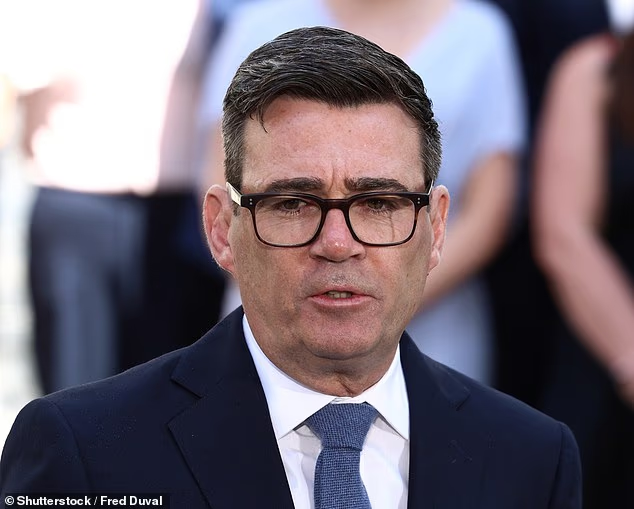
Andy Burnham has condemned the “disturbing” case of a man who photographed women and children before using AI software to create sexualised images, after he was repeatedly released on bail despite police and prosecutors opposing it.
Zafer Dogan, 32, was jailed for two years and four months after admitting a series of offences involving thousands of images. He had been allowed to return to his flat in Enfield, north London, while awaiting sentence, despite the property overlooking a children’s playground.
One family affected by his offending was forced to move into temporary accommodation. Metropolitan Police Commissioner Sir Mark Rowley criticised the decision, saying: “Children should be put first, not the paedophile.”
Sir Mark said the family had “ultimately felt forced to move to a distant temporary accommodation, disrupting their lives and disrupting their children’s lives, simply to escape being in the neighbourhood of the offender”.
He added: “That is simply not acceptable. The pressure to reduce the remand population has contributed to more dangerous and prolific offenders being granted bail routinely despite strong submissions from the police and CPS.”
The Prime Minister said Sir Mark’s concerns “need to be heard” and called on those working in the criminal justice system to make “necessary changes”.
Speaking to BBC London, Mr Burnham said courts were independent when making bail decisions but should listen to the Metropolitan Police Commissioner.
“The failure to build prison places over a number of years has led to this unacceptable situation,” he said. “I don’t believe anyone would want this situation to have arisen – it results from that failure to ensure proper planning of prison places in the past.”
He added: “But we are where we are. I have to deal with it.”
Images taken from bedroom window
Dogan, who worked as a mechanic, admitted creating purported intimate images of an adult, possessing extreme pornography and a prohibited image of a child, as well as multiple offences involving indecent images of children.
Prosecutor Sarah Gabay told the court that investigators had found “thousands of images of women and children which seem to have been taken without their consent or their knowledge”. Some showed children playing on climbing frames or going about their daily lives.
Police said more than 5,000 images had been taken, many from Dogan’s bedroom window. Images involving 33 adult women and two children, aged seven and 13, were digitally altered using AI software.
Dogan pleaded guilty to three counts of making indecent images of a child, including 900 category C images, 294 category B images and 653 category A images, the most serious category. He also admitted a further two counts of making indecent photographs of a child and obstructing a constable.
The mothers of the two child victims described the impact of the offending in statements read to the court. The mother of the 13-year-old said she felt as if she had been “punched in the gut” and feared the images could be online and accessible to other paedophiles.
The mother of the seven-year-old said she felt “helpless”, adding: “Our lives will never be the same again and I can’t do anything about it all because one man exploited my child.”
Andrea Simon, London’s victims’ commissioner, said families had been “grossly failed by the decision” to grant Dogan bail. She said the fact that police and prosecutors had opposed bail on several occasions showed that prison capacity pressures were not being balanced against the effect on victims.
Public Accounts Committee figures cited in the case showed that prisons were operating at between 98% and 99.7% occupancy from October 2022 to August 2024. The number of prisoners held on remand while awaiting trial or sentencing reached 17,711 in August 2024.
Police Constable Natalie Scagliarini, who led the investigation, described Dogan’s conduct as “deeply distressing”. She said his actions were “predatory and dangerous” and had left people feeling unsettled and violated, not knowing when they might be watched or photographed.
