


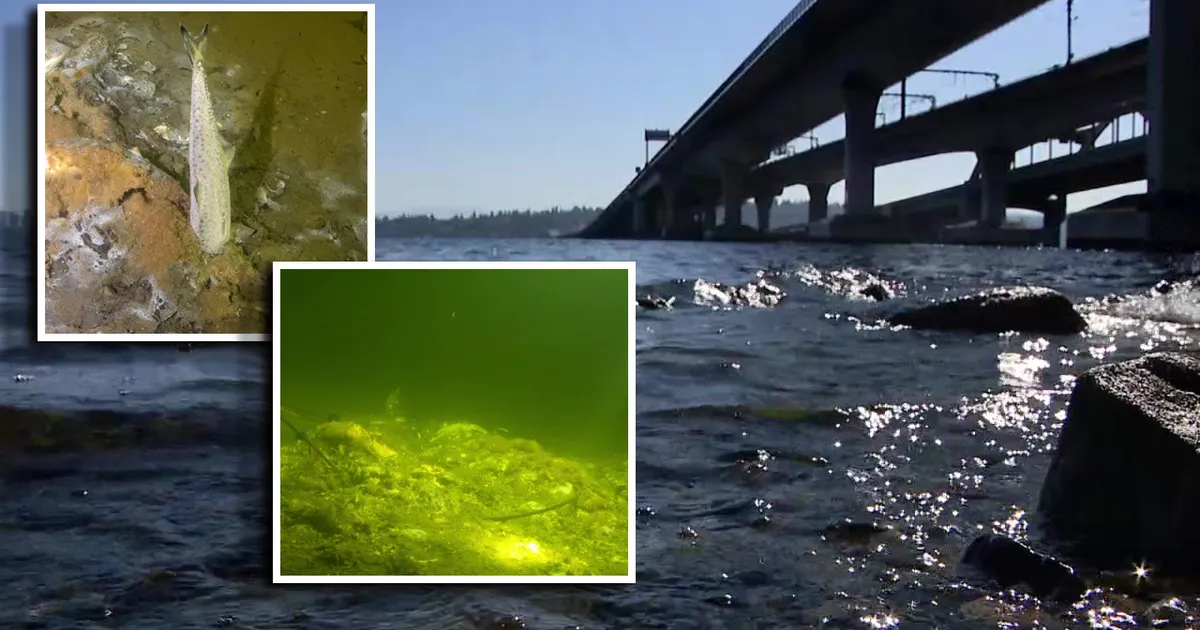
About 2,000 fish have been found dead beneath the I-90 floating bridge on Lake Washington, prompting an investigation into whether electrical equipment installed for Seattle’s new light rail service may be responsible.
The fish, including perch, bass and a small number of salmon, were discovered close to cables hanging from the bridge pontoons. Sound Transit, which operates the Link light rail network, has since raised 32 anode strings from the lakebed while it examines the possible cause of the deaths.
The anode strings form part of a cathodic protection system designed to prevent corrosion in the bridge’s metal structures. Officials have not established that the equipment caused the fish mortality, but the concentration of carcasses around the cables has made the system a central focus of the inquiry.
Dead fish found beneath Lake Washington bridge
Travis Eiler, a diver exploring the remains of the old bridge, said he came across piles of dead fish roughly 80ft below the surface.
He said the carcasses were lying near lines descending from the floating bridge and appeared unusually untouched by predators. When he returned about a week later, Eiler said he saw further dead fish and found that some of the older carcasses had developed a fungus-like coating.
The discovery was reported to conservation groups, the Washington Department of Natural Resources, the Washington Department of Fish and Wildlife and Muckleshoot tribal representatives.
The Washington State Department of Transportation alerted Sound Transit to the deaths on 3 August. The transit agency said it responded by sending divers to the site and bringing in fish biologists, engineers, regulators and tribal fisheries staff.
Electrical system under investigation
Sound Transit chief executive Dow Constantine said initial work had identified a possible connection between the fish deaths and localised sections of the bridge’s corrosion-protection system, particularly where groups of anodes had come to rest on the lakebed in shallow water.
The system uses a controlled electrical current to protect the bridge from corrosion. Divers and engineers are investigating whether the arrangement of the anodes may have created conditions harmful to fish, although the precise mechanism has not been confirmed.
Sound Transit said the bridge remains safe for passengers and other members of the public. The Crosslake Connection, which carries Link trains across Lake Washington, opened to passengers on 28 March 2026.
The agency completed an interim measure to lift the anode strings off the bottom of the lake on 23 August. It is now inspecting the affected areas for further signs of fish mortality and preparing a sampling and testing programme with tribal fisheries managers and other regulatory bodies.
Eiler said that, during a later visit, he saw no fresh carcasses at the locations where the cables had previously been resting.
Sound Transit said testing over the coming weeks should help determine the root cause and guide a permanent remedy. It is also considering replacing the existing arrangement with a closely coupled anode system similar to the one used on the nearby SR-520 floating bridge.
