


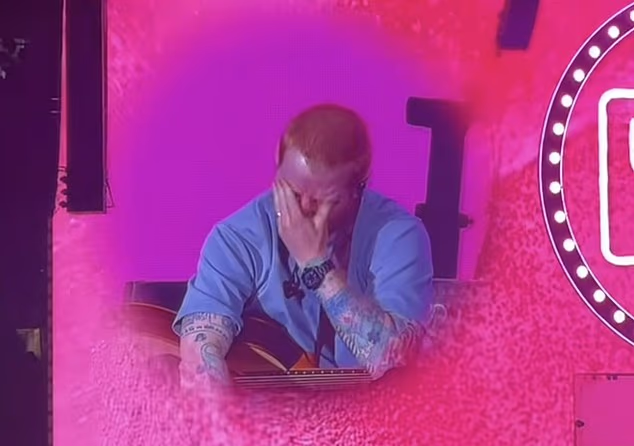
Ed Sheeran has said he felt abandoned by family and friends as the Israel-Palestine controversy surrounding his tour intensified, becoming emotional during his return to the stage in Philadelphia.
The 35-year-old singer apologised to fans at Lincoln Financial Field after Macklemore was removed as a support act following the rapper’s public backing for a “Free Palestine”. Sheeran said he had been unsure whether the tour would continue amid calls for a boycott.
“In these situations, you really find out who your friends are and it’s been a weird week,” he told the audience. “Everyone’s telling me to cancel and I’m feeling all of my friends and family and people I know abandon me.”
He added that the sight of 50,000 people attending the concert had reassured him. “I look at the end of the week and I see 50,000 people who haven’t abandoned me,” he said. “People will say what they want, but I am doing this for you. I love you. I love this.”
Sheeran had previously said he did not want to bring politics into his concerts. But, in a speech at the start of the show, he said the conflict had become a humanitarian issue about which he could no longer remain silent.
“I have tried in my career not to be a political commentator of any kind because I want my music and shows to be about unity and not division, about humanity and not politics,” he said.
He described the October 7 attacks at the Nova music festival in Israel as “horrific” and said what was happening in Gaza was “catastrophic and unjustifiable and disproportionate”. Sheeran also referred to the loss of civilian and children’s lives and said “the systemic injustice we’re seeing unfold in the West Bank cannot be overlooked”.
The singer said he had been forced to make difficult decisions and admitted: “I am making mistakes, and I’m so, so sorry.” He said he had never wanted to be an “activist musician” but had been placed at the centre of an argument about freedom of speech.
Sheeran also apologised at the end of the concert for speaking about the issue, saying he understood that families had not bought tickets to hear a political discussion.
“The one thing that I would like to apologise for is the first bit of the show where it wasn’t about music and I had to talk,” he said. “But that was something I felt like I needed to say.”
He insisted that the tour would continue, despite several support acts withdrawing after Macklemore’s removal. Finneas, Billie Eilish’s brother, said artists should not be silenced when speaking up for oppressed people, while Aaron Rowe, Lukas Graham and Sheeran’s backing folk band Beoga also pulled out of planned appearances.
The dispute began after Macklemore was barred from performing at Gillette Stadium near Boston, which is owned through the Kraft Group by Robert Kraft. Kraft, who is Jewish, had accused the rapper of hate speech during earlier support appearances in which he called for a “Free Palestine”.
Macklemore later claimed that Sheeran had told him Kraft had spoken to other stadium owners and that Sheeran faced an ultimatum over keeping him on the tour. Sheeran subsequently said on Instagram that removing Macklemore had been the promoter’s decision, not his.
Sheeran said he had chosen not to speak publicly about his personal views on the conflict because he did not want to let down fans, the touring crew or other musicians who depended on the shows for work.
He faced criticism from artists including Pink Floyd co-founder Roger Waters, while his cousin Jethro Sheeran described him as a “coward” and said he was “ashamed” of him.
At the Philadelphia concert, Sheeran told fans that his shows were intended to bring together people with different beliefs. “They’re about unity. They’re about love. They’re about family,” he said.
Appearing tearful, he added: “The world is a scary place right now. America is a scary place right now. This gives hope.”
