


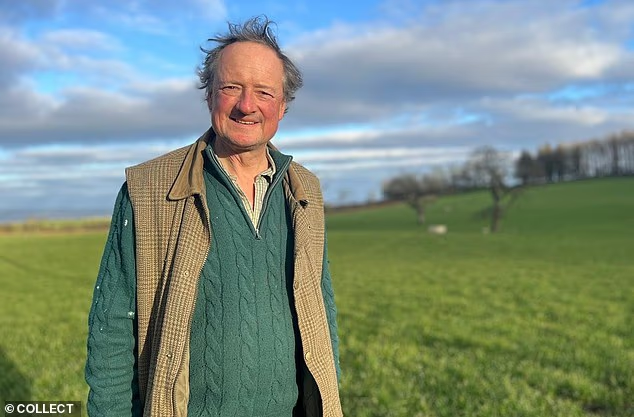
Andy Burnham’s efforts to win over farmers risk being undermined by Labour’s rural policies, according to farmer and author Jamie Blackett, who has urged the Prime Minister to abandon the family farm tax and proposed restrictions on hunting and game shooting.
Mr Burnham recently acknowledged that he needed to regain the trust of the farming community, praising farmers for putting food on tables, caring for the countryside and supporting rural communities.
He also said that decisions affecting local areas should be made by the people who understood them, rather than imposed from Westminster. But Mr Blackett argues that the Government’s record has so far failed to match those assurances.
A Countryside Alliance survey cited by Mr Blackett found that only 15 per cent of people living in rural areas believed Labour was concerned about those who lived and worked there.
Labour’s rural challenge
Lord Blunkett, a Labour grandee, has warned that the party should reconsider the family farm tax, which has led to widespread protests. He has also called for the planned ban on trail-hunting to be dropped and urged Labour to develop a better understanding of the countryside.
Mr Blackett said that genuine devolution of power to rural communities would deserve support, but argued that Mr Burnham’s plans appeared instead to involve adding another tier of local government.
He also criticised Labour’s proposed licensing system for the release of game birds, saying it represented a serious threat to game shooting. The Countryside Alliance has described the situation as the most serious threat the activity has faced.
Mr Blackett claimed that ministers were listening to environmental campaigners, including television presenter Chris Packham, rather than people involved in rural communities. He said shooting and hunting brought together people from a wide range of backgrounds, disputing what he described as Labour’s portrayal of the activities as the preserve of wealthy interests.
He further blamed the Government’s approach to moorland management for worsening the impact of summer wildfires. The raw material states that more than 57,000 acres burned, releasing nearly 1.4 million tons of carbon, while homes were lost and rare species were deprived of habitats.
Mr Blackett said the Government had responded with “arrogance, ignorance and pig-headedness” rather than an apology or partial reversal. He criticised Environment Secretary Dame Angela Eagle for ruling out a return to controlled burning and continuing to support rewilding.
He also objected to the appointment of Baroness Hayman as a Defra under-secretary, describing her as an animal rights campaigner driving the Government’s anti-hunting agenda.
Despite his criticism, Mr Blackett said Labour was not inevitably unsuited to representing the countryside. He pointed to Tom Williams, who served in the Attlee government, as one of the strongest agriculture ministers since the Second World War, and noted that Nye Bevan and Jim Callaghan had both been farmers.
He said Mr Burnham could draw on MPs with knowledge of rural affairs, including former farming minister Daniel Zeichner, Markus Campbell-Savours and Henry Tufnell.
Mr Blackett argued that the Prime Minister needed farmers’ skills, investment and knowledge to address food security, support rural employment, build homes and tackle biodiversity loss and wildfires.
He concluded that Mr Burnham risked alienating the farming community by pursuing further restrictions on hunting and retaining the family farm tax, and called for Defra ministers who understood what it was like to live and work in the countryside.
