


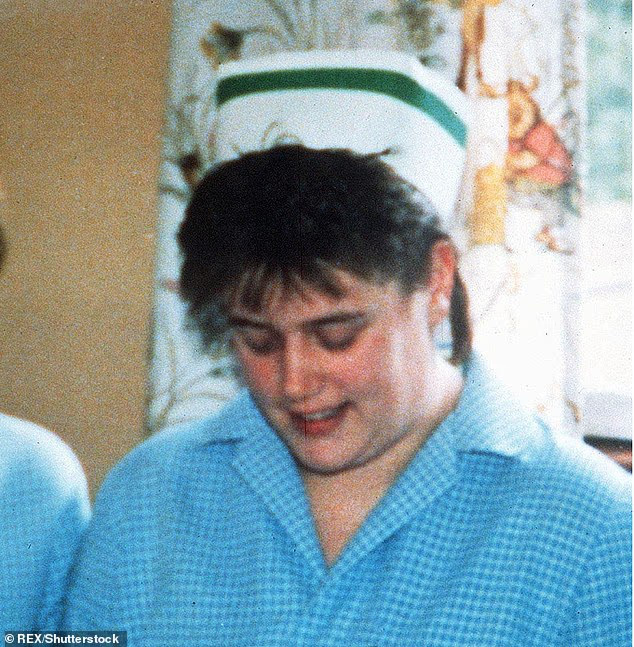
A survivor of Beverley Allitt’s attacks has said lessons from the nurse’s crimes were ignored before Lucy Letby murdered babies at another NHS hospital.
Paul Crampton was five months old when he suffered three unexplained collapses at Grantham and Kesteven Hospital in Lincolnshire in March 1991. His parents later learned that he had been poisoned with a huge dose of insulin while in the children’s ward.
The findings of Lady Justice Thirlwall’s inquiry into Letby’s crimes brought back painful memories for Paul’s father, David Crampton, who believes the warning signs identified after the Allitt case were not acted upon.
“Someone should have spotted that sequence of events and said, ‘Hey, what’s going on here’,” he said.
Paul had been admitted with a chest infection as a precaution and was expected to recover quickly. But when his parents arrived, they found him cold, clammy, lethargic and in distress.
Allitt, then 22, was present as doctors tried to save him. She stepped forward and said: “This child is hypo”, referring to dangerously low blood sugar levels.
A pathology report later showed that Paul had 43,147 milliunits of insulin in his blood. A normal reading was said to be in the region of 10 to 13, and detectives believed an entire adult syringe of insulin had been injected into him.
Paul’s mother, Kath, suspected that his condition was not the result of illness and raised her concerns with the person responsible for his care.
“Kath felt strongly that something was being done to him,” Mr Crampton said. “This wasn’t an illness.”
The family were later told by police that Paul was one of 13 children attacked by Allitt over 59 days. Four children were murdered.
Allitt was convicted in 1993 of killing Liam Taylor, Timothy Hardwick, Becky Phillips and Claire Peck, and of harming nine other children, including Paul. She received 13 life sentences and claimed she had been suffering from Munchausen’s syndrome by proxy.
Pages from the ward allocation log covering the time of Paul’s admission had been ripped out. They were found in a drawer during a search of Allitt’s home.
Inquiry found warnings about the Beverley Allitt case were not acted on
An independent inquiry chaired by Sir Cecil Clothier reported in 1994 and identified a series of failings. Paul was transferred to the Queen’s Medical Centre in Nottingham, where he made a full recovery.
Lady Justice Thirlwall’s inquiry found that babies murdered by Letby at the Countess of Chester Hospital might have been saved. It concluded that senior executives prioritised protecting the hospital’s reputation over investigating the deaths, while a police investigation was stalled and doctors who raised concerns were targeted.
Letby, who maintains her innocence, was convicted of murdering seven infants and attempting to murder seven others, including one baby she attacked twice. She is serving 15 whole-life terms and has twice been refused permission to appeal.
The inquiry referred to Allitt and Victorino Chua, who murdered and poisoned patients at Stepping Hill Hospital in Stockport. Lady Justice Thirlwall said: “Nurses do kill. It is not unthinkable. All doctors, nurses and managers should know that.”
She also said that, despite awareness among safeguarding staff of the Allitt case and a recommendation to remain alert to the possibility of deliberate harm by healthcare professionals, training did not cover the possibility of a member of staff harming children.
Mr Crampton said the Allitt and Letby cases showed an “inability” at both hospitals to identify suspicious circumstances and take immediate action.
“With the Letby case, I understand that people raised a red flag and it would appear that wasn’t necessarily reacted to,” he said. “If a whistleblower said something there needs to be a thorough review of what they’re saying and an investigation to see if it is correct.”
He stressed that Allitt’s crimes should not be allowed to undermine public confidence in the NHS.
“The vast majority of people who work in the health service are decent, kind and caring people,” he said. “Allitt is a very unusual person. Therefore, let’s not let that reflect on all those thousands of caring people that do a really good job every day.”
Allitt was initially regarded as a helpful nurse on the children’s ward, where parents trusted her and she appeared repeatedly when children unexpectedly collapsed. It later emerged that she had administered high doses of insulin and potassium, and had injected air into some victims.
Now aged 57, Allitt has served the minimum term of 28 years and 175 days and is eligible for release. She remains at Rampton high-security hospital and is assessed every three years for a possible transfer to a mainstream prison, where she could apply for parole. Her latest assessment is due in 2026.
The Ministry of Justice said there was no evidence that such a transfer had taken place. Rampton did not respond.
Mr Crampton said he believed Allitt was a manipulative individual and that a prison might be more appropriate for her crimes.
Paul, now 35, went on to obtain a master’s degree and is building a career. He has a daughter of his own.
“Paul is well, fit and healthy,” his father said. “He completed his education, went on to do a degree and now is building a career like I was in my thirties.”
