


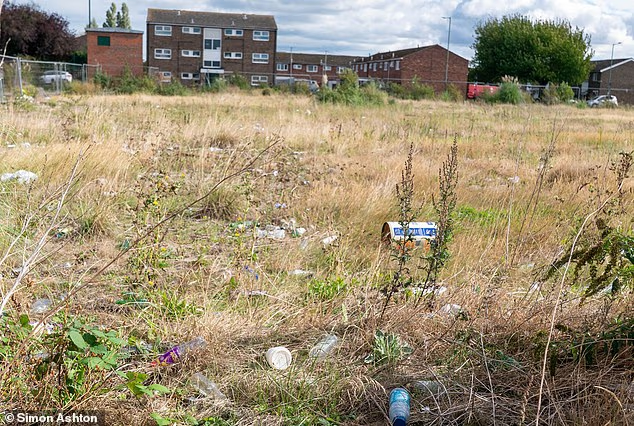
Grimsby neighbourhood East Marsh and Port has been identified as Britain’s worklessness capital, with an estimated 1,700 of its 3,492 working-age residents unemployed and claiming Universal Credit.
The figures, broken down from constituency data held by the House of Commons Library into smaller areas, suggest that 48.9 per cent of working-age adults in the district are in that position.
The rate is almost 1.5 percentage points higher than in the nearest comparable areas, both in Blackpool. But the statistics also reflect deep ill health, with about 30 per cent of working-age adults in the area receiving health-related benefits.
Patrick Salmon, who runs the Alfred Enderby traditional fish smokers on Grimsby’s docks, works 12-hour days, six days a week. The 62-year-old supplies smoked fish to chefs including Tom Kerridge, Marco Pierre White and Raymond Blanc, but says the contrast between his working life and the town’s wider difficulties has left him questioning why he continues to work such long hours.
He employs seven people and has previously taken on two local residents who had been out of work for long periods. Mr Salmon said he had tried to support them through the transition into regular employment, but believes the financial pressures facing small businesses now make it harder to repeat that effort.
“If the Government really wants to get people back into work, it should make businesses thrive instead of burying us in schemes and paperwork,” he said.
“Just make businesses strong and profitable, then turn round and say: ‘Now go and employ somebody.’ If you did that, businesses like mine would be out there taking people on.”
Worklessness and deprivation in East Marsh
The area’s economic problems are reflected in other measures. Government data suggests that 87 per cent of children in East Marsh and Port live in low-income families, compared with 38 per cent nationally, while 58 per cent of pupils qualify for free school meals.
Healthy life expectancy is also far below the national average. For men it is 48, and for women 49 — about 12 years below the average across the country.
On Freeman Street, once the commercial centre of a prosperous fishing town, residents described persistent shoplifting, drug and alcohol problems and a lack of confidence in the future. Many shops are closed or boarded up, with a vape shop and Turkish barber among the few signs of newer business activity.
Wendy Aisthorp, 61, has worked at Heron Foods for 11 years and said thefts had become a daily concern.
“If the security guard isn’t in, it can be a free-for-all,” she said. “People just help themselves.”
Ms Aisthorp said she had worked throughout her life, raised her children alone and paid taxes, adding that some people receiving benefits appeared to have “no intention at all of getting a job”.
Parvaneh Ghanbar, 42, said there were jobs available but that some residents were content to remain on benefits. She also pointed to drug and alcohol abuse in the back streets.
However, the figures do not show why every person is out of work, and residents spoken to in the area included people who wanted to work but were prevented from doing so by health or family circumstances.
Chloe Revell, 20, lives in East Marsh with her partner, Charlie Wright, 22, and their one-year-old daughter. The household receives about £500 a month in Universal Credit and Child Benefit, while housing costs are covered through the benefits system.
Ms Revell, who previously worked in an amusement arcade, said she wanted to return to employment and hoped to work in a nursery.
“I love working. I can’t wait to get back into work,” she said. “It’s good for your mental health. It’s good to get out of the house.”
Mr Wright, who used to work on Grimsby’s docks, said mental health problems had kept him out of employment for the past three years.
From fishing port to regeneration hub
Grimsby was once the world’s largest fishing port, with hundreds of trawlers supporting businesses ranging from net makers and chandlers to fish auctions. The industry declined rapidly after the Cod Wars with Iceland, culminating in restrictions on British fishing vessels in 1976.
Jon King, who runs the Great Escape and Blackball Cafe while working with people recovering from addiction, said the loss of the docks had created a “collective grief” in the town.
But he believes the area has opportunities that are not reaching local people. “The nation’s energy infrastructure is on our doorstep,” he said.
Grimsby’s seafood industry still supports 7,000 direct jobs and a further 10,000 in the wider supply chain. The town is also expected to benefit from offshore wind and green-energy investment, while the derelict 19th-century Ice Factory is due to be converted into a hotel, conference centre and offices with capacity for about 1,800 jobs.
Grimsby is also set to become a hub for the Hornsea 3 wind farm, which is expected to generate enough electricity to power 3.3 million UK homes.
Thomas Shutes, the financier and philanthropist behind the Ice Factory plans, said the challenge was ensuring local residents could access the new employment opportunities.
“These will be really high-paying, high-skilled jobs,” he said. “But when you’re in the East Marsh, what they’ll say to you is: ‘What’s offshore wind ever done for me?’”
He said training pathways were needed to connect young people with the expanding industries, adding: “They don’t necessarily have to leave, the jobs are here for them, but their training pathways are not.”
Mr Salmon said rising wages, national insurance costs, energy bills and inflation had squeezed his business. He argued that strengthening companies, rather than adding more schemes and administration, would give employers the confidence to take on people who had been out of work.
“At the moment, we’ve got the cart in front of the horse and it is the horse that is pushing this thing over the hill,” he said.
