


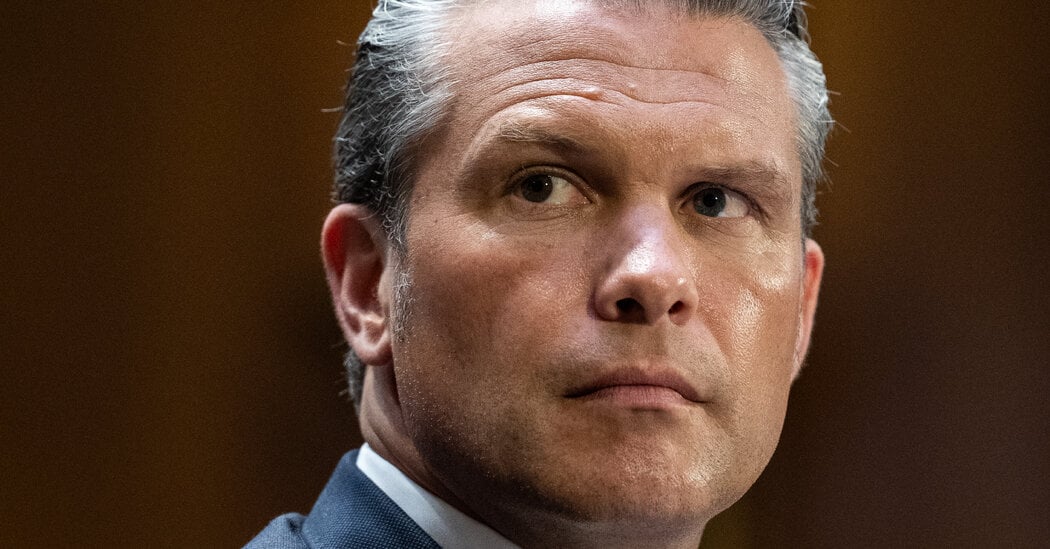
President Donald Trump’s defence secretary, Pete Hegseth, has plunged the Pentagon into unprecedented turmoil by bringing America’s culture wars into the military, according to current and former officials. The upheaval has included the removal or blocked promotion of as many as 80 generals and admirals, restrictions on officer education and widespread polygraph tests aimed at identifying leakers.
The disruption comes as the prolonged war with Iran places additional strain on the US armed forces. Extended deployments have damaged sailors’ morale, while shortages of crucial missile interceptors have raised questions about the military’s ability to sustain the conflict and respond to another war elsewhere.
Many of the pressures pre-date Mr Hegseth and have been worsened by a war that lasted far longer than the Trump administration or the Pentagon expected. But current and former military officials say the defence secretary’s tenure has become a continuing distraction, drawing senior leaders away from operational priorities and creating mistrust among the top ranks.
Officials spoke anonymously because they feared retaliation. They said officers had watched trusted mentors with decades of experience being removed without a clear explanation, while important leadership posts remained vacant for months.
Hegseth’s “warrior ethos” campaign
Mr Hegseth, a former Army National Guard officer who served in Iraq and Afghanistan, left the Army in 2021 after being singled out over tattoos the service judged to be extremist. In 2024, he wrote: “I separated from an Army that didn’t want me anymore. The feeling was mutual. I didn’t want this Army anymore either.”
At the Pentagon, he set out to raise military standards and dismantle what he described as a left-wing agenda that weakened troops and encouraged division. In a speech to hundreds of generals and admirals, he said they were “liberated to be apolitical, hard-charging, no-nonsense, constitutional leaders”.
Kingsley Wilson, the Pentagon press secretary, said Mr Hegseth wanted to restore a “warrior ethos” that had been “buried under bureaucratic process, quotas and institutional self-preservation”.
Critics within and outside the military say the campaign has instead targeted some of the force’s most experienced combat leaders. H R McMaster, a retired Army general and former national security adviser during Mr Trump’s first administration, warned against creating a system in which “everything’s a loyalty test”.
Mr Hegseth has also urged the military to return to what he regards as the tougher standards of an earlier era, while pressing it to adapt to warfare shaped by drones and artificial intelligence. He has praised figures including General H Norman Schwarzkopf, who led US forces in the 1991 Persian Gulf War, and General George S Patton Jr, a Second World War commander.
Earlier this year, he questioned why ruck marches had been removed from Army officer training courses. The Army reported that the marches had not been eliminated and that the standards had become more demanding when 2025 benchmarks were compared with those from 1990.
Restrictions on education and military research
Mr Hegseth has expressed similar suspicion towards officer education, which he has portrayed as a route for what he considers corrupting liberal ideas. Midcareer officers were barred from attending graduate programmes at Harvard, Princeton, Columbia and Yale.
“They’ve taken our best and brightest, the men and women who pledged their lives to this nation, and subjected them to a curriculum of contempt,” Mr Hegseth said.
The scrutiny has reached officers’ master’s theses. At least two Army officers chosen for promotion to one-star general were blocked after officials in Mr Hegseth’s office objected to their papers.
One officer wrote about why Black officers had historically chosen support roles over frontline combat positions. The other examined how political polarisation affected the military’s ability to recruit and retain personnel.
Senior officers say the treatment of academic work has had a chilling effect on a force that had traditionally valued curiosity, questioning and innovation. Some said they had begun avoiding ideas associated with dismissed generals and admirals or censoring themselves on issues they believed could attract Mr Hegseth’s attention.
Peter Feaver, who advises the military and directs Duke University’s American Grand Strategy programme, questioned whether the policy would produce leaders able to think independently or simply officers trained to repeat the administration’s preferred answers.
General Charles Q Brown, the former chairman of the Joint Chiefs of Staff who was dismissed by Mr Hegseth last year, said military personnel should not be punished for carrying out their duties. He said some officers were being singled out or used as “pawns in the culture wars”.
Doubts over the Joint Chiefs chairman
The turmoil has also prompted questions about General Dan Caine, the chairman of the Joint Chiefs of Staff and the principal military adviser to Mr Trump and Mr Hegseth. Senior officers, including four-star generals, have questioned whether he has been unwilling or unable to shield the force from the defence secretary’s campaign.
A spokesman for General Caine declined to comment on the advice he had given Mr Hegseth, particularly on sensitive personnel matters.
General Caine, a former fighter pilot, has taken a narrower view of the chairman’s role than some of his predecessors. In a speech at the National Defense University, he said his responsibility was to tell the president whether the military could carry out a mission and explain the risks, rather than intervene in arguments over whether a particular action should be taken.
“We don’t do that in our business,” he said.
Yet in the same speech, General Caine urged graduates to remain committed to study and intellectual curiosity. “The complex environment that we’re facing requires you to be and remain relentlessly curious,” he said.
He cited Brent Scowcroft, who studied at the National Defense University, earned a doctorate while serving in the Air Force and became national security adviser to President George HW Bush. General Caine did not mention that Scowcroft’s doctorate was from Columbia, one of the universities that officers are no longer permitted to attend.
Supporters of Mr Hegseth have defended his approach. Army Colonel Kevin T Black recently praised the defence secretary for challenging what he called a “protected class” of officers and a promotion system disconnected from the military’s central mission.
“If that stings, it is because it landed on the people who needed to hear it,” Colonel Black wrote.
But the continuing uncertainty has led career officers to discuss privately whether they should seek promotion or remain in the service, while the Pentagon faces the practical demands of a war that has already placed the force under sustained pressure.
