


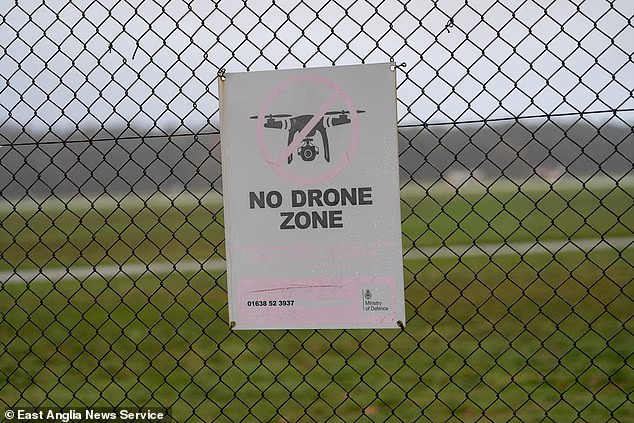
British military sites recorded 340 security incidents involving drones in the year to August 2026, as tensions with Russia intensified and Moscow warned that British facilities in Ukraine could become legitimate targets.
The figures, obtained through a Freedom of Information request, cover incidents at or near Ministry of Defence sites in the UK. They represent a sharp rise from 250 incidents in 2025 and 126 the year before.
The Ministry of Defence has not identified who was responsible for the drone activity. The incidents have nevertheless taken place during a period of heightened concern over Russian activity and wider security threats, including from Iran.
Tobias Ellwood, the Conservative former defence minister and army veteran, said the number of incidents showed that the British military was being viewed as a target.
“In the UK we are doing nothing about protecting our critical national infrastructure, as well as military bases, and it’s such an easy way to disrupt,” he told the Independent.
“At the moment these are just rogue drones, and they’re passive, but it’s not a huge step to then add a kinetic dimension to them to make them introduce lethality.
“All this points to the fact that we are not taking the rise in threat levels that our European cousins are addressing seriously at all.”
Warnings over British military sites
The Ministry of Defence said national security remained the Government’s “first duty” and insisted that the UK and its allies were alert to potential threats.
“The public should be reassured that the UK and its allies remain vigilant against potential threats and adversaries should be in no doubt about this Government’s resolve to stand against aggression towards the UK and our allies,” a spokesperson said.
The ministry added that Russia was “constantly probing us and testing” the UK, but said the Government did not believe Vladimir Putin was seeking a direct confrontation with Nato.
Britain has a range of air defence capabilities operated by the Royal Navy, the British Army and the Royal Air Force. The Ministry of Defence has allocated £790 million to counter-drone and anti-missile measures in the UK and at overseas bases.
The latest figures emerged as the Russian foreign ministry summoned the UK’s deputy head of mission in Moscow, Danae Dholakia, to protest against British support for Ukraine.
Russia warned that it could take “retaliatory measures” over the supply of drones and other weapons systems to Ukrainian forces. Its foreign ministry said any British facilities in Ukraine used to support strikes on Russian territory would be considered “a legitimate target”.
The Foreign Office rejected the warning, accusing Russia of trying to “deflect attention” from its invasion of Ukraine. It said the UK would continue providing Ukraine with equipment needed to defend itself and support efforts towards “a just and lasting peace”.
Britain has committed to provide more than 120,000 drones to Ukraine this year, with 25,000 delivered so far. The equipment includes interceptors designed to destroy Russian unmanned aerial vehicles and attack drones intended to help Ukraine strike back.
The UK has also agreed that defence company MBDA can release classified information about components for the Storm Shadow long-range missile, allowing Ukraine to begin manufacturing the weapon locally.
A report published this summer concluded that Russian drones had entered British airspace and loitered over RAF and US military bases. The sites affected over four days in 2024 included RAF Lakenheath and RAF Mildenhall in Suffolk, RAF Fairford in Gloucestershire and RAF Feltwell in Norfolk.
The drones were reported to have been launched from the Russian spy ship HAV Dolphin, which had been seen off the coast of Humberside. Specialist British troops were subsequently deployed to the bases with equipment intended to intercept Russian drones.
The International Institute for Security Studies said the operation formed part of a wider Kremlin campaign involving shadow-fleet vessels operating in international waters to launch drones over Britain and mainland Europe.
In a separate warning, Poland’s prime minister Donald Tusk said Moscow was planning hybrid attacks involving drones or rockets against European countries supporting Kyiv, including Poland.
