


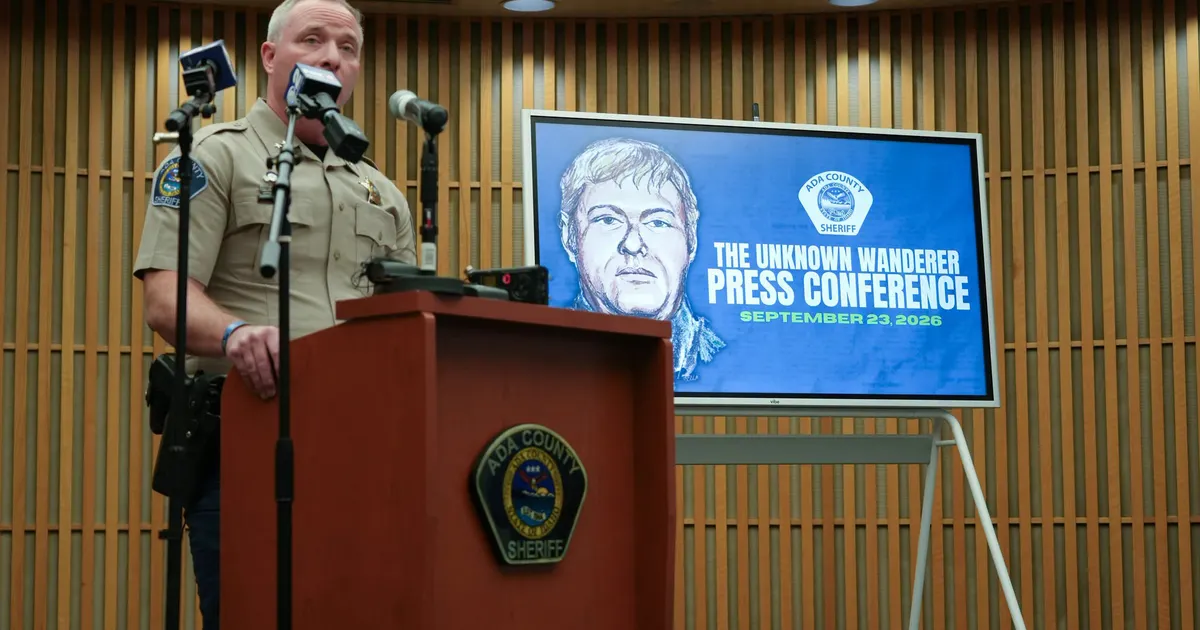
A man found dead after poisoning himself with cyanide in an Idaho church in 1982 has been identified as Dr Mathew Francis Betkouski, an organic chemist whom investigators believe may have been connected to the unsolved Chicago Tylenol murders.
The Ada County Sheriff’s Office announced the breakthrough in Boise on Wednesday, ending a 43-year mystery surrounding the man known as the “Unknown Wanderer”. However, investigators stressed that they have not formally named Betkouski as a suspect in the killings.
Betkouski was found dead on 4 December 1982 inside Sacred Heart Catholic Church. He was carrying no identification and had left a typed note using the false name William L Toomey. The Ada County coroner determined that he had died after ingesting cyanide.
His belongings included two key rings, nearly 30 keys and an envelope containing 19 $100 bills. The case attracted national attention and was later featured on the television programme Unsolved Mysteries, but the man’s identity remained unknown for decades.
Detective Tim Cooper reopened the investigation in 2019. A key found among the man’s possessions eventually led detectives to Mills Court in Jacksonville, Florida, after markings on it were traced to a local hardware shop.
Investigators examined property records connected to the street and found the name of a man who had disappeared in 1982 and was declared legally dead in 1989. A surviving brother in the Los Angeles area provided a DNA sample, which showed that he and the unidentified man shared the same father.
That evidence enabled authorities to identify the “Unknown Wanderer” as Betkouski, who had lived in five states, including Florida, New Mexico, Texas, Ohio and California.
Possible link to the Chicago Tylenol murders
Once detectives established Betkouski’s identity, they began examining whether he could have been involved in the Chicago-area poisonings that claimed the lives of seven people in September and October 1982.
The victims died after taking Extra-Strength Tylenol capsules that had been tampered with and filled with lethal cyanide. The killings triggered a nationwide panic and led to major changes in the packaging of over-the-counter medicines.
Investigators said Betkouski had worked in drugstores while at university, giving him knowledge of pharmacy operations. Former colleagues and acquaintances also described a fascination with cyanide and the idea of committing a “perfect crime”.
Detectives found cyanide in a desk linked to Betkouski. They said it appeared to have been made at home, although testing indicated that it was a different compound from the one used in the Tylenol poisonings.
Photographs showed Betkouski had visited the Chicago area before the killings, and investigators found maps and other material relating to the city. They have not, however, been able to establish that he was in the Chicago area during the crucial period when the poisonings occurred.
The Chicago Police Department has been in contact with Idaho investigators, but has not said whether it considers Betkouski a suspect. The case remains officially unsolved.
Dr Park Dietz, a forensic psychiatrist who advised investigators during the original Tylenol inquiry, said he regarded Betkouski as a viable suspect after reviewing the material gathered by the Idaho team.
“It’s an extraordinary thing to have been around at the beginning in 1982, and now today in 2026, to see very likely closure,” Dr Dietz said.
Detective Cooper said the evidence raised serious questions but acknowledged that investigators could not place Betkouski inside a Chicago pharmacy during the poisonings.
Authorities are seeking information about his movements between 15 October and 4 December 1982, as well as any suspicious cyanide deaths or medication-related cases in the states where he lived during the late 1970s and early 1980s.
“There’s still a lot of questions we don’t have answers to,” Ada County Sheriff Matt Clifford said. “This isn’t over.”
