


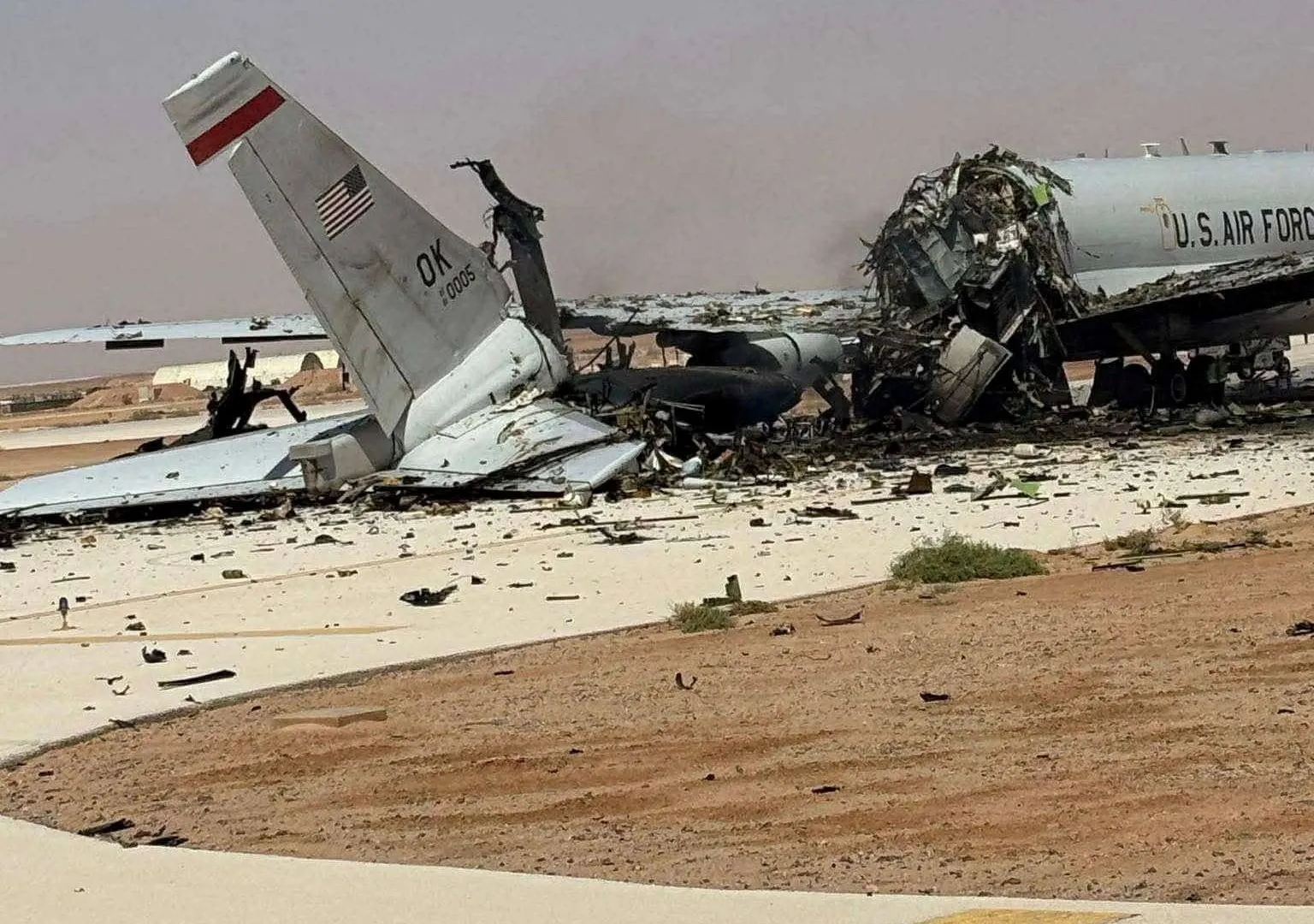
The United States lost dozens of aircraft and suffered damage to hundreds of buildings during Iranian attacks, according to a Pentagon watchdog report detailing the scale of American losses in the conflict.
The Department of Defence inspector general’s report, covering the period from February 28 to June 30, said at least 30 MQ-9 Reaper drones were destroyed. It also acknowledged shortages in US munitions and “bottlenecks” in supply chains, despite President Donald Trump’s repeated claims that American weapons stocks were effectively unlimited.
The findings provide the first official account of the damage sustained by US forces and facilities during the war, which began with US and Israeli attacks on Iran in late February. Iranian strikes targeted American bases and assets across the Gulf region, although Washington and Gulf states had generally said incoming attacks were intercepted.
Aircraft losses included fighters, tankers and drones
The report records damage to or destruction of a range of aircraft, including fighter jets, refuelling tankers, helicopters and surveillance platforms.
At least four F-15E fighter jets were destroyed. Three were shot down by friendly fire over Kuwait on March 1, while another was lost during combat over Iran in April. All the aircrews were recovered.
At least one F-35A stealth fighter was damaged by Iranian fire in March, while an A-10 ground-attack aircraft was shot down. At least one AH-64 Apache attack helicopter was also downed near the Strait of Hormuz on June 8.
Seven KC-135 aerial-refuelling tankers were damaged or destroyed. One crashed in Iraq during a refuelling mission on March 12, killing all six crew members, while five others were damaged on the ground by Iranian missiles and drones in Saudi Arabia. Another aircraft was involved in the Iraq incident and was included in the wider loss count.
An E-3 Sentry airborne early-warning aircraft was damaged on the ground at Saudi Arabia’s Prince Sultan airbase. An HH-60W helicopter was damaged during a combat search and rescue mission, while an MQ-4C Triton surveillance aircraft, valued at about 240 million dollars, crashed in April.
Four AH-6 helicopters were destroyed after being deemed unrecoverable during a rescue operation in Iran. At least one MH-60S helicopter later crashed in the Arabian Sea on July 1; three of its four crew members were wounded and rescued, while the fourth was reported missing.
The report said as many as 30 MQ-9 Reaper drones, used for surveillance, intelligence gathering and precision strikes, were destroyed. Iran has claimed further successes against US surveillance and attack drones near the Strait of Hormuz, as well as the capture of a US submersible called Dive-LD.
US casualties and damage to military bases
The Pentagon report said 11 US military personnel had been killed in action and seven had died in non-hostile events. It also recorded at least 417 military personnel wounded in Iranian attacks up to June 30.
Six personnel were killed at Kuwait’s Port Shuaiba on March 1 and another in Saudi Arabia on the same day. The report also listed three deaths at Jordan’s Muwaffaq al-Salti airbase on July 17 and one at Iraq’s Erbil airbase on July 19 in Iranian attacks.
The watchdog said hundreds of buildings and structures at US military installations in Kuwait, Bahrain, Qatar, the United Arab Emirates, Saudi Arabia, Iraq, Oman and Jordan were damaged or destroyed. It did not give a detailed breakdown of the damage.
It said establishing naval bases and support ports had presented significant difficulties during the campaign, including uncertainty over access to facilities in host countries. The report also cited extended 14- to 18-day sea transit cycles when logistical support and infrastructure were moved to Diego Garcia.
Diplomatic facilities suffered millions of dollars in damage
US diplomatic facilities in Iraq, Kuwait, Saudi Arabia and the UAE sustained damage estimated at a total of 184 million dollars, according to the report.
The State Department said the US mission in Iraq faced more than 600 attacks by the end of June, with costs reaching nearly 157 million dollars. Several buildings at the new US consulate compound in Erbil were damaged, while the embassy in Baghdad suffered lesser damage and the Baghdad Diplomatic Support Centre sustained extensive damage.
The US Embassy in Kuwait City suspended operations on March 5 because of regional tensions, attacks and damage to its facilities. The cost was estimated at nearly 14.75 million dollars.
Two Iranian drones struck the US Embassy in Riyadh on March 3, causing material damage estimated at about 11.5 million dollars. In Dubai, a utility building at the US Consulate General was damaged at a cost of nearly 120,000 dollars.
The report also estimated that ordered departures and travel restrictions in Baghdad, Jerusalem, Tel Aviv, Cairo, Amman, Kuwait City and Muscat caused construction project delays costing about 24.5 million dollars a month.
The findings contrast with Mr Trump’s assertion that the US is producing “more Exquisite and Elite Weapons than at any time in our History”. He has previously said the country has “virtually unlimited” ammunition, following reports of shortages in the US media.
