


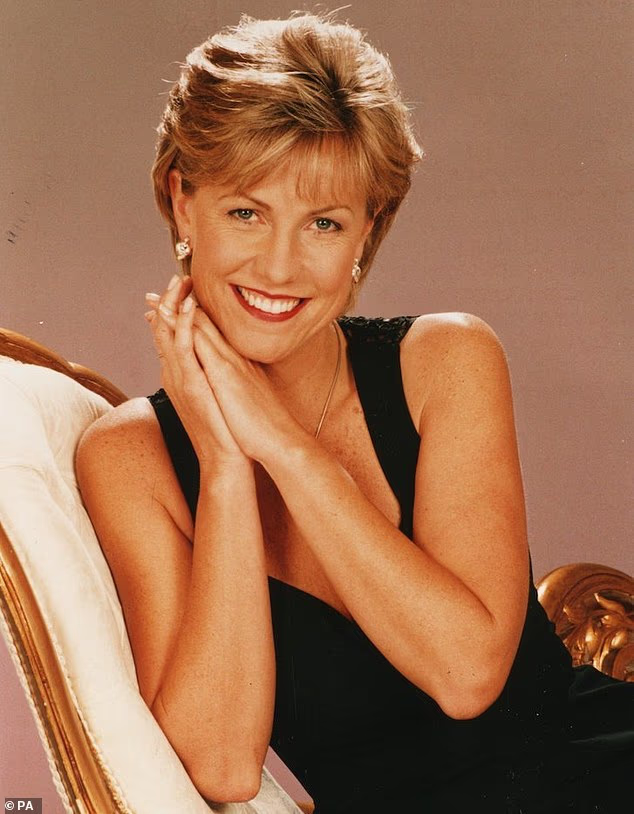
The Metropolitan Police has launched a fresh investigation into the unsolved murder of Jill Dando after advances in CCTV technology allowed officers to revisit footage of a possible suspect.
The BBC Crimewatch presenter, 37, was shot in the head on the doorstep of her home in Gowan Avenue, Fulham, in April 1999. No one has been convicted of the killing.
Investigators are re-examining original footage from Putney Bridge Tube station, about a mile from Ms Dando’s home, which showed an unidentified man known as Man X walking along the suspected escape route around 20 minutes after the shooting.
The man’s appearance has been said to bear a close resemblance to Milorad Ulemek, a Serbian assassin and former paramilitary commander who is serving a 137-year prison sentence for Yugoslav war crimes.
A Metropolitan Police spokesman said: “Recent advancements in CCTV enhancement technology have provided investigators with the opportunity to re-examine original footage from Putney Bridge train station.”
The force added that the investigation remains ongoing.
Man X footage revisited
Cold-case officers are understood to have spent 10 months locating and digitising the original footage, using modern forensic imaging technology to establish whether Ulemek was present at the station on the night of the murder.
Ulemek, 58, was first publicly linked to the case in 2024, after a facial comparison expert identified similarities between his features and those of Man X.
Police were initially told about Man X by a witness who was driving along Fulham Palace Road when Ms Dando was killed. She said she had seen a suited man “running for his life” and later selected Man X from the CCTV footage.
Her evidence was dismissed by police, who said her description did not match the man shown in the footage. A second witness later said he was “80 per cent” certain that Ulemek was the man who ran in front of his vehicle on the same road.
Ulemek, a former French Foreign Legionnaire, was a paramilitary commander whose units were implicated in atrocities during the Yugoslav wars. A court previously heard that he had been asked to murder a “leading journalist” a month before Ms Dando’s death, but said he declined because he was needed in Kosovo.
At the time of the killing, he led a squad of assassins targeting opponents of Yugoslav and Serbian politician and dictator Slobodan Milosevic.
In the weeks after Ms Dando’s death, the BBC received a call claiming she had been killed in revenge for a Nato attack on a television station in Belgrade, Serbia, in which 17 people died. Shortly before her murder, she had hosted an appeal which raised £54 million for Kosovan refugees who had fled Serbian paramilitaries during the civil war in the former Yugoslavia.
Ms Dando had previously said that her work on Crimewatch left her fearful of retaliation from criminals featured on the programme.
Barry George was tried and convicted of her murder, but was cleared on appeal in 2007. The case has long been associated with the theory that she was killed by a professional assassin.
