


Nineteen sixty six was notable for many things. England winning the World Cup. The birth of your favourite columnist.
Our most appalling post-war disaster, the tragedy of Aberfan; and the debut of Star Trek.
But sixty years ago also saw Camberwick Green. A stop-motion animation for small children from the inspired Gordon Murray, the first in a trilogy of similar series set in the fictitious Trumptonshire.
Trumpton followed in 1967; Chigley in 1969. All were painstakingly made on modest budgets – heads crafted from pingpong balls; clothing from foam latex – had their own regular songs and rituals and were narrated by kindly Brian Cant .
At the inspired insistence of Mr Murray’s colleagues, Bura and Hardwick, the shows were filmed not just in black and white but in colour and when colour television was not in 1966 even a thing.
It only began, for just five hours a week, with the Wimbledon Championships in 1967 and a full service wasn’t laid on till 1969. But it accordingly granted the little people of Trumptonshire, from Windy Miller to Lord Belborough’s loping butler to gossipy Mrs Honeyman, very long broadcast careers.
Windy Miller became a children’s TV favourite

Gordon Murray created Camberwick Green

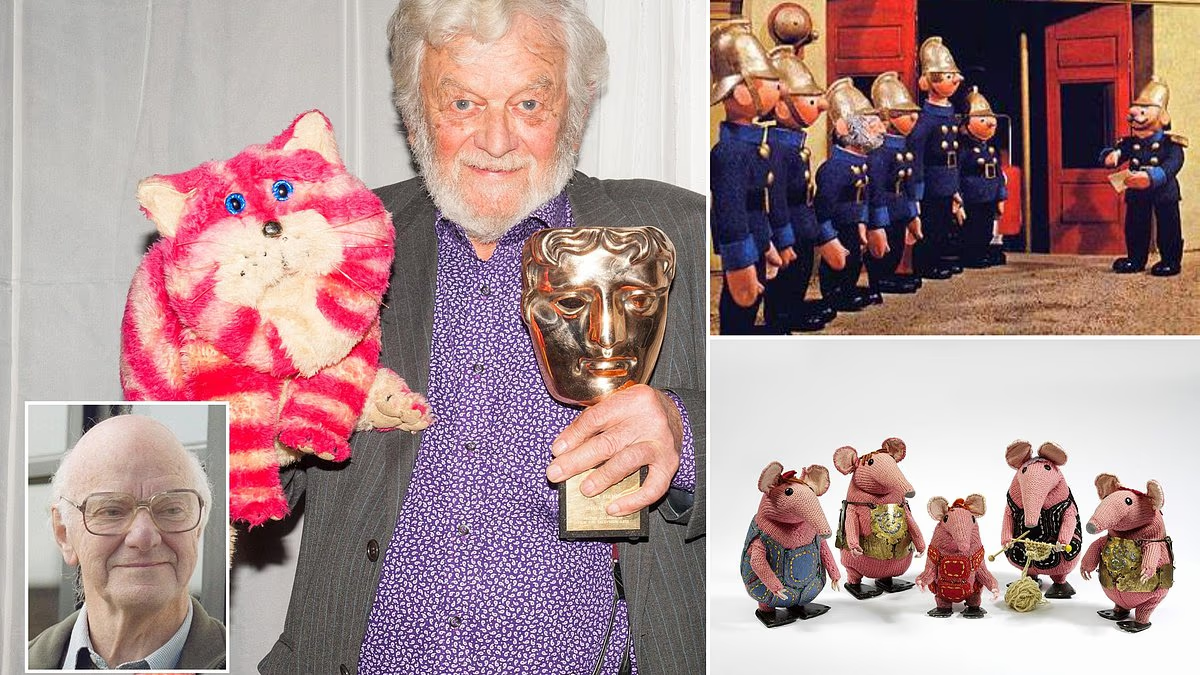
The Trumpton fire brigade from Camberwick Green
As late as 2000 Camberwick Green and the rest were still airing on terrestrial television: tales set in a gently idealised England, just before the Great War, and with much reassuring repetition.
Anyone over 40 can still name the Trumpton fire brigade. How time flies by when you’re the driver of a train, and ride on the footplate there and back again.
Remember the biscuit-factory whistle, the dances that concluded every episode of Chigley or the town band – said firemen: Pugh, Pugh, Barney McGrew, Cuthbert, Dibble and Grubb – signing off every outing of Trumpton.
It was a modest but glorious golden age of children’s broadcasting, as old-fashioned be-stringed marionettes like Muffin the Mule were set aside for the persuasive stop-motion order.
Very different to the frenetic matiness that later characterised many shows for children, from The Multi-Coloured Swapshop to Tiswas… or the earnest, preachy tick-box approach to ‘issues’ that would make later Grange Hill and, from the start, Byker Grove such a trial.
Far less such dubbed, faintly weird imports as White Horses, or the nightmarish The Singing Ringing Tree. (You can never forget that fish.)
Not that this was a field Gordon Murray was allowed to have to himself. Swinging in from their studio – a repurposed cowshed near Canterbury – came Oliver Postgate and Peter Firmin. Firmin was the designer – sets, characters, backdrops; Mr Postgate the scriptwriter and narrator.
A bassoonist, Vernon Elliott, provided a minimalist soundtrack. Not all the Postgate/Firmin shows were hits: Alexander the Mouse, The Journey of Master Ho, Pogle’s Wood and Pingwings are little remembered now.
What made the duo’s name was just four enduring classics. Ivor the Engine (1959-1964) was such a hit – about a little Welsh locomotive that dreamed of joining a male-voice choir – that, a decade later, the BBC insisted Mr Postgate and Mr Firmin remake it in colour.
Then there was the delightful Norse saga Noggin the Nog, inspired by the Lewis chessmen and to Elliot’s sweetly lugubrious music.
‘In the lands of the North, where the Black Rocks stand guard against the cold sea, in the dark night that is very long, the Men of the Northlands sit by their great log fires and they tell a tale … and those tales they tell are the stories of a kind and wise king and his people; they are the Sagas of Noggin the Nog…’
This too, in the Eighties, would be reprised in colour. But by then we had been enchanted, too, by The Clangers (1969-72) and, finally, the glory that is Bagpuss (1974.)
Happy accidents tended to befall Mr Postgate and Mr Firmin and Bagpuss was one of them. He had been conceived as a marmalade cat, but something went wrong with the chemicals and the cloth delivered was improbably striped in pink and white.

Artist and puppet maker Peter Firmin, the creator of Bagpuss

The Clangers were another children’s favourite
The auteurs exchanged glances and decided they’d swing with it.
Many still think, though, The Clangers their supreme achievement – the first show they shot in colour, pegged to the Apollo moon-landings then entrancing the world. Gentle mouse-like creatures who live on a moon, clang dustbin-lids atop their burrows – hence the name – and live on green soup (furnished by the Soup Dragon, from volcanic wells) and blue string pudding.
While Mr Postgate did actually write a script for the little things, in an inspired touch they were never actually voiced. Instead, they whistled to the precise rhythm of the text.
If you listen closely, as Mr Postgate later chortled, there are many Swannee whistle moments when some Clangers are ‘swearing their little heads off’.
What he had never anticipated was the sheer power of suspension of disbelief. Screening a few episodes at a later international conference, folk from the Federal Republic were enchanted: how ever did the Clangers speak such excellent German?
‘That is not so,’ intoned someone sternly from the Scandinavian seats. ‘They spoke only Swedish.’
There are of course other delights in the Watch With Mother pantheon from this era – Captain Pugwash, Sir Prancelot, Tales From The Riverbank and the eerily gentle world of Mr Benn among them.
Not to mention Roobarb – bouncing around with Custard the cat in episodes of such surreal titles as ‘When Roobarb Was Bored, Then Not Being Bored.’
Or the quiet insanity of The Magic Roundabout, a French import revoiced by Eric Thompson and buddies to a completely different script and for very different characters. To this day, I have never figured out if Dougal is a Highland cow or just a very shaggy dog.
The striking thing about most of this is how little there was. There were only ever 13 episodes of Camberwick Green. Ditto for Bagpuss; and Mary, Mungo and Midge. And yet these worlds and their personalities enchant us still – the creations of men who believed fiercely in the true magic of childhood.
‘I am very upset, because I’m an old man now, at the short length of childhood that children have,’ mused Gordon Murray.
‘They don’t have childhood for long and I think that’s a wicked shame, because childhood is the most marvellous thing you’ve got to remember for the rest of your life.’
And a headmistress all but boxed Oliver Postgate’s ears when he turned up at her school with two Bagpusses. ‘Quickly – hide that one. Back in your car, now – as far as the children are concerned, there’s only one Bagpuss…’
Voted by viewers, in 1999, as the best children’s television ever made.
A saggy old cloth cat, baggy, and a bit loose at the seams – but Emily loved him.
