


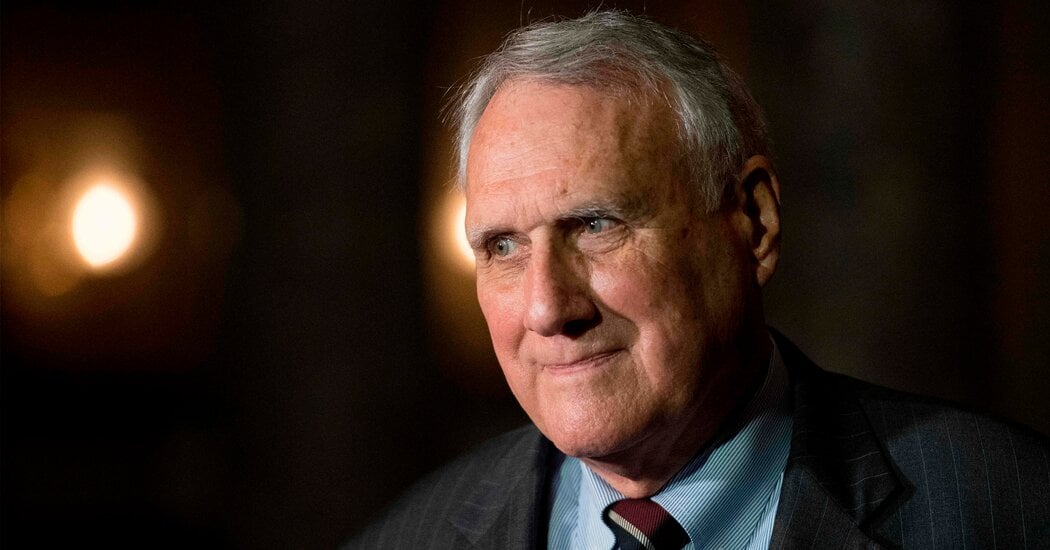
Jon Kyl, the former Republican congressman and senator from Arizona, has died aged 84 at his home in Phoenix, his son said.
His family said he died on Thursday from complications related to a neurological disease. Mr Kyl announced in December 2025 that he had been diagnosed with dementia.
During 26 years on Capitol Hill, Mr Kyl became known as a discreet but influential policy expert and political operator. He served four terms in the House of Representatives before winning election to the Senate in 1994.
He eventually became the Republican whip behind the party’s minority leader, Mitch McConnell, and held a succession of leadership positions that gave him considerable influence over the Senate’s legislative agenda.
Jon Kyl’s influence in the Senate
Mr Kyl rarely sought the spotlight, but his grasp of policy and ability to manage lawmakers made him a significant figure within the Republican caucus. Time magazine described him in 2006 as “the Operator” and one of the 10 best serving senators.
“You can accomplish a lot if you’re not necessarily out in front on everything,” he said at the time.
He was widely regarded as well informed on a broad range of issues, including arms control, immigration and water rights – a particularly important subject in drought-prone Arizona. His staff admired his work ethic, although some found it difficult to keep pace with him.
Ron Bonjean, a Republican strategist who served as chief of staff to the Senate Republican Caucus under Mr Kyl, said: “He was one of the fastest walkers I’ve ever known. He was just intensely focused. He had a sense of urgency.”
Although firmly conservative, Mr Kyl was prepared to negotiate. He helped secure Democratic support for a partial extension of the Bush-era tax cuts in 2013 and played a central role in a broader immigration reform effort in 2007.
The immigration proposal included a path to citizenship for millions of undocumented migrants, drawing fierce criticism from conservative Republicans. Mr Kyl had a lifetime voting score of 96.6 from the American Conservative Union, but argued that his responsibility was to achieve the best practical result rather than follow ideology rigidly.
“I would have rather ended my political career with people saying, ‘Throughout his political career, he was recognized as one of the top reasonable spokesmen for conservatism in this country,’” he said in 2007.
His behind-the-scenes influence was sometimes the subject of speculation. He was rumoured to have helped derail the 2005 Supreme Court nomination of Harriet Miers, then White House counsel, although his precise role was never established.
A contrast with John McCain
Mr Kyl’s political career unfolded in the shadow of John McCain, the prominent Arizona Republican senator and presidential candidate. The two men differed sharply in style: Mr McCain was a nationally recognised maverick, while Mr Kyl was a low-profile party operator.
They nevertheless developed a working relationship. Mr McCain used his appeal across party lines to assist Mr Kyl during his difficult 2006 re-election campaign, while Mr Kyl defended Mr McCain’s conservative credentials during his unsuccessful 2008 presidential bid.
Mr Kyl announced in 2011 that he would not seek a fourth Senate term. “I think it’s better to leave when people have a very good attitude about you, rather than be hounded out of office like so many,” he said.
He added: “There is more to life than being in the United States Senate. Some people stay too long and there are other things to do in life.”
After leaving the Senate, Mr Kyl became a lobbyist for the Washington law firm Covington & Burling. He returned briefly to the political stage in 2018 as the Senate guide for Brett Kavanaugh during his nomination to the Supreme Court.
Following Mr McCain’s death in August 2018, Arizona’s Republican governor, Doug Ducey, appointed Mr Kyl to fill his former colleague’s Senate seat. He said the arrangement would be temporary and left the chamber again in early 2019.
In a 2018 interview, Mr Kyl criticised Donald Trump’s manner, saying: “I don’t like his style. I think it is boorish. I think he’s his own worst enemy.” He said the then president could be more effective if he were “more politic, more diplomatic”, while acknowledging that some people valued his lack of restraint.
John Llewellyn Kyl was born on April 25, 1942, in Oakland, Nebraska. His father, Henry Kyl, was an English teacher who later joined the family clothing business, worked as a television journalist and served in the House of Representatives from 1967 to 1973.
Mr Kyl studied political science at the University of Arizona, graduating in 1964, and received a law degree from the university in 1966. He worked for a Phoenix law firm before winning his first House election in 1986.
He went on to win most of his House and Senate races comfortably. In his 2000 Senate re-election campaign, he faced no major-party opponent, while in 2006 he defeated a strong Democratic challenger by nine points.
Mr Kyl is survived by his wife, Caryll Collins; their children, John Kyl and Kristine Kyl Gavin; and four grandchildren.
