


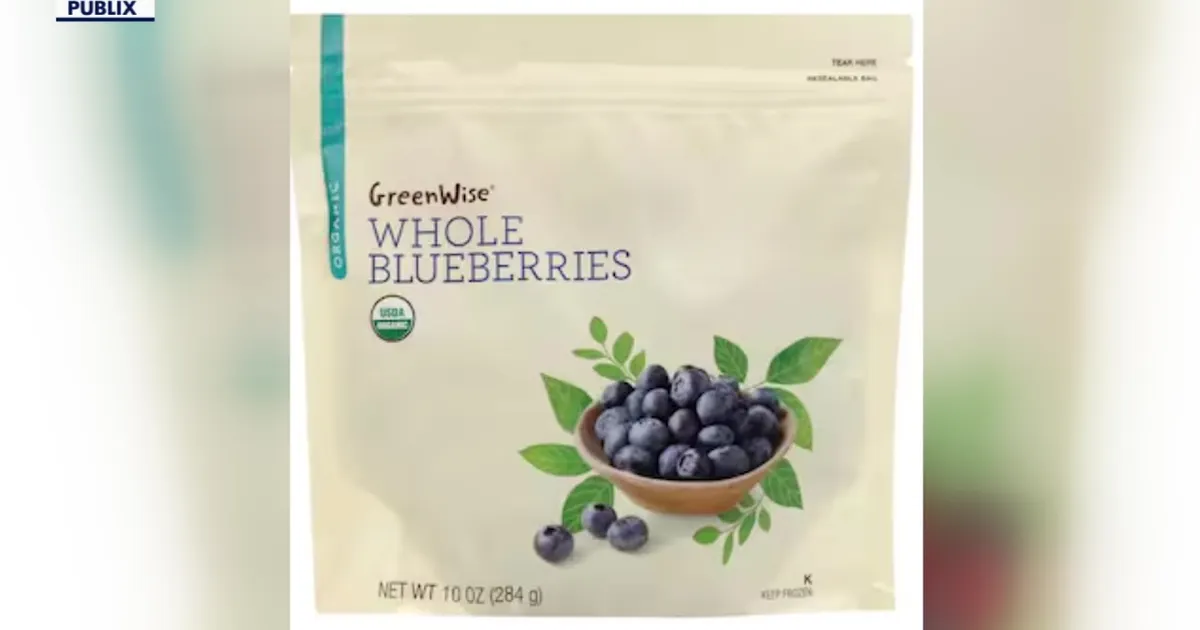
A Florida family is suing supermarket chain Publix and distributor Quirch Foods, alleging that contaminated frozen blueberries bought in Largo caused the death of a 74-year-old woman and left her son in hospital.
The wrongful-death claim says Karla Mullins became ill after eating GreenWise Organic frozen blueberries purchased from a Publix store on Ulmerton Road. Her son, Spencer Mullins, is also said to have eaten the berries before developing symptoms and requiring hospital treatment.
The complaint, filed in Pinellas County Circuit Court, alleges that Karla Mullins died on 20 June after falling ill. Her husband, Richard Mullins, and their son are seeking damages from Publix and Quirch Foods.
The lawsuit says the berries were contaminated with E. coli O145:H28, a Shiga toxin-producing strain that can cause severe stomach cramps, diarrhoea and vomiting. It describes Publix, which sold the GreenWise product, and Quirch Foods, identified as an intermediate distributor, as responsible for supplying an allegedly defective and unreasonably dangerous product.
In a statement issued through the family’s lawyers, Morgan & Morgan said: “This family lost a treasured mother and wife because a product that was supposed to be safe was contaminated with a dangerous and deadly pathogen. Karla Mullins should be alive today. We intend to hold Publix and Quirch Foods fully accountable for the role they played in putting this product on store shelves and into the hands of unsuspecting customers.”
Representatives for Publix, Quirch Foods and Morgan & Morgan did not immediately respond to requests for comment.
The case follows a recall linked to a multistate E. coli outbreak. Chilean supplier Frutas y Hortalizas del Sur S.A. recalled one lot of GreenWise Organic frozen blueberries on 3 July, before Publix widened the recall on 29 July to include all lots of its Organic Whole Blueberries and Whole Mixed Berries.
The recalled products were distributed to Publix stores in Alabama, Florida, Georgia, Kentucky, North Carolina, South Carolina, Tennessee and Virginia. The US Food and Drug Administration said the products should no longer be available for sale, but warned that some packets have use-by dates extending into 2028.
In its final update on 21 September, the FDA said the outbreak investigation had ended after 17 infections were reported in Florida and Georgia, with six hospitalisations. No deaths were included in the official outbreak count. Consumers have been advised not to eat any recalled berries and to discard them or return them to the shop where they were bought.
