


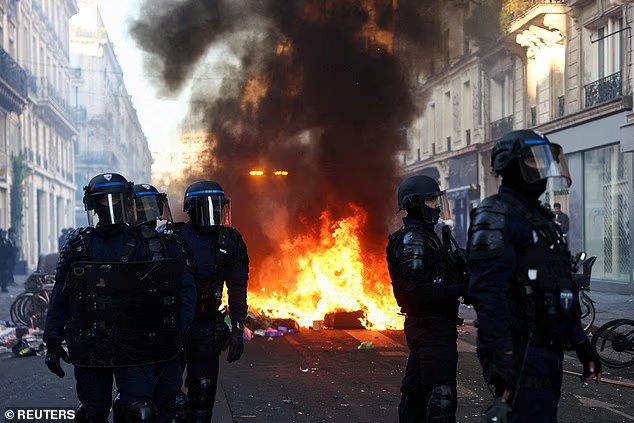
Students and workers are being urged to join a planned “International Youth Day of Action” in Britain, with demonstrations advertised in London and several other cities following violent protests in France.
The event is due to take place on Friday November 20, with a central gathering at Trafalgar Square and further protests planned in Manchester, Liverpool, Bristol, Leicester and other towns and cities.
Socialist and anti-war organisations, pro-Palestinian groups and anarchists are encouraging university students to walk out of lessons for what organisers are calling a “youth strike”. They say the protests will demand increased spending on jobs and education, an end to defence funding, support for Palestine and opposition to Israel.
The campaign is being coordinated with demonstrations elsewhere in Europe. A post promoting the action calls on students and workers to “rise against imperialism, capitalism, authoritarianism and the far right across all our governments internationally”.
The protest has been backed by SOAS Liberated Zone, described as the UK’s longest-running pro-Palestinian student encampment at the School of Oriental and African Studies in London, among others.
Chris Philp, the shadow home secretary, said the violence and looting seen in France and elsewhere in Europe was “deeply shocking”.
“The Conservative Party supports the right to free speech and peaceful protest,” he said. “However, any attempt by extreme left-wing groups to replicate this chaos in Britain should be met with the full force of the law.
“They cannot be allowed to unleash anarchy, riots and chaos here.”
Mr Philp also claimed there were 6,500 fewer frontline officers under the Labour Government, saying police were being left without the resources needed to fight crime and protect the public.
A social media user responding to the London protest wrote: “The Met ain’t got the balls to get as violent as the stormtroopers in Paris.”
A spokesman for Prime Minister Andy Burnham said police had the powers and resources required to protect communities and keep the public safe.
“Clearly, the violence we’re seeing on the streets of France is unacceptable,” he said. “And while the power to protest is at the heart of democracy, this can never excuse violence.”
Reform UK policing and crime adviser Colin Sutton said the Metropolitan Police should take a “firm, no-nonsense approach” to any disorder, adding that anyone breaking the law should face the consequences.
The unrest in France began with student demonstrations over school conditions before escalating into clashes with police, destruction and looting. At least 2,400 people were arrested and at least 3,000 businesses were damaged or looted, while more than 500,000 people took part in protests across the country.
Fires were set to rubbish bins, bicycles and other objects in Paris, Lyon, Marseille and other cities. A group of individuals also forced entry into the 19th-century city hall in Limoges, where a fire caused the roof to collapse.
French interior minister Laurent Nunez offered his resignation after acknowledging that authorities had “lost control” in some major cities, but President Emmanuel Macron refused it. Mr Macron instructed him to introduce new policing tactics and ensure transparency over alleged failures in planning and intelligence-gathering.
