


The Northern Sea Route is emerging as a new arena for trade, military rivalry and strategic competition, as melting Arctic ice allows commercial vessels to travel earlier in the year while Donald Trump seeks greater American control over Greenland.
The developments point to a profound shift in the High North, with Russia, China, the United States and Nato positioning themselves around shipping lanes that could reshape global trade and national security.
In May, the liquefied natural gas carrier Christophe de Margerie left Utrenneye, a remote port on Siberia’s Kara Sea coast. The 299-metre vessel, capable of carrying more than 170,000 cubic metres of gas, travelled east under escort from a Russian nuclear-powered icebreaker.
After passing through the Bering Strait on June 8, it continued to a floating storage unit off the Kamchatka peninsula to unload its cargo, almost certainly for onward delivery to China.
The voyage was significant because it was the earliest known passage by a commercial vessel along the Northern Sea Route. Until June, ice would normally be considered too thick for such a journey.
The Christophe de Margerie is designed for the conditions. Its reinforced double hull and three independently rotating propulsion units allow it to break through ice more than two metres thick, opening access to terminals that conventional carriers cannot reach for much of the year.
Its passage came as the effects of a warming climate began to alter not only Arctic conditions but also the strategic geography of the world’s shipping routes.
The Northern Sea Route and the race for Arctic influence
For centuries, sailors searched for a shorter route between Europe and Asia. Attempts to navigate the passage were repeatedly defeated by ice, with Willem Barents reaching Novaya Zemlya in 1596 before his ship was crushed during the winter.
The first successful transit came in the 1870s, when Erik Nordenskjold’s vessel, the Vega, survived almost 11 months trapped in ice before continuing through the Bering Strait to Yokohama.
Modern icebreaking technology has made such voyages more feasible, while warmer conditions have left the ice thinner and more fragmented. The UN’s Intergovernmental Panel on Climate Change has suggested that the Arctic Ocean could experience its first practically ice-free summer by 2050, although one study cited in the source material places the possibility as early as the 2030s.
The commercial attraction is clear. A journey from Shanghai to Felixstowe via the Suez Canal currently covers about 11,000 miles and takes 35 days. Last year, the Spirit of Istanbul travelled from Ningbo to Felixstowe in 21 days using a northern route that was almost 30 per cent shorter.
Only about 100 vessels were reported to have used the Northern Sea Route last year, but the number is expected to increase. Shorter journeys could reduce fuel use, speed up deliveries and lower costs, while offering an alternative to established maritime chokepoints.
The vulnerability of those routes has been underlined by attacks and threats against commercial shipping in the Red Sea by the Iran-aligned Houthis. Shipping companies have avoided the area, pushing up insurance costs, while the Strait of Hormuz has also been described as effectively closed following US attacks on Iran in February.
China has spent more than two decades building its influence in the polar regions. In 2005, polar scientist Yang Huigen said the country should aspire to become a “polar great power”, while President Xi Jinping has repeatedly highlighted the importance of Arctic and Antarctic capabilities.
China has described the polar regions, the seabed and outer space as “strategic frontiers”. In 2018, it declared itself a “near-Arctic state”, despite the northernmost part of the country being almost 1,000 miles south of the Arctic Circle.
The designation reflected Beijing’s desire to take part in decisions and international agreements affecting its economic growth, political stability and military posture. Around half of the Northern Sea Route transits last year either began or ended in China, while Chinese investment supports Russian energy projects.
Greenland and the return of Arctic military rivalry
Trump’s agreement with Denmark has added a further dimension to the contest. The deal apparently gives the United States total responsibility for Greenland’s security and allows it to build military bases there “as needed”, according to Fox News.
Danish commentators have pointed out that Washington has long enjoyed extensive military freedom on the island. Nevertheless, Trump’s interest in Greenland reflects its growing importance as Arctic trade routes open and military activity increases.
The United States already operates the Pituffik Space Base and could seek to revive several abandoned Second World War bases to strengthen missile warning, space surveillance and satellite capabilities. Denmark blocked a Chinese company’s attempt to buy the former base at Gronnedal in 2016 on security grounds.
Russia has also spent years reopening, modernising and fortifying bases along its 15,000-mile Arctic coastline. Twelve of its nuclear-armed submarines operate at the western and eastern ends of the Northern Sea Route, with six based on the Kola Peninsula and six belonging to the Pacific Fleet at Vilyuchinsk on the Kamchatka Peninsula.
The Royal Navy has responded with Atlantic Bastion, a programme combining warships, patrol aircraft, autonomous vessels and underwater sensors to track Russian submarines across the North Atlantic. The First Sea Lord, Sir Gwyn Jenkins, has warned that Russian activity in UK waters is more serious than at any point since 1989, particularly in the North Atlantic and High North.
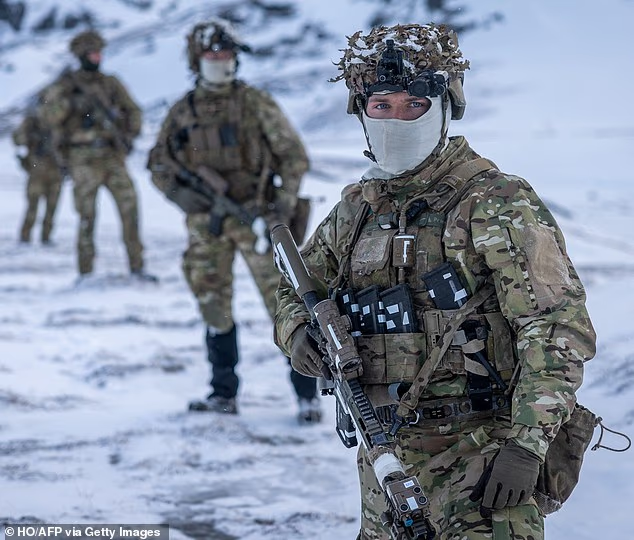
American forces in the region include about 22,000 personnel spread across eight bases on Alaska’s northern shore. Nato also maintains a presence on Canada’s Arctic islands and along Norway’s northern coast, where there are air, naval and army bases, including facilities for F-35 fighter jets.
Britain’s main foothold is Camp Viking, a hub for the Commando Force led by the Royal Marines. The force aims to maintain a year-round presence in the region.
Russia has traditionally been cautious about allowing China too close to its Arctic policy, despite joint exercises and growing cooperation. But Moscow’s increasing isolation from the West has brought the two countries closer together, raising the possibility of a more tightly contested Arctic as the Northern Sea Route becomes more important to world trade.
