


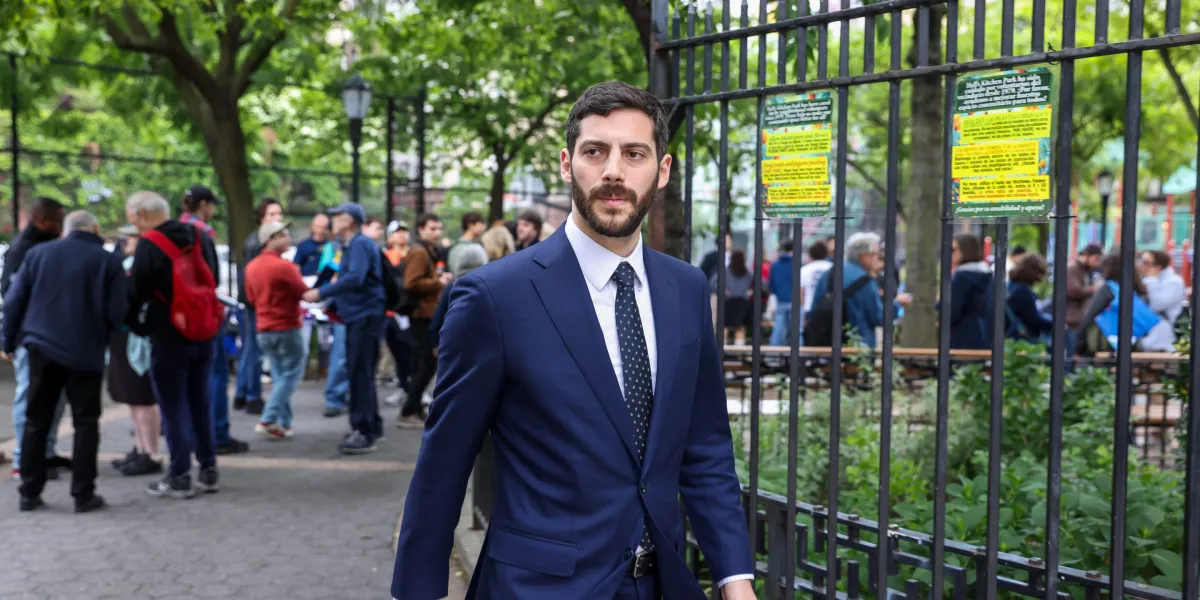
Former New York state Assemblymember Alex Bores has launched a $10 million nonprofit aimed at helping Democrats develop a united approach to artificial intelligence regulation after he was defeated in a congressional primary marked by more than $40 million in outside spending.
Who Decides, founded with Bores’s former chief of staff Anna Myers, plans to raise a further $20 million in 2027 ahead of the 2028 elections. The organisation will work with existing AI advocacy groups in 11 battleground states rather than impose a single platform on them.
Bores said the group would seek to establish “a shared floor of an agenda on things that we all want to see good done”, while allowing the organisations involved to develop their own priorities.
“Give the American people a say in how AI develops,” he said, arguing that voters had established views on issues such as Medicare and the Green New Deal but that public debate over AI remained unsettled.
“We’re in this limited time where it’s not even just the answers that are up for grabs, but even the questions that are being asked are up for grabs,” he said.
Bores co-authored New York’s RAISE Act, a frontier AI safety law signed by Governor Kathy Hochul late last year. He ran for the open congressional seat of Representative Jerry Nadler on a platform that included the legislation, despite receiving donations from people in the AI industry.
His campaign was opposed by Leading the Future, a super PAC partly funded by OpenAI president Greg Brockman and venture capital firm Andreessen Horowitz, which spent more than $7.6 million against him. Public First Action, funded with $20 million from Anthropic, spent on Bores’s side.
Bores nevertheless lost the primary, which became the most expensive House primary of the cycle. The contest attracted more than $40 million in outside spending.
Building support for AI regulation
Who Decides is intended to connect organisations that already have influence among Democratic voters and help them campaign on AI policy. Bores said the group was not trying to match the spending power of major pro-industry political groups, including Leading the Future and Build American AI.
Its outreach accelerated after Jacob Coxon resigned from Anthropic last week. Bores said seven major presidential candidates had made contact since his election campaign and that 16 members of Congress had reached out since Coxon’s resignation. So far, those contacts have all come from Democrats, although he said the organisation was open to people of any political outlook.
Bores said support for stronger AI regulation crossed party lines. While he put the figure at 80 per cent, an Annenberg Public Policy Center survey conducted in February and March found that 65 per cent of Americans believed the Government had done too little to regulate AI. That included 77 per cent of Democrats, 72 per cent of independents and 53 per cent of Republicans.
He compared the issue with gun legislation, where broad public support for tighter rules has not consistently translated into congressional action. In his view, AI policy risked following the same pattern, with a diffuse majority facing more concentrated political spending.
The industry’s position has also shifted. OpenAI chief executive Sam Altman called for regulation during Senate testimony in May 2023, but told the Senate Commerce Committee two years later that requiring government approval would be “disastrous”. Anthropic chief executive Dario Amodei has maintained a pro-regulation position, while money linked to the company has entered political contests over AI policy.
Bores said a small group of wealthy donors was driving opposition to regulation, naming Marc Andreessen and Elon Musk as examples of Republican mega-donors who favour no regulation of AI.
He described the RAISE Act as “arguably still” the strongest AI safety law in the United States, although third-party audits and whistleblower protections were removed before it passed. He expects Illinois and Massachusetts to adopt stronger measures soon.
Warning over federal AI legislation
Bores also criticised attempts in Washington to restrict states’ ability to legislate on AI. In 2025, Senator Ted Cruz included provisions in the “One Big Beautiful Bill” that would have prevented states from enforcing AI laws for 10 years. Seventeen Republican governors opposed the measure, and the Senate later voted 99–1 to remove it.
Cruz is now backing a federal AI safety bill with Senator Amy Klobuchar and Majority Leader John Thune, covering safety testing and incident reporting. Bores said the proposal could use the current focus on AI safety to undermine state-level regulation.
He also warned Democrats against allowing disagreements between sympathetic advocacy groups to overwhelm their shared objectives.
“Democrats are very passionate about making a difference, and that passion is usually well placed,” he said, but added that it could become “a circular firing squad” in which groups argued that their own sub-issue mattered more than another’s.
“The people who are opposing almost every issue in AI are the same people… we should be sitting at the same table,” Bores said.
