


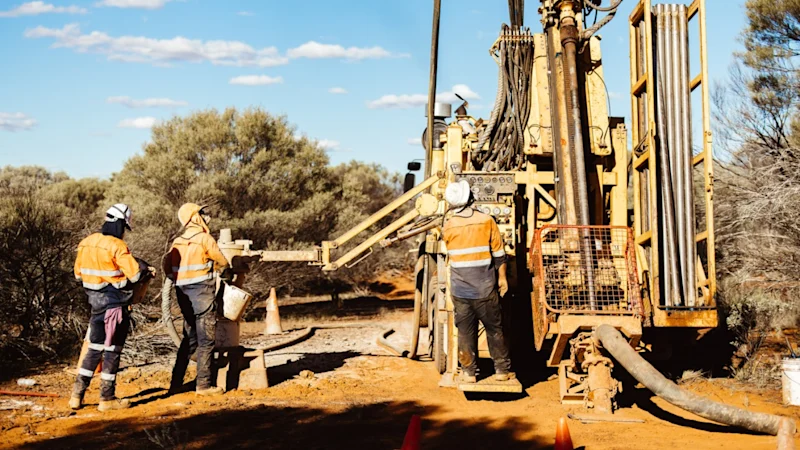
Platina Resources is concentrating its exploration strategy on Western Australian gold after three years of reshaping its portfolio, with early drilling results at Sunrise Bore strengthening the junior miner’s focus on the Laverton district.
The company has moved away from its former scandium ambitions and is now prioritising Sunrise Bore, Mt McKenna and Mt Morgans South, while reducing spending on assets that have failed to deliver sufficiently compelling exploration results.
Platina received a significant cash injection in 2023 when it sold its namesake scandium project in New South Wales to Rio Tinto for up to US$14 million, equivalent to A$19.7 million. A$18.3 million has been received, with a further A$2.8 million potentially due later this year under a timing condition linked to the granting of the project’s mining licence, now known as Burra.
The proceeds have helped fund the company’s gold exploration without repeated equity raisings. Platina entered 2026 with A$11.4 million in cash and held A$8.6 million at the end of June, despite increasing drilling activity and completing several acquisitions.
Sunrise Bore drilling gives Platina an early lift
Sunrise Bore, 44km south of Laverton, became the immediate focus after Platina completed a largely scrip-based A$1.15 million acquisition of the 11.59-square-kilometre project from Bravo Minerals in June.
An initial 23-hole, 2,863-metre reverse circulation programme produced an intersection of 29 metres at 3.38 grams of gold per tonne from 11 metres, including 11 metres at 8.62 grams per tonne. Other results included 18 metres at 1.12 grams per tonne and 37 metres at 0.43 grams per tonne.
The project sits within the Laverton greenstone belt, close to AngloGold Ashanti’s Sunrise Dam operation and Gold Fields’ Granny Smith mine. Historical deposits in the surrounding area include Keringal, Golden Delicious and Jubilee.
Platina’s interpretation suggests the mineralised zone at Sunrise Bore is about 80 metres thick and remains open down-dip. A simple weighted average of current and historical drilling through the central area returned 0.5 grams of gold per tonne.
The strongest recent grades were found mainly in oxide material, raising the possibility that supergene enrichment may be masking a larger fresh-rock system beneath it. Drilling into that deeper material is therefore a priority.
Only 200 metres of a historically identified 1.2km mineralised trend was covered by the latest campaign. That trend forms part of a wider 3.6km structural corridor, leaving substantial ground still to be tested.
Historical drilling included 78 metres at 1.17 grams per tonne, with a 38-metre section grading 2.13 grams per tonne. Another hole returned 20 metres at 2.77 grams per tonne, including 10 metres at 5.31 grams per tonne.
Mt McKenna adds a second Laverton target
Platina’s 174-square-kilometre Mt McKenna project lies 13km east of Laverton and 20km north-east of Granny Smith. It was acquired last September through the purchase of Jasper Exploration for A$320,000 in cash, 20 million Platina shares and a 1.5 per cent net smelter royalty.
The company has since completed extensive air core drilling. A 2025 programme of 26 holes covering 6,000 metres was followed by 220 holes over more than 10,800 metres this year.
At the Granite Well East prospect, the work outlined a mineralised corridor extending for about 1km. Results included 1 metre at 7.1 grams per tonne from 40 metres and 4 metres at 1.11 grams per tonne from 12 metres.
Drilling at the Black Rock and Granite Hill prospects produced a 4-metre intersection grading 4.69 grams per tonne from 16 metres. Gold and arsenic anomalies also point to a north-north-east structure that may extend for more than 800 metres.
Several holes ended at, or close to, the top of fresh rock, prompting Platina to plan deeper reverse circulation drilling. The company has received A$109,200 through the Western Australian Government’s Co-funded Exploration Drilling Programme to support a 13-hole programme at Black Rock and Granite Hill later this year.
Mt Morgans South, a 126.4-square-kilometre project 35km south-west of Laverton, is the newest addition to the company’s core gold portfolio. Platina acquired the 18 tenements from Genesis Minerals for A$100,000 in cash and five million shares, with a further A$550,000 payable if a JORC resource of at least 200,000 ounces is defined.
The project includes part of the regional Celia fault and is close to the Mt Morgans operations and Westralia deposit, which contains more than 1.4 million ounces of gold. The nearby Jupiter deposit contains a further 740,000 ounces.
Platina is still reviewing historical exploration data and carrying out soil sampling at Mt Morgans South before defining drilling targets. A heritage agreement must also be completed.
Portfolio narrowed as gold focus takes shape
The Laverton assets form part of a wider effort to concentrate spending on projects that offer the strongest potential. Platina sold its Xanadu project in the Ashburton region to Kalamazoo Resources after follow-up results disappointed, while retaining a 1 per cent royalty and the possibility of a A$500,000 milestone payment.
The Challa project near Sandstone was relinquished when further work did not justify continued expenditure. At Brimstone, 40km north-east of Kalgoorlie, Platina has instead retained exposure through an agreement allowing NE Minerals to earn an 80 per cent interest by funding exploration, evaluation and development through to a decision to mine.
The company’s other projects include Beete near Norseman, where selected zones and the historic 24.8-gram-per-tonne Beete mine are planned targets for reverse circulation drilling, subject to native title requirements. Jubilee, 15km east of Meekatharra, remains subject to heritage negotiations before its tenement application can progress.
Dr Paul Polito became managing director in July, succeeding Corey Nolan, who oversaw much of the company’s portfolio restructuring and its move into the Laverton region.
Polito has more than 30 years of experience spanning exploration, geoscience, mine geology and development, including senior positions with IGO and Anglo-American Exploration. His task is to establish whether the projects retained by Platina can support discoveries on a larger scale.
With Sunrise Bore delivering strong initial intersections, Mt McKenna generating targets for deeper testing and Mt Morgans South broadening its Laverton footprint, Platina is now relying on further drilling to convert its streamlined portfolio and financial backing into a substantial gold discovery.
