


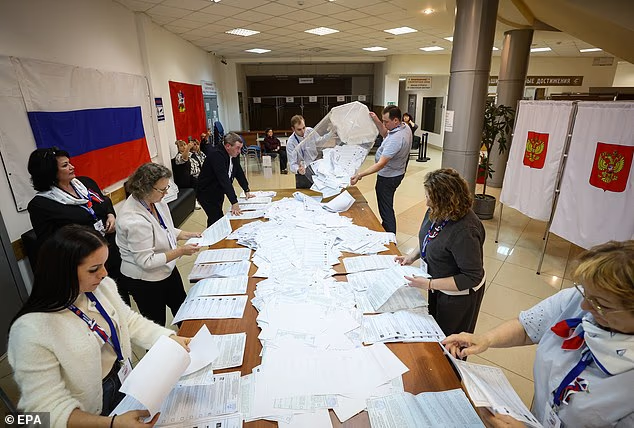
Russia’s ruling United Russia party is projected to win a decisive victory in the country’s first wartime parliamentary elections, in a result widely regarded as a sham.
Exit polls put the pro-war party on around 58 per cent of the vote, well ahead of its closest rival, the Communist Party, which is forecast to receive about 14 per cent.
Voting for the State Duma, Russia’s parliament, took place over three days and closed on Sunday with turnout reported at 56 per cent among an electorate of 111 million.
Vladimir Putin was not a candidate because the election was not for the presidency. Although he is not a member of United Russia, he led the party between 2008 and 2012.
The outcome had been widely expected, with the Kremlin maintaining tight control over the electoral process. Russian elections have faced allegations of corruption for decades, and claims of malpractice again emerged during this vote.
Some ballots were reportedly pre-marked in favour of United Russia, while there were also allegations of ballot stuffing, in which a voter casts more than one paper.
Credible opposition to the Kremlin is largely absent. Critics of the regime have been barred from standing, jailed or forced into exile, particularly when they have begun to attract political support.
Human rights groups estimate that more than 2,000 people are currently imprisoned in Russia for political reasons.
The only openly anti-war party, Yabloko, was prohibited from standing as a nationwide party. Some of its candidates were nevertheless permitted to contest individual constituencies.
Ukraine drone attack coincides with Russian election
The vote took place as Ukraine launched its largest attack on Moscow since the war began, with more than 1,000 drones fired into Russia and an unprecedented number directed at the capital.
Moscow Mayor Sergei Sobyanin said Russian forces had destroyed more than 1,600 drones since Saturday night, including 450 heading towards Moscow. Explosions were reported at the Moscow Oil Refinery, while one drone struck an apartment block.
Mr Sobyanin said: “The unprecedented attack was clearly planned with the aim of disrupting the elections. The adversary failed to achieve this.”
