


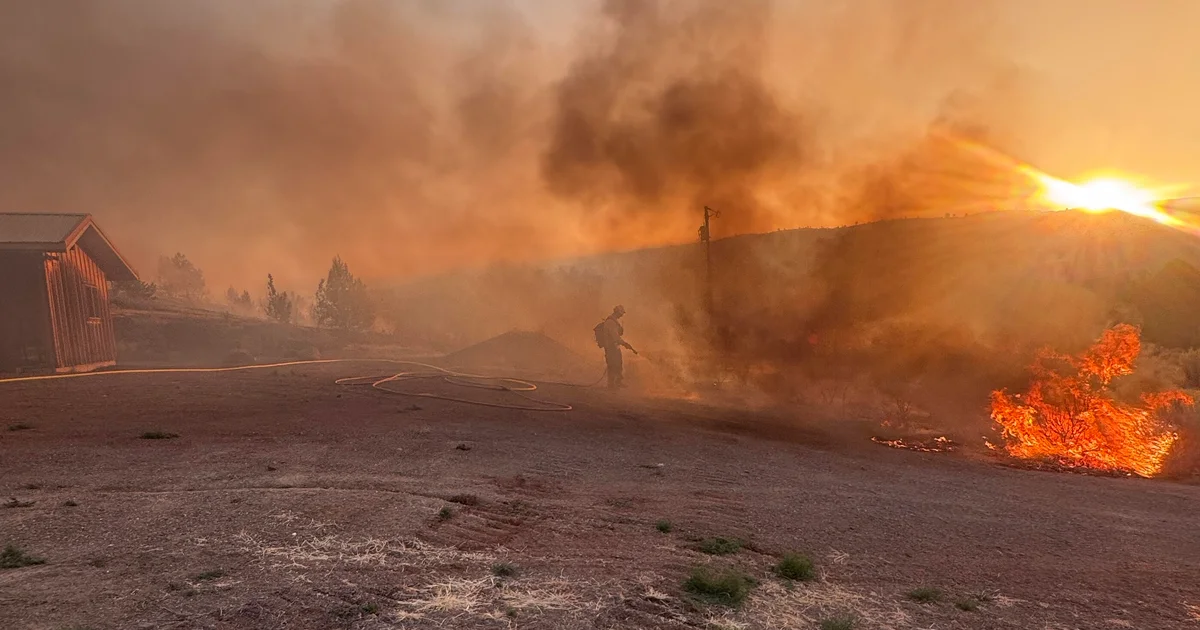
US wildfire firefighter shortages and equipment gaps left crews struggling to contain fast-moving blazes during a record season, with some teams waiting hours for reinforcements that never arrived.
In Spokane, Washington, firefighter Cody Turcotte said his crew joined two other engines battling fires that had already spread towards homes. With only three people on each truck, crews faced burning gardens, furniture and back porches while trying to protect several properties at once.
After 16 hours on duty, Turcotte said his team had still received no update on extra engines requested earlier. Their supervisor eventually told them: “Nobody’s coming. Keep working.” The crew was later moved to another nearby fire while houses continued to burn.
The fires became known as the Spokane Complex Fire, which destroyed almost 900 structures and scorched more than 10,000 acres. Officials described it as the worst natural disaster in the region’s history.
“The fires that we’re seeing now are quickly becoming large, campaign fires, and they’re happening much more frequently,” said Turcotte, who has worked as a firefighter for 17 years. “We’re able to respond, but man, we’re just running thin, and kind of moving pawn pieces around to try to cover these holes.”
Staffing shortages stretch wildfire response
Wildfires have burned a record 8.5 million acres across the US so far in 2026, the highest figure recorded by this point in the year since tracking began in 1983.
At the height of the season, about 15,000 firefighters were involved in active wildfire responses nationwide, including federal, state and international crews. Much of the country’s equipment and personnel had been committed for months, leaving resources unavailable for newly emerging fires.
Federal employment data shows that roughly 6,000 people left the US Forest Service last year through terminations and buyouts, reducing its workforce by about 16%. Some of the largest reductions were in wildfire states including Colorado and Oregon.
The cuts did not directly target frontline firefighters, but affected administrative staff who could be given wildfire qualifications and provide logistical support. Their work included arranging equipment, land permissions and water supplies during emergencies.
Justin Brown, a wildland firefighter in Nevada, said the loss of support staff had made it harder to establish incident management teams and provide operational assistance. The Forest Service had also lost mid-level staff such as engine drivers, engineers, operators and captains, according to current and former employees.
Some of those roles were being filled temporarily by less experienced staff or contractors brought in at short notice, the employees said.
Fire crews forced to do more with less
Firefighters deployed to the Pacific Northwest said requests for crews and equipment were often left unfilled. Blake Miller, a firefighter from Scottsdale, said teams sometimes had to continue without the resources normally required for particular tasks.
“You can put the order in for the resources that you would traditionally need to get certain tasks done. But if those crews or those trucks aren’t available, then you just have to deal with what you have on scene there,” he said. “There were some days that we did more with less, for sure.”
Records from the Hawk Fire near Reno, Nevada, show that requests for aircraft were rejected repeatedly on its first day. Requests for large water-dropping aircraft were turned down seven times, marked with the code “UTF”, meaning “Unable to Fill”.
In total, resource requests were rejected 45 times during the week it took to contain the fire. The requests included airtankers, helicopters, supervisors, equipment managers, tactical support teams and ambulances.
A national wildfire co-ordinating group warned shortly before the fire that resource availability was “critically low”, with intense competition for crews, equipment, aviation, incident management teams and logistical support.
Firefighters also criticised the response to the Hawk Fire, saying that delays and poor communication left residents with little information until almost 24 hours after the blaze began. One responder said he spent four hours waiting in a car park with about 100 others before being sent to the fire front, by which time homes were being affected.
“Failure to predict potential outcomes, led to a failure to act, led to a failure to communicate with and evacuate residents before the front hit,” the firefighter said.
Truckee Meadows Fire and Rescue, which led the initial response before a unified command was established, said it was reviewing the operation to identify lessons and strengthen its response to future disasters.
Forest Service acknowledges limited capacity
The Forest Service said it had more operational firefighters working at the peak of the season than at any point in the previous five years. It also said it had increased the number of non-fire employees qualified to support wildfire operations.
However, the agency acknowledged that its 11,745 wildland firefighters nationwide as of August 17 did not provide enough capacity to meet the demands of the continuing wildfire crisis. It said additional recruitment could not be supported with its existing infrastructure, funding and other resources.
The agency said wildfire seasons had evolved into “year-round wildfire years” and that the growing scale and complexity of fires was placing greater demands on all emergency services.
The Trump administration has also sought to reorganise federal wildfire operations through the creation of the US Wildland Fire Service, which has about 5,500 firefighters under the Department of the Interior.
Forest Service employees said the reorganisation had created bureaucratic difficulties and raised concerns about further staffing losses. The Wildland Fire Service said bringing its workforce, equipment and aviation capabilities into a single organisation had improved co-ordination and reduced administrative barriers.
