


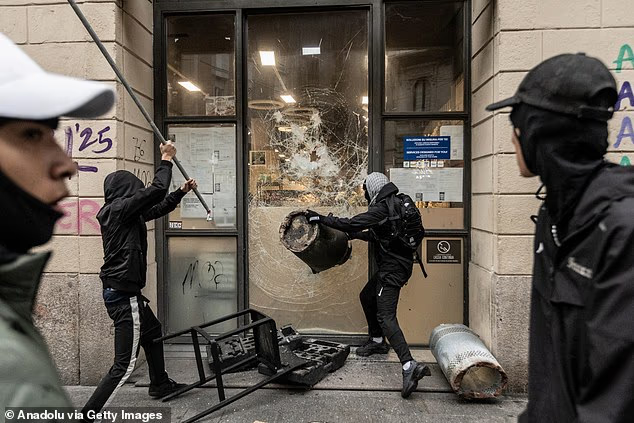
Violence in France and Italy has escalated after riots, looting and clashes with police spread from demonstrations over the cost of living, prompting President Emmanuel Macron and Italian Prime Minister Giorgia Meloni to demand a firm response.
Milan was hit by a second night of disorder on Sunday, with masked protesters accused of smashing shop windows, ransacking stores and damaging property. Police used tear gas and water cannon to disperse groups near the city’s cathedral.
The unrest followed a weekend of turmoil in France, where nearly 2,400 people were arrested and almost 1,000 police officers and gendarmes were injured, seven of them seriously, according to President Macron.
Mr Macron said those responsible for looting and attacks would be held to account, while accusing far-Left groups and criminals of driving what he called “unbridled violence”.
In a televised address, he said: “Nothing justifies it, nothing explains it, nothing excuses it.” He added that those who looted would have to pay for the damage and that those who had sought “to bring down the Republic” would be held accountable.
Violence in France and Italy follows cost-of-living protests
In Milan, clashes began on Saturday on the fringes of an authorised demonstration. Similar trouble was reported in Bologna and Turin after other protests.
On Sunday, a supermarket on a shopping street leading from the Piazza del Duomo was ransacked, while rubbish bins were overturned and scooters and bicycles were vandalised. Images showed young people, many with their faces covered, throwing objects at police vehicles.
Giuseppe Sala, the mayor of Milan, said he had seen “smashed shop windows, looted stores, and frightened citizens”. He described the unrest as part of a “new phenomenon” with an international dimension.
Ms Meloni called the vandals “thugs who exploit demonstrations to spread chaos, attack those who guarantee security, and hold entire cities hostage”. Writing on X, she said: “To demonstrate is a right. To lay our cities to waste is not.”
Matteo Salvini, Italy’s deputy prime minister and leader of the League party, described the scenes as “urban warfare”. Ms Meloni called an urgent security meeting to discuss the violence.
The protests began in France a month ago with teachers and students demonstrating over staff shortages, before broadening into a movement against rising prices. They were later joined by extremist politicians and activists, including Jean-Luc Mélenchon, leader of the hard-Left France Unbowed party.
Luxury shops in France were among the targets. Groups of hooded young men were filmed breaking into outlets including Christian Dior and Louis Vuitton, stealing jewellery and clothing and leaving shelves bare. Trainers and smartphone shops were also attacked.
In Paris, a woman attempted to stop masked looters entering a grocery shop through a smashed doorway. “Why are you doing this? Stop! This isn’t the cause!” she pleaded before the rioters forced their way past her.
One of the most serious incidents occurred in Limoges, where the historic clock tower of the 140-year-old town hall was destroyed by fire after a group forced its way into the building.
The town’s mayor, Guillaume Guerin, said those responsible were organised extremists rather than young protesters acting spontaneously. “They are people who are organised to wage war,” he said, pointing to the alleged logistics and premeditation behind the attack.
After Mr Macron’s speech, rioters returned to the streets of Paris, erecting barricades and fighting running battles with police. One demonstrator said: “We are here because we want Macron to resign.”
US President Donald Trump blamed immigration for the disorder in France. In a post on Truth Social, he wrote: “France is burning!” and called for borders to be closed and control to be taken before it was too late.
Kirill Dmitriev, a liaison between Vladimir Putin and Washington, also blamed what he described as “migration-driven chaos”, saying: “Left-wing globalists are sowing migration-driven chaos.”
Demonstrations were also held in Lisbon, where protesters gathered over housing shortages, rising rents and low wages. Banners called for higher wages and pensions and highlighted the cost of housing and fuel.
