


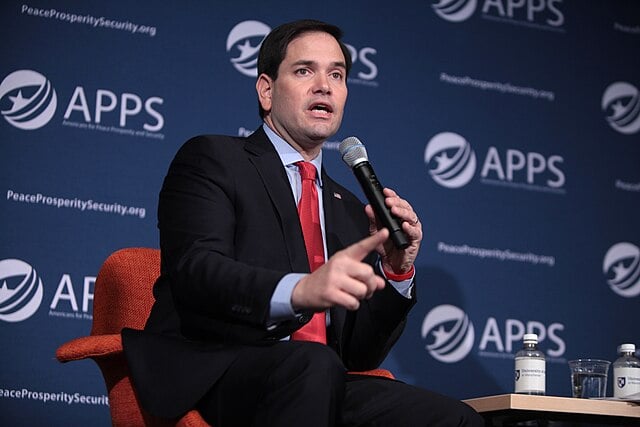
Republican presidential hopeful Marco Rubio used a speech in Detroit to set out his case for a sweeping overhaul of the American tax system, arguing that the kind of pro-business reforms he is proposing could breathe new life into cities that have struggled through years of economic decline.
Speaking before a packed audience of business and political leaders at the Detroit Economic Club, the Florida senator described the city as the perfect backdrop for a conversation about building a new American economy, pointing to Detroit’s recent rebound as evidence of what can be achieved under pro-growth leadership.
Rubio outlined a tax plan developed alongside Senator Mike Lee of Utah that would cut the corporate tax rate from 35 percent to 25 percent, bringing it in line with the average for developed nations, and allow businesses to immediately write off 100 percent of capital investment including new equipment. He claimed the combined measures would grow the US economy by 15 percent, raise wages by 12.5 percent and create approximately 2.7 million full-time jobs, though he did not set out how the plan would be funded.
The proposal would also consolidate the current seven individual income tax brackets into three, raise the child tax credit to $2,500 per child, and remove the marriage penalty for joint tax returns. Estate taxes and the Alternative Minimum Tax would be eliminated entirely under the plan.
Rubio also used the occasion to back an expansion of international trade, telling the audience that Michigan alone supports 1.2 million jobs through trade and that as president he would push to finalise both the Trans-Pacific Partnership and the Transatlantic Trade and Investment Partnership.
Taking questions after his address, Rubio commented on the success of unconventional candidates such as Donald Trump and Ben Carson in the Republican primary race, acknowledging public frustration with Washington while cautioning that anger alone should not define the country’s political direction. On the subject of Edward Snowden, he was unequivocal, describing the former intelligence contractor as a traitor who should face American justice.
The speech forms part of a broader effort by Rubio to position himself as the candidate best placed to lead an economic renewal, with Detroit serving as a symbol of both the damage caused by outdated economic models and the potential for recovery under different policies.
