


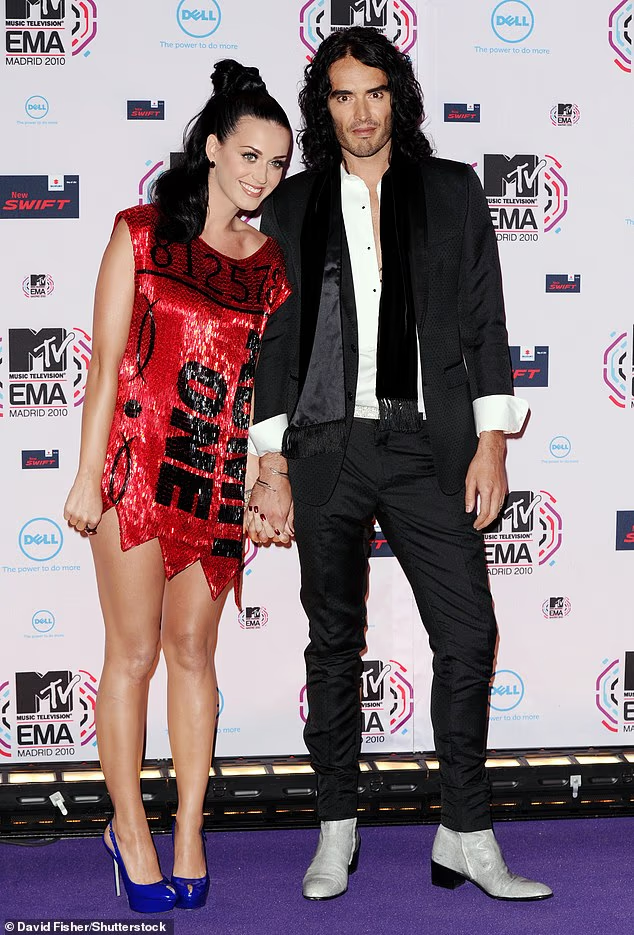
Russell Brand’s conviction for rape and three sexual assaults has renewed scrutiny of his short-lived marriage to Katy Perry, amid claims that he resented the singer’s growing success and felt inadequate beside her.
Brand, 51, was convicted this week and faces years behind bars. Two further rape allegations against him are still being investigated by the Metropolitan Police.
Perry, 42, and Brand first met in 2009 when she made a cameo in the film Get Him To The Greek. They crossed paths again at the MTV Video Music Awards three months later, beginning a relationship that quickly developed into a marriage.
Brand proposed on New Year’s Eve in India, and the couple married in a traditional Hindu ceremony in Rajasthan the following year. Their relationship ended after about 14 months, with the divorce finalised in 2012.
In the early stages of the romance, Perry described Brand to American presenter Ryan Seacrest as “like Oscar Wilde meets Dudley Moore meets Jim Morrison meets a little Elvis Presley meets Charles Manson … that’s the curveball, by the way”.
But the relationship came under strain as Perry’s music career accelerated. Her album Teenage Dream brought further success, while Brand’s film Arthur, in which he played the title character, performed poorly.
People familiar with the marriage have claimed Brand struggled as Perry spent lengthy periods touring. One source said he had initially enjoyed having an American star on his arm but later wanted a wife who would stay at home and have children.
“He just couldn’t cope with her star eclipsing his — he would mock her, and be mean behind her back,” the source said.
A second source described Brand as “selfish to the extreme” and said he began “resenting” Perry’s success.
The marriage ended when Brand told Perry he wanted to separate by text message. He did so on New Year’s Eve, shortly before she was due to perform on stage.
The moment was later shown in the documentary Katy Perry: Part of Me, in which Perry is seen crying before composing herself to appear in front of the audience.
Perry later said that Brand had initially wanted “an equal” but had changed after they married.
“I think a lot of times strong men do want an equal, but then they get that equal and they’re like, ‘I can’t handle the equalness’,” she said in a 2013 interview.
She added: “He didn’t like the atmosphere of me being the boss on tour. So that was really hurtful, and it was very controlling, which was upsetting.”
Katy Perry’s possible connection to the Russell Brand trial
Brand’s defence sought to portray him as a changed man after meeting Perry. He dedicated his second memoir, Booky Wook 2: This Time It’s Personal, to her, writing after their first date: “No more women. Well, actually, thousands of women. I wake up to a different one each day, but they’re all her.”
However, legal arguments before his trial included a reference to Perry’s possible presence during an alleged sexual assault in 2009, when Brand was working on a Channel 4 programme.
Ian Winter KC, defending, said the woman who made the allegation believed other people may have witnessed the incident, “possibly including the defendant’s future wife, Ms Katy Perry”.
The prosecution agreed to remove Perry’s name from the proceedings. Riel Karmy-Jones KC said matters involving Brand’s relationship with Perry could be sensitive.
The Metropolitan Police did not approach Perry for a statement, it is understood.
Brand’s conviction concerned rape and three sexual assaults. Separately, an actress has alleged in a civil claim that he exposed himself to her on the set of Arthur and sexually assaulted her in a toilet.
The Met has confirmed that investigations into two allegations of rape made against Brand remain ongoing. Its chief, Sir Mark Rowley, has said he would not be surprised if many more alleged victims came forward.
