


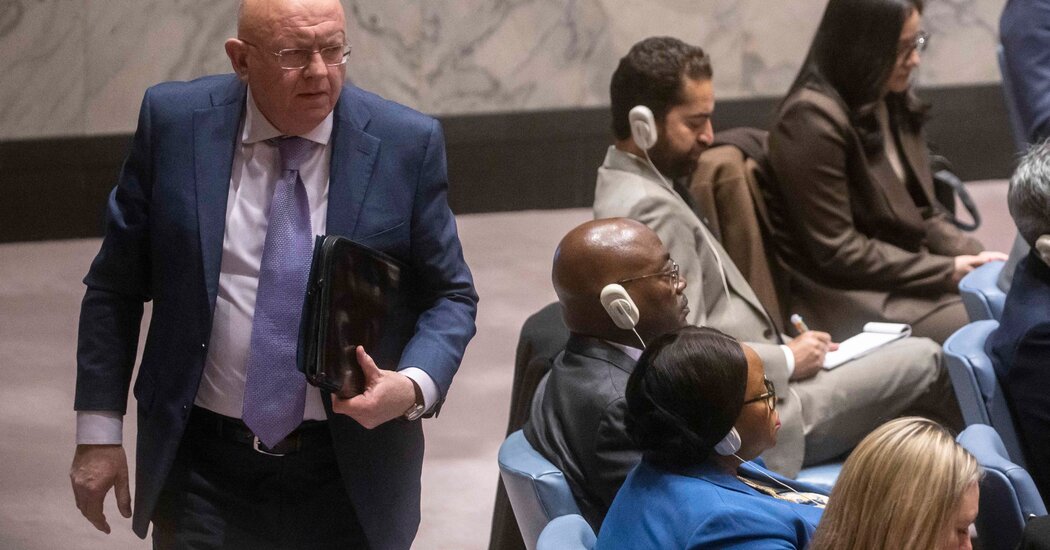
Russia and China have vetoed a US resolution at the United Nations Security Council to renew the mandate of experts monitoring Iran’s nuclear programme and alleged attempts to evade international sanctions.
The vote in New York deepened tensions between Washington and the two permanent members of the council, coming less than a week before a planned meeting between Donald Trump and Chinese President Xi Jinping in Washington.
Britain and France were among the countries backing the resolution, alongside eight non-permanent members. Two countries abstained, while Russia and China voted against the measure.
Both vetoing powers argued that the sanctions had expired and that the issue should no longer be considered by the council. Their representatives also called for a diplomatic end to the US war with Iran and supported Tehran’s right to maintain a civilian nuclear programme.
Fu Cong, China’s ambassador to the UN, urged members to avoid “double standards, political manipulation, pressure and confrontation”.
Russia’s ambassador, Vasily Nebenzya, accused Western countries of following “the destructive path of our Western colleagues, determined purely by their economic interests in exerting pressure on the Islamic Republic of Iran”.
Jennifer Locetta, the US ambassador to the UN, described the vetoes as an “act of obstructionism”. She said they were intended to suppress reporting “that implicates their own activities in support of rogue regimes”.
Ms Locetta warned that the decision would create “a monitoring gap that only benefits the Iranian regime and those who profit from evading those measures”. Iranian officials did not immediately comment on the vote.
The panel of experts was established to monitor Iran’s nuclear activities and its efforts to circumvent international sanctions. The International Atomic Energy Agency said this month that it had been denied access to Iranian nuclear facilities.
The confrontation came a day after a high-level meeting between the foreign ministers of China and Iran in Beijing. China has continued buying Iranian oil, while Beijing ordered Chinese companies not to comply with a new US sanctions campaign against Tehran announced in August.
US officials have also accused Russia of sending drone components to Iran through the Caspian Sea and providing intelligence during the conflict, including satellite imagery showing the positions of warships and military personnel. Those claims were included in the wider dispute over support for Tehran.
The vote coincided with the publication of a report by a UN fact-finding mission which said it had “found reasonable grounds to believe the United States committed a war crime by launching indiscriminate attacks resulting in the loss of life or injury to civilians or damage to civilian objects”.
The report referred to two US attacks, including a February missile strike on an Iranian school in which more than 150 people, mostly children, were killed. US officials acknowledged in March that a preliminary Pentagon investigation had found the United States was at fault, although the Trump administration has denied targeting civilians and has not released the findings.
Iran is expected to feature prominently when Mr Trump and Mr Xi meet next week, alongside discussions on extending a US-China trade truce and co-operation on artificial intelligence safety.
