


US air strikes in Somalia have intensified sharply under Donald Trump, while families in the southern town of Jamaame say a 2025 offensive left relatives dead, injured and displaced.
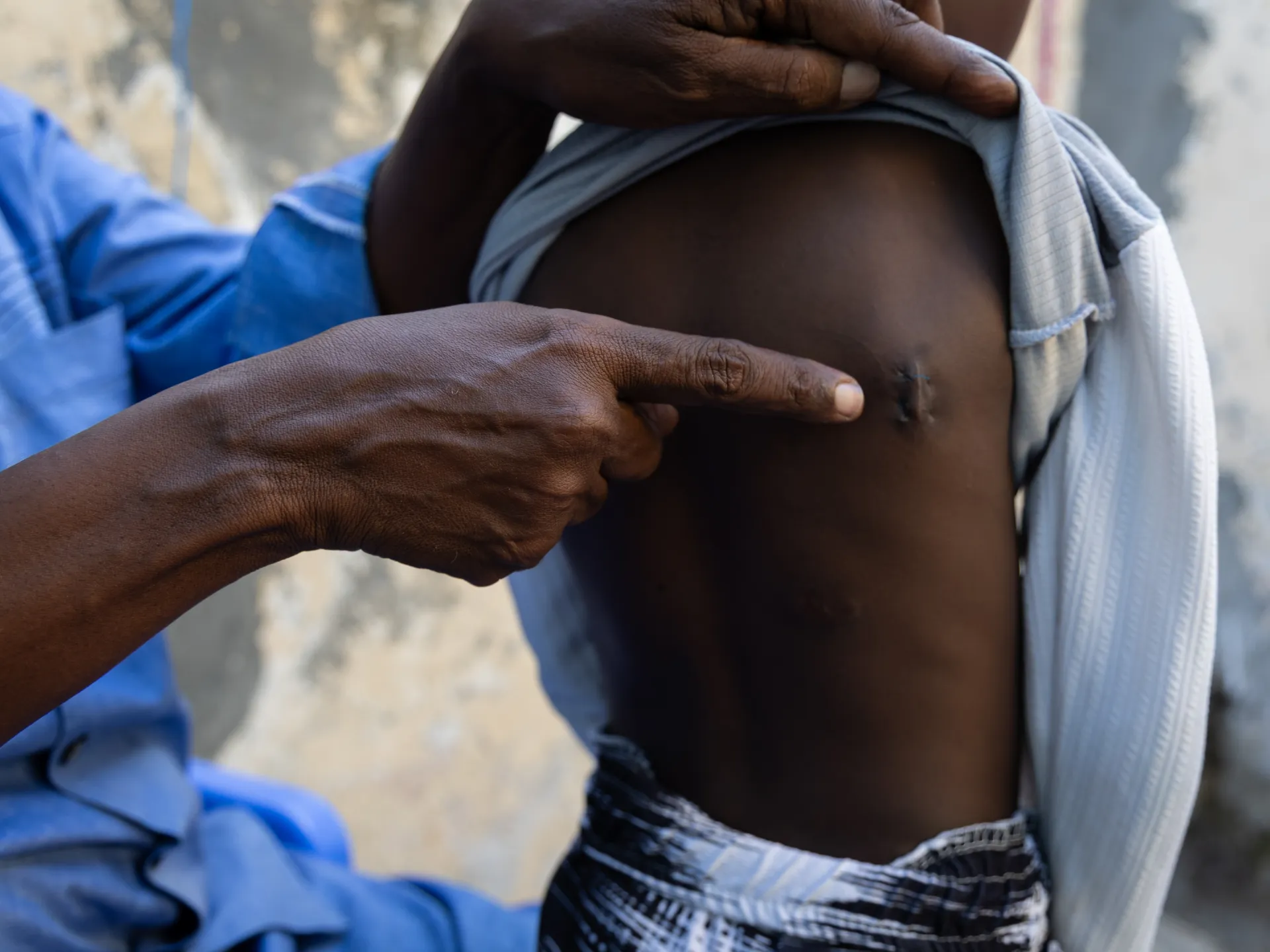
Among them is Maryam Haji Abdi Guled, whose seven-year-old son, Abdiqadir Salah, still has shrapnel lodged near his hip almost a year after the bombardment. Doctors have warned that removing the fragment could paralyse him.
Maryam accompanies him to school each day, fearing that another child could knock him and disturb the metal in his body. “I hold his hand, take him to school, and I bring him back myself. I watch over him,” she said.
The boy was injured during a November 2025 operation involving US air strikes and Somali ground forces around Jamaame, in southern Jubaland. Maryam said three of her six children were wounded as aircraft bombarded the area.
US Africa Command, or AFRICOM, has acknowledged carrying out air strikes in the area on November 14 and 15 last year. However, it disputes allegations that American aircraft caused civilian casualties.
The command said it had assessed reports that between 10 and 12 civilians were killed and homes and businesses destroyed in Jamaame. Its conclusion was that the information available did not meet the military’s “more likely than not” threshold for establishing that US strikes caused the reported harm.
AFRICOM has not disclosed the evidence underlying its assessment, nor said whether investigators spoke to survivors, relatives, hospital staff, local officials or other witnesses. It said the review could be reopened if new information emerged.
The finding does not establish that no civilians were harmed. It means only that AFRICOM said it could not determine that US operations were more likely than not to have caused the reported deaths and damage.
US air strikes in Somalia and the civilian toll
Public AFRICOM records list 84 strikes in Somalia through September 2026. The New America Foundation, which independently tracks the campaign, recorded 88 over the same period.
Witnesses described the Jamaame bombardment as coming without warning. A monitoring network led by the United Nations High Commissioner for Refugees recorded 12 civilian deaths during fighting and air strikes around the town between November 16 and 18, although the figures cover both air operations and ground combat and cannot establish responsibility for each death.
The same network recorded 22,800 people fleeing Jamaame and surrounding villages over those three days, describing the displacement as “rapid and widespread”. It also reported damage to shops and storage facilities, restrictions on movement and signs of psychological distress among those who escaped.
Ali Aden Borrow, a 52-year-old farmer, said his nine-months-pregnant wife was killed while trying to gather their children and flee the fighting. He said debris from what he believed was an air strike struck her neck, killing her and their unborn child.
The couple’s three surviving children now live with their grandmother. Ali has moved between villages and Kismayo, searching for work and trying to support them, while debt has mounted because of food, transport and other expenses.
Another farmer, Nuur Ali Nuur, said his wife was struck by debris during the same period of fighting. He said she was left paralysed from the waist down, while their breastfeeding daughter suffered minor injuries.
Medical treatment has been difficult to obtain. Nuur said he could not afford to take his wife promptly to better-equipped facilities and still owed money for her care.
Anna Zahn, the US-based archive lead at Airwars, said the effects of air strikes could continue for years, particularly where injuries were under-reported and medical treatment was expensive or unavailable.
Earlier research in Jubaland by the peace organisation PAX documented chronic injuries, lost livelihoods, displacement and psychological trauma following alleged US air strikes. Researchers said they could not establish the target status of most of those examined.
Questions over targeting and accountability
US officials say the strikes are carried out in coordination with Somalia’s federal government as Washington expands operations against al-Shabab and an ISIL-affiliated armed group in northern Somalia.
AFRICOM distinguishes between deliberate strikes, which undergo several layers of review, and defensive strikes against imminent threats. Its definition of combatants includes people it considers to be providing material support for hostilities.
That approach has prompted questions over how individuals are classified and how the criteria affect the risk to civilians.
In a separate case, AFRICOM said a September 2025 strike near Badhan in northern Somalia killed Omar Abdullahi, whom it described as an al-Shabab arms dealer. Puntland’s Criminal Investigation Department later said he had no criminal record and was not under investigation, while Somalia’s Defence Minister Ahmed Moallim Fiqi said in parliament that he could have been questioned rather than targeted.
AFRICOM said its civilian-harm assessment in that case also did not meet the “more likely than not” threshold. It did not directly answer questions about the evidence for identifying Abdullahi as an arms dealer or whether the targeting decision had been reviewed.
Airwars documented at least 216 civilians killed or wounded in US strikes in Somalia between 2007 and the end of May 2025, based on cases it was able to identify. The figure predates the Jamaame offensive and is not an estimate of the full toll.
Under Trump, approval authority for air strikes was returned to military commanders, reversing the more centralised procedures used under Joe Biden. Airwars said the number of strikes during Trump’s second presidency had nearly reached the total conducted during his first term and was roughly four times the rate recorded under Biden.
Somalia’s President Hassan Sheikh Mohamud has acknowledged that US military support became “bigger and much easier” under Trump. But al-Shabab has continued to regain territory after offensives by Somali and allied forces.
Somali national security official Ahmed Suleiman Hussein has warned that civilian harm could create grievances that al-Shabab and the ISIL affiliate might exploit for propaganda and recruitment. Somalia has since adopted a national civilian-protection policy, which he said should be incorporated consistently into counterterrorism operations.
A family unable to return home
Maryam spent more than 24 hours travelling with Abdiqadir to Mogadishu after the attack. She said he was bleeding during the journey and unable to sit or stand without severe pain.
Doctors in the capital removed two pieces of shrapnel during surgery in September 2026, but left the fragment near his hip because of the risk of paralysis. “He is currently able to play and move, and we can’t take this risk,” Maryam said.
She remains in Mogadishu to keep her son close to medical care and has been unable to resume the farming and livestock work that supported the family in Jamaame.
“I cannot return there now. This child will not get medical care there, and the situation that we fled yesterday is still there, it is even possible that something worse could happen,” she said.
