


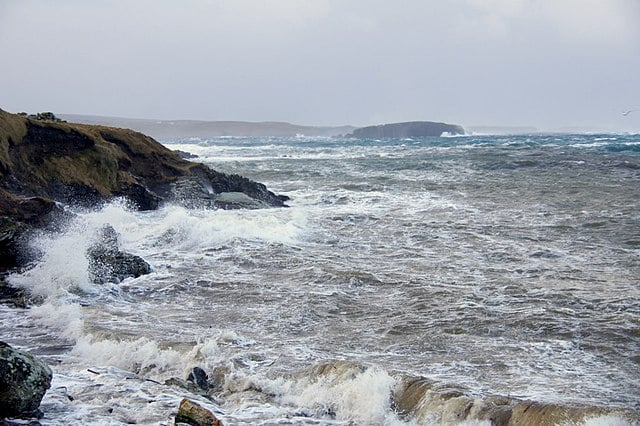
An upgraded wind warning signals a turbulent night for millions as the season’s timing compounds an already serious weather event
Britain’s Easter weekend has been upended by the arrival of Storm Dave, a fast-moving Atlantic system that has prompted the Met Office to issue an amber wind warning across a broad swathe of northern England, north-west Wales and southern Scotland. The warning, which came into effect at 19:00 BST on Saturday and runs until 03:00 on Sunday morning, represents an escalation from the severe yellow warning previously in place — a distinction that carries significant practical weight.
Where yellow warnings signal the possibility of disruption, amber denotes something more urgent: the Met Office’s own guidance warns of “possible injuries or danger to life from flying debris,” a “good chance” of power cuts, and meaningful risk to transport networks already stretched by one of the busiest travel periods of the year.
How an Atlantic Low Became the Weekend’s Defining Story
Storm Dave did not arrive without warning. Meteorologists had been tracking the system’s development for several days, but the decision to upgrade the warning level reflects how the storm’s intensity and trajectory evolved in ways that exceeded earlier modelling. The system is advancing from the west, with Northern Ireland absorbing the first sustained impact — a yellow wind warning there came into effect at 14:00 on Saturday afternoon — before the storm’s energy spreads north and eastward across the rest of the UK overnight.
Met Office chief meteorologist Chris Bulmer confirmed that wind speeds were expected to intensify progressively, moving from Northern Ireland into the broader northern regions as the evening wore on. The amber zone — southern Scotland, northern England and north-west Wales — represents the corridor most directly in the storm’s path, where gusts of between 60 and 70 mph are anticipated. At exposed coastal locations, that figure could reach 80 mph, conditions under which debris becomes genuinely dangerous and large wave activity poses a direct threat to anyone near shorelines.
Scotland faces a compounding hazard not present elsewhere in the UK: up to 30 centimetres of snow could accumulate in parts of the country, with the Met Office cautioning of “strong wind blizzards and drifting snow.” A separate yellow snow warning covering the west Highlands, Argyll and the Western Isles runs alongside the wind alerts, adding a dimension that transforms what is already a disruptive event into something more operationally complex for emergency services, transport operators and local authorities.
Why the Easter Timing Transforms a Weather Event into a National Disruption
Storms are not uncommon in the British spring, and the Met Office issues dozens of wind warnings each year without generating significant public concern. What distinguishes Storm Dave is not simply its meteorological character, but the moment at which it has arrived.
Easter weekend represents the first major domestic travel surge of the calendar year. Millions of people are on the move — by road, rail, air and sea — and many have made plans that are difficult or costly to reverse at short notice. It is precisely this inflexibility that converts a weather event with a finite window into something with a long tail of practical consequences.
The disruption is already materialising in concrete terms. Ferry services along the western Scottish coast have been cancelled and amended. Holiday park operators in Wales have reported cancelled bookings as guests opted not to travel into worsening conditions. Council facilities in Northern Ireland have been closed, and visitors have been formally advised to avoid parks and nature reserves — an instruction that, during a bank holiday weekend, carries a particular sting.
National Highways has urged drivers to plan journeys carefully and adjust their plans where possible, with the RAC issuing its own guidance about extra care on exposed and elevated routes. ScotRail has asked passengers to check before travelling, while Highlands and Islands Airports have flagged potential flight impacts. The cumulative picture is one of a transport network operating under stress across multiple modes simultaneously.
The Fragility of the Long Weekend
There is a broader pattern worth examining here. The UK’s relationship with Easter weather has long been defined by an almost fatalistic acceptance of disappointment — the phrase “it always rains at Easter” functions more as cultural shorthand than meteorological observation. Yet the increasing frequency with which named storms are making landfall during key public holiday periods raises a more substantive question about infrastructure resilience and public communications.
The Met Office’s tiered warning system has been refined significantly over the past decade, and the decision to upgrade to amber in a geographically specific corridor reflects a more sophisticated approach to communicating risk than the blunt all-or-nothing alerts of earlier years. The inclusion of explicit references to “danger to life” at coastal locations is not alarmism — it is a calibrated attempt to prompt behavioural change in a population that has historically been inclined to underestimate wind-related hazards.
What is less clear is whether the public’s response to tiered warnings has kept pace with the system’s development. The proliferation of yellow warnings across all four nations simultaneously risks a degree of alert fatigue, particularly when amber designations — which should command greater attention — sit within the same broader framework. The challenge for forecasters and emergency communicators is maintaining the credibility and distinctiveness of upgraded warnings without either understating risk or producing a numbness born of over-repetition.
A Nation Bracing, From Shetland to the Severn
The geography of Storm Dave’s impact is notable for its reach. The warning architecture spans from Orkney and Shetland — where a yellow alert runs from midnight Sunday until midday — to north-west Wales. Northern Ireland, Scotland, northern England and Wales are all affected to varying degrees, while even areas lying outside formal warning zones face cooler temperatures, showers and residual gusty conditions on Easter Sunday.
The storm is expected to ease its grip on Sunday as it tracks eastward, though strong winds will persist across Scotland, Northern Ireland and northern England into the morning. Further south, conditions will be more mixed — sunshine and showers, cooler than Saturday but manageable for those venturing out for the afternoon.
The recovery is projected to be relatively swift by the standards of significant Atlantic systems. Monday is forecast to bring afternoon highs of 10 to 15 degrees Celsius across much of England, with dry and sunny intervals for most. By Tuesday, the picture brightens further still, with 20 degrees possible in parts of England and Wales — a marked contrast to the conditions expected overnight on Saturday, and a reminder that British weather’s volatility cuts in both directions.
For now, however, the immediate priority is weathering the night. Residents in affected areas have been advised to remain indoors where possible, secure any loose items in gardens or on properties, and avoid unnecessary journeys. It is guidance that, in the context of a bank holiday weekend, will be unwelcome — but it reflects the seriousness with which Storm Dave is being treated by those responsible for public safety.
The storm will pass. The disruption it leaves behind — cancelled bookings, delayed journeys, power outages, damaged property — will take rather longer to resolve.
