


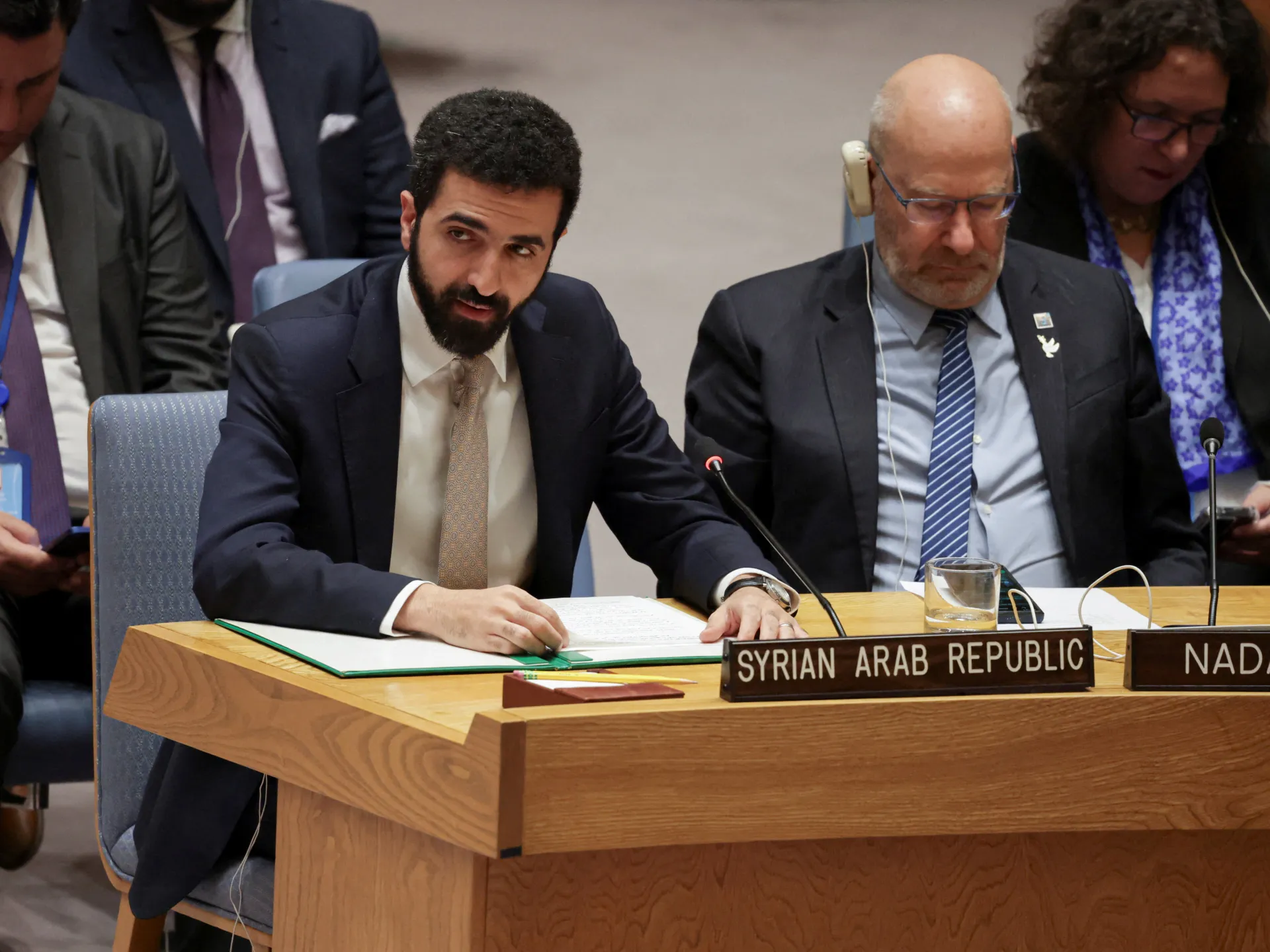
Syria has told the UN Security Council that Israel poses the greatest threat to stability in the Middle East, as a meeting on the country’s post-Assad transition became a heated dispute over foreign troops on Syrian territory.
Ibrahim Olabi, Syria’s permanent representative to the UN, said he had intended to discuss progress in the transition but was forced to respond to Israel’s military actions. He accused Israel of entering villages, displacing people and bombing facilities while Syria sought to avoid further regional suffering.
“Israel penetrated our villages, displaced our people, bombed our facilities while we chose to spare the region further suffering,” Mr Olabi said, accusing Israel of answering mediation efforts and dialogue with “air strikes, incursions and violations”.
He said Israeli aggression was “the greatest threat facing the stability of the entire region, not just Syria”. He also referred to an emergency declaration by 44 countries outside the council, which condemned a visit by Israeli leaders to Jabal al-Sheikh inside Syrian territory on September 9 as unlawful and a “blatant violation” of international law.
Israel shifts focus to Turkiye
Danny Danon, Israel’s ambassador to the UN, played down the scale of his country’s presence in Syria and instead accused Turkiye of expanding its military role there.
He claimed Ankara was seeking to enlarge its military capabilities inside Syria and take control of the country. “If Israel’s tiny defensive buffer is considered a threat to Syrian stability, then what about a foreign power that controls a much larger portion of Syrian territory and is building its military presence there? I am talking about Turkiye,” he said.
Mr Danon said Turkiye had 20,000 troops and more than 100 bases in Syria, controlled 5 per cent of its territory and maintained a presence 50 times larger than Israel’s “security buffer”. He accused Ankara of following “the Iranian proxy playbook”.
Ahmet Yildiz, Turkiye’s ambassador to the UN, rejected the accusation and said Turkish forces in Syria were there at the invitation of Damascus.
“We categorically reject Israel’s attempts to smear Turkiye’s legitimate cooperation with Syria and portray it as a threat in an effort to justify its own violations of international law,” Mr Yildiz said.
He accused Israel of damaging Syria’s current trajectory through “reckless attacks” and incursions, and called on it to de-escalate and withdraw its forces.
Mr Olabi criticised the confrontation at the council, saying Syria’s meetings should no longer focus on proxy disputes. “That was the case during the regime era. It should no longer be the case. It’s frankly traumatising,” he said.
