


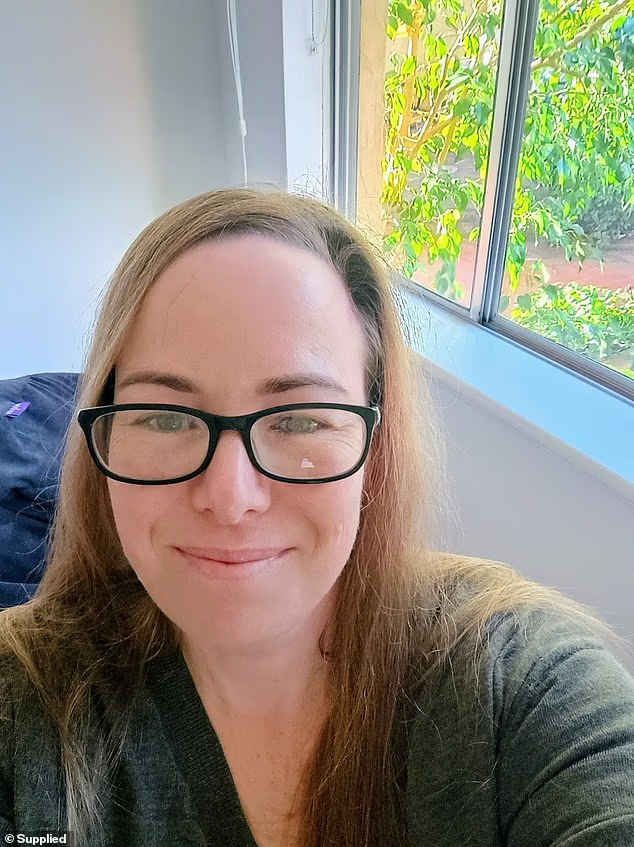
Sarah Brookes is leaving Sydney after two years on the Northern Beaches, saying the city’s housing costs, traffic and day-to-day frustrations have outweighed its beaches, harbour and national parks.
She is returning to Perth, where she previously lived in a four-bedroom, two-bathroom house on a bushy half-acre. In Sydney, she exchanged that property for a 59-square-metre apartment affected by recurring mould and intense heat during summer.
Brookes said her decision was not prompted by a lack of attractions. Sydney’s harbour, clifftops, architecture and secluded coves remained among its great strengths, but she concluded that its beauty did not justify the financial and practical demands of living there.
She moved to the city after her teenage daughter secured a place at a public high school on the Northern Beaches. Brookes had also been left with painful memories in Perth following the deaths of her mother and grandmother, and decided to make a temporary move.
The Northern Beaches, sometimes referred to as Sydney’s “Insular Peninsula”, brought its own difficulties. Surrounded by water and linked to the rest of the city by bottlenecks, the area could feel isolated, while journeys of only a few kilometres could take close to an hour.
Brookes said residents were often judged by their postcode, with assumptions that they were affluent and rarely travelled beyond the area. She also described a strong locals-only culture, including at North Narrabeen’s The Alley surf break, which has a reputation for being unwelcoming to visiting surfers.
Why Sarah Brookes is leaving Sydney
Housing was at the centre of her dissatisfaction. She described a rental market in which competition was intense, vacancies were scarce and landlords had little incentive to improve properties when prospective tenants were readily available.
Her apartment became particularly difficult to live in. It trapped Sydney’s muggy heat, had no air conditioning and developed a major mould problem. Brookes also endured two bathroom waterproofing projects, a lengthy renovation in the Airbnb below and a week without hot water.
When she sought help over the lack of hot water, her property manager suggested joining a gym or using cold showers at the beach, she said. On another occasion, a homeless man slept in the apartment hallway during winter.
Overnight roadworks outside the building were carried out from 7pm until 7am, while the surrounding noise included leaf blowers, school announcements and people searching recycling bins for 10-cent containers.
Brookes acknowledged that Sydney’s public transport was preferable to its roads, praising the B-Line bus service into the city. However, she said the system was expensive, citing a Deutsche Bank report which ranked Sydney as having the world’s second-most expensive public transport after London.
Driving was worse, in her view, with heavy congestion, impatient motorists, potholes and confusing road layouts. She noted that Northern Beaches council had repaired more than 9,000 potholes across its network in the 12 months to June.
She also referred to delays on the M1 caused by crashes, breakdowns and debris, including one incident in which motorists were left with flat tyres after metal fell from a truck across a 30-kilometre stretch of motorway.
Despite her criticism, Brookes said there were aspects of Sydney she would miss. They included daily walks along the beach, the city’s national parks, ocean pools and the ability to walk to local shops.
She also credited her trainer, Charli Downey, with helping her maintain her fitness and avoid what she described as her fear of falling and breaking a hip in later life.
Brookes will return to Perth to her vegetable garden and dogs, and to a house with space for family and friends. She said she was looking forward to Sunday dinners around the table and a less cramped way of life.
Her final assessment was that Sydney remained one of the world’s great cities, but its financial and emotional cost had become too high to accept indefinitely.
