


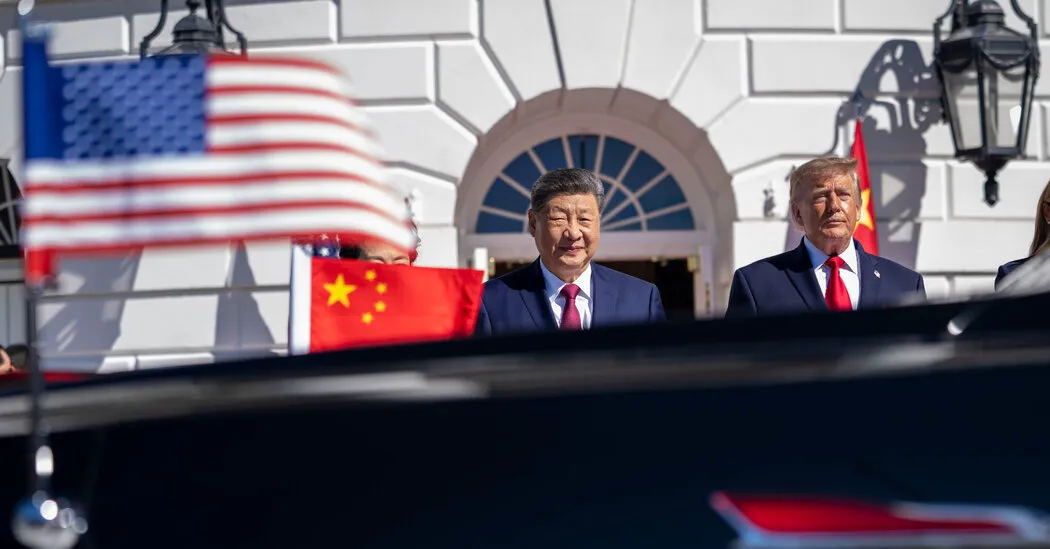
The Trump-Xi summit in Washington overshadowed this week’s United Nations General Assembly, highlighting how decisions by major powers are increasingly taking place outside the global body’s traditional forum.
President Donald Trump hosted China’s President Xi Jinping at the White House as the two countries exerted considerable influence over the global economy, technology and the rapidly developing field of artificial intelligence.
The meeting produced no immediate agreement on artificial intelligence and concluded with little more than a promise from both leaders to meet again soon. Even so, it was viewed as at least as consequential as the diplomatic activity in New York.
Mr Xi did not travel to the UN after arriving in the United States, despite attending and speaking at the General Assembly during a visit to the Obama White House in 2015.
Jeffrey Prescott, a former US ambassador to the UN offices in Rome, said the decision carried powerful symbolism. “The symbolism of Mr. Xi’s absence could hardly be more devastating for the U.N.,” he said.
“The train between Washington and New York is slower than the one in China would be. But Xi is not far away, and yet he’s not taking the time to go there,” Mr Prescott added. “I think that tells you something about how important the U.N. platform is right now.”
President Trump spoke at the UN gathering and held meetings with visiting leaders, but several other heads of government also stayed away, including India’s Prime Minister Narendra Modi.
The United Nations has struggled to influence some of the central issues discussed during the gathering, including the US-Israeli war against Iran, the conflict in Gaza and the governance of artificial intelligence.
Divisions among the United States, China and Russia have repeatedly paralysed the Security Council, where each holds veto power. The disputes have obstructed substantive action on conflicts including those in Iran, Ukraine, Gaza, Yemen and South Sudan.
China has particular influence over the conflicts in Ukraine and Iran. It has provided Russia with economic and political support during its war, while remaining Iran’s largest trading partner despite Mr Trump’s demand that countries end trade with Tehran.
The UN’s struggle for influence
UN secretary general António Guterres led discussions on global governance of artificial intelligence, including concerns about a possible technological arms race. The United States rejects international regulation, while China says it is open to global co-operation but opposes efforts to impose severe limits on development.
Experts have argued that safeguards could include prohibiting the use of artificial intelligence to create biological weapons. However, any significant attempt to prevent the technology escaping human control would probably require an agreement between Washington and Beijing comparable to Cold War arms-control deals between the United States and the Soviet Union.
China has increased its funding for the United Nations under Mr Xi and sought greater influence across its institutions. US critics of Beijing allege that it is attempting to manipulate the organisation and shift it away from Western countries.
Others believe Mr Xi’s absence from New York was intended chiefly to underline China’s status as an equal to the United States. Combining a UN appearance with the White House visit, they argue, could have reduced the significance of the summit.
Mr Trump has cut US funding to the UN and withdrawn from dozens of specialised organisations, although his administration told Congress in August that it would pay 850 million dollars towards some of the roughly five billion dollars it owes the body.
He did not seek significant UN backing before launching the war on Iran, arresting Venezuela’s President Nicolás Maduro or applying pressure on Cuba’s government. On Gaza, he established an independent Board of Peace to pursue security, governance and reconstruction in the territory; although the board received the Security Council’s endorsement last year, it does not report to the council.
UN officials and experts have warned that the organisation is being sidelined as international norms weaken and powerful states feel increasingly able to act without it. A group of UN specialists at the International Crisis Group recently described the body as being “in poor shape”, pointing to its “political irrelevance in major crises from Ukraine to Sudan to the Persian Gulf”.
Opening the UN’s 81st session, Bangladesh’s foreign minister, Khalilur Rahman, acknowledged that observers were asking “whether it works”. He said the organisation needed reform after failing to prevent or end numerous conflicts.
But Mr Rahman argued that the UN remained indispensable, citing its security and development work in Myanmar, Iraq and Haiti. “Yet, through it all, the United Nations has persevered,” he said. “Not because it is perfect, but because it is irreplaceable, and because the alternative is simply unfathomable.”
