


Artificial intelligence is no longer a future threat to the British workforce — it is an active, measurable force already reshaping hiring, redundancies, and career pipelines across the country. While politicians debate its long-term potential, the hard numbers from 2025 tell a more immediate story.
The Scale of the Problem: What the Research Actually Says
No single official figure tracks AI-driven job losses in the UK in real time. But when the leading research bodies are placed side by side, a clear and consistent picture emerges.
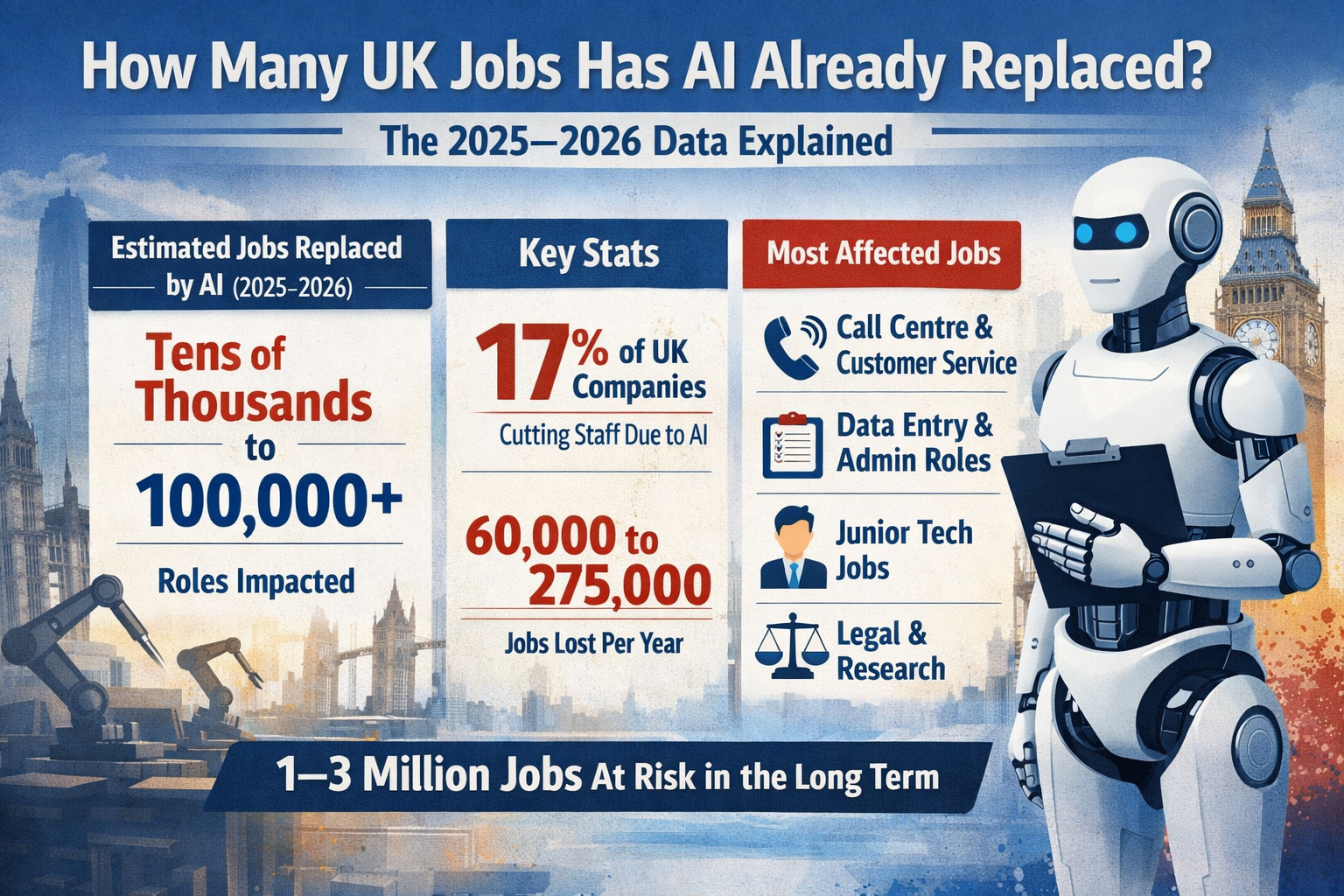
The Tony Blair Institute (TBI) projects that between 1 million and 3 million UK jobs could ultimately be displaced by AI — with peak annual losses estimated at between 60,000 and 275,000 positions per year at the height of AI adoption. The TBI describes these as “relatively modest figures” compared with the average number of job losses across the UK over the last ten years, which amounts to around 450,000 annually. British Safety Council
The Institute for Public Policy Research (IPPR) paints a broader picture. Its central scenario projects 545,000 jobs lost with GDP gains of 3.1%, while its worst-case scenario of full displacement would see 1.5 million positions eliminated with no GDP gains — and up to 7.9 million roles at risk in total. IPPR
Meanwhile, a landmark study from King’s College London, which analysed millions of job postings and LinkedIn profiles between 2021 and 2025, found that firms whose workforces are highly exposed to AI capabilities reduced total employment by 4.5% on average, with the effect concentrated almost entirely in junior positions, which fell by 5.8%. King’s College London
What Is Already Happening in 2025
The shift from projection to reality accelerated sharply in 2025. Between May 2022 and May 2025, the total number of UK job vacancies fell by 43%, dropping from 1.3 million to 0.7 million. McKinsey & Company While economic headwinds played a role, AI’s fingerprints are clearly visible in specific sectors.
Analysis of job advertisements by Bloomberg shows that vacancies for roles most susceptible to AI — such as software developers — have plummeted 37% since ChatGPT launched in late 2022. eWEEK
Youth unemployment has been hit particularly hard. The jobless rate for workers aged 16 to 24 reached 15.9% between September and November 2025 — the highest level since 2020 — with 729,000 young people out of work, up 103,000 from a year earlier. eWEEK
The UK now holds a troubling distinction: only 11% of British businesses planned to increase headcount in the final quarter of 2025, a 17 percentage point fall compared with a year earlier — the steepest recruitment decline of all 42 countries surveyed by ManpowerGroup. People Management
What UK Employers Are Planning Right Now
The most direct evidence of AI’s workforce impact comes from the Chartered Institute of Personnel and Development (CIPD), whose autumn 2025 Labour Market Outlook surveyed over 2,000 UK employers.
One in six employers — 17% — expect AI to shrink their workforce over the next 12 months, with junior roles identified as most at risk. Of those expecting cuts, 62% believe clerical, junior managerial, professional, or administrative roles are most likely to be eliminated. The risk is highest in large private sector firms, where one in four anticipates a reduction in headcount. CIPD
Among those expecting AI-related job losses, nearly one in four predict cuts of more than 10% of their total staff. Computing
These figures represent employer intentions, not completed redundancies — but they signal what is coming in the very near term.
The Jobs Most at Risk
Across all major studies, the same categories of work surface consistently as the most vulnerable:
- Administrative and clerical roles — routine document handling, scheduling, data processing
- Customer service and call centres — AI chatbots and voice tools are already handling large volumes
- Junior software and tech roles — entry-level coding tasks increasingly handled by AI tools
- Legal research and document review — AI performs contract analysis and case research at scale
- Data entry and back-office operations — among the first functions to be automated in practice
- Banking and finance operations — data-intensive environments where AI delivers the fastest efficiency gains
The most pronounced effects have been seen in hiring intentions, with firms effectively slowing or stopping entry-level recruitment rather than making immediate mass redundancies. King’s College London This “silent displacement” — where roles simply go unfilled rather than being formally cut — is one of the hardest trends to capture in official statistics.
The Jobs That Are Safer
Not all work is equally exposed. Manual jobs in construction and skilled trades are less likely to be affected by AI, while the technology could have a positive impact on healthcare by resulting in a healthier workforce, fewer sick days, and longer careers. British Safety Council
Roles requiring physical dexterity in complex or unpredictable environments — electricians, plumbers, care workers — remain largely beyond AI’s current reach. Senior strategic roles, legal accountability positions, and highly creative work at the top end of the skills spectrum also retain a meaningful degree of protection for now.
The Bigger Picture: Displacement or Transformation?
The honest answer is both — but the timing matters enormously. The World Economic Forum’s Future of Jobs Report 2025 projects 92 million jobs displaced globally by 2030, offset by 170 million new roles created — a net gain of 78 million positions. AIMultiple The challenge is not the long-run balance; it is whether workers have the time, resources, and support to make the transition.
Research from the National Foundation for Educational Research warns that up to 3 million low-skilled UK jobs could disappear by 2035, while 3.7 million UK workers already lack essential digital and problem-solving skills — a figure projected to nearly double to 7 million by 2035 without serious intervention. Substack
The CIPD has called on government and employers to urgently prioritise reskilling, with particular focus on workers in early-career and lower-level professional roles in finance, insurance, IT, and administrative services. The Bank of England Governor has also warned that the UK must prepare for job displacement and the strain AI could place on career pipelines — even if mass unemployment does not materialise.
Key Statistics at a Glance
| Source | Finding |
|---|---|
| Tony Blair Institute | 60,000–275,000 UK jobs displaced per year at peak |
| IPPR | Up to 7.9 million roles at risk in worst case |
| King’s College London | 4.5% employment reduction in AI-exposed firms |
| CIPD (2025) | 17% of UK employers expect to cut headcount due to AI within 12 months |
| ManpowerGroup | UK has the steepest recruitment decline of 42 countries surveyed |
| Bloomberg analysis | Software developer job ads down 37% since ChatGPT launch |
| ONS / House of Commons | Youth unemployment at 15.9% — highest since 2020 |
What Comes Next
The trajectory is set. AI adoption across UK businesses will continue to accelerate, hiring for entry-level roles will remain subdued, and certain categories of work will contract structurally rather than cyclically. The question is not whether the British labour market will be reshaped — it is how prepared workers, employers, and policymakers are for that reshaping.
Retraining programmes, updated educational curricula with AI literacy at their core, and targeted financial support for displaced workers are all measures experts say are needed now — not at the point when the full impact has already arrived.
Sources: Tony Blair Institute for Global Change, CIPD Labour Market Outlook (Autumn 2025), King’s College London, IPPR, ManpowerGroup Employment Outlook Survey, McKinsey Global Institute, World Economic Forum Future of Jobs Report 2025, Bloomberg job market analysis, National Foundation for Educational Research.
