


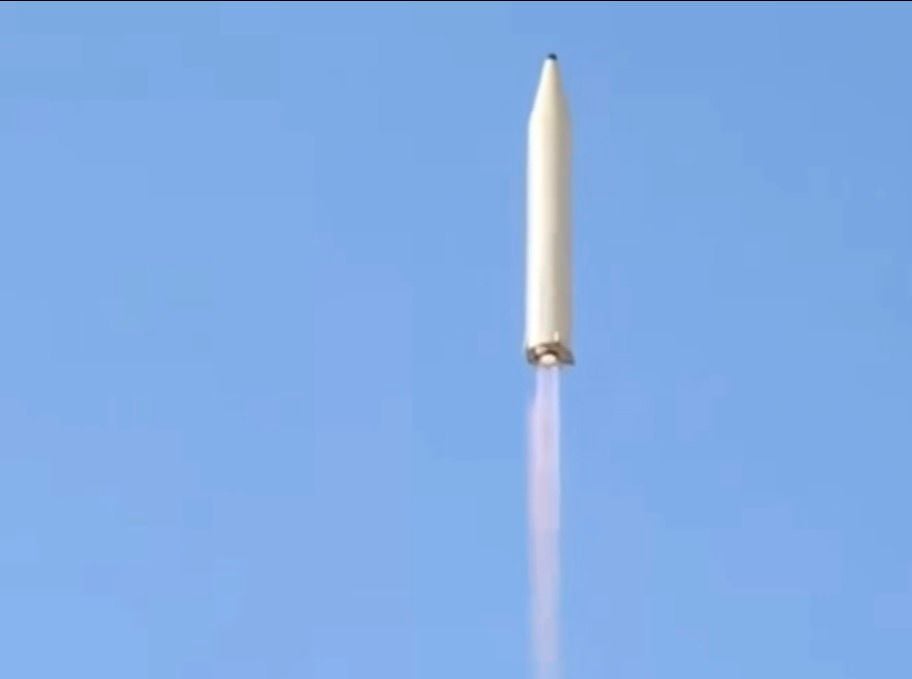
A ballistic missile attack on a British and American military base in the Indian Ocean has exposed a significant and alarming gap in Western intelligence assessments of Iran’s military reach, with defence analysts now warning that major European cities including London and Paris may fall within range of Tehran’s weapons.
Two Iranian ballistic missiles were fired at Diego Garcia, a strategically vital base in the Chagos Islands used as a launchpad for operations across the Middle East, on Friday night. One missile failed during flight while the other was intercepted by a US warship, in what is believed to be the first ever strike on the installation. The base houses a large airfield, deep-water port, fuel storage facilities and radar installations.
The distance from Iran to Diego Garcia is approximately 3,800 kilometres — nearly double the 2,000 kilometre range Iran had previously claimed its ballistic missiles could achieve. The revelation has prompted urgent reassessment among defence specialists. Foreign affairs analyst Nawaf Al-Thani described it as a strategic leap, warning that the accepted ceiling for Iranian missile capability had “just collapsed” and that the radius of deterrence and fear had expanded dramatically.
Experts have raised the possibility that Iran deployed an intermediate range ballistic missile or repurposed a space launch vehicle to achieve the distance. Justin Bronk, a senior research fellow at the Royal United Services Institute, noted that Iran’s Simorgh space launch vehicle could provide greater range, albeit at a cost to accuracy. Retired Royal Navy Commodore Steve Prest drew a direct line between space programmes and weapons capability, explaining that ballistic missiles and space rockets operate on the same fundamental principle.
The implications for Europe are stark. Paris sits approximately 4,198 kilometres from Tehran, while London lies at around 4,435 kilometres — a distance analysts now describe as within the edge of vulnerability depending on launch point and payload.
General Sir Richard Barrons, former head of the UK’s Joint Forces Command, said Iran’s military capabilities had been “serially underestimated” and warned that British interests were now directly at risk. He said the UK was engaged whether it had chosen to be or not, and that the conflict had developed in ways that could not simply be ignored.
The attack came hours after Prime Minister Sir Keir Starmer authorised the United States to use UK-based bombers, including B-52s flying from RAF Fairford, for operations targeting Iranian missile sites threatening the Strait of Hormuz. The Government confirmed the strike on Diego Garcia took place before that authorisation was granted. Conservative leader Kemi Badenoch has since accused Starmer of a cover-up, demanding he explain publicly why the attack was not disclosed sooner.
Iran’s foreign minister had warned earlier on Friday that Starmer was placing British lives in danger by allowing UK bases to be used in what he called a war of choice against Iran.
The Ministry of Defence described Iran’s actions as reckless and a direct threat to British interests, confirming RAF jets and other military assets were continuing to operate in the region.
On the economic front, the conflict is increasingly being felt by British households. Oil prices surged to nearly $118 a barrel following Iran’s threat of full-scale economic war and a strike on Qatar’s liquefied natural gas facility, which the chief executive of QatarEnergy said would take between three and five years to repair. Energy analysts have warned UK bills could rise by more than a fifth when the price cap is next reviewed in July. The Cabinet met to formally condemn Iran’s expansion of its targeting to include international shipping, with around a fifth of global oil supplies passing through the Strait of Hormuz, which Iran has effectively closed since hostilities began.
General Barrons said US and Israeli forces now faced a fundamental choice between declaring victory and halting operations, or escalating further given the limits of air power alone, with the possibility of ground operations or a blockade of key Iranian oil infrastructure among the options being discussed.
