


Britons desperate to catch a glimpse of the spectacular solar eclipse were forced to get creative after struggling to get their hands on proper glasses.
With supplies selling out and queues forming at shops across London, some viewers resorted to an unlikely bit of kitchen equipment – the humble colander.
Rather than looking directly at the sun, eclipse-watchers used the holes in their colanders to project dozens of tiny images of the eclipsed sun onto the ground.
Each hole acts like a tiny pinhole camera, producing a little crescent-shaped image as the moon moves across the face of the sun.
The result was a pattern of hundreds of miniature eclipses dancing across pavements and grass – turning an everyday kitchen utensil into an unlikely astronomical instrument.
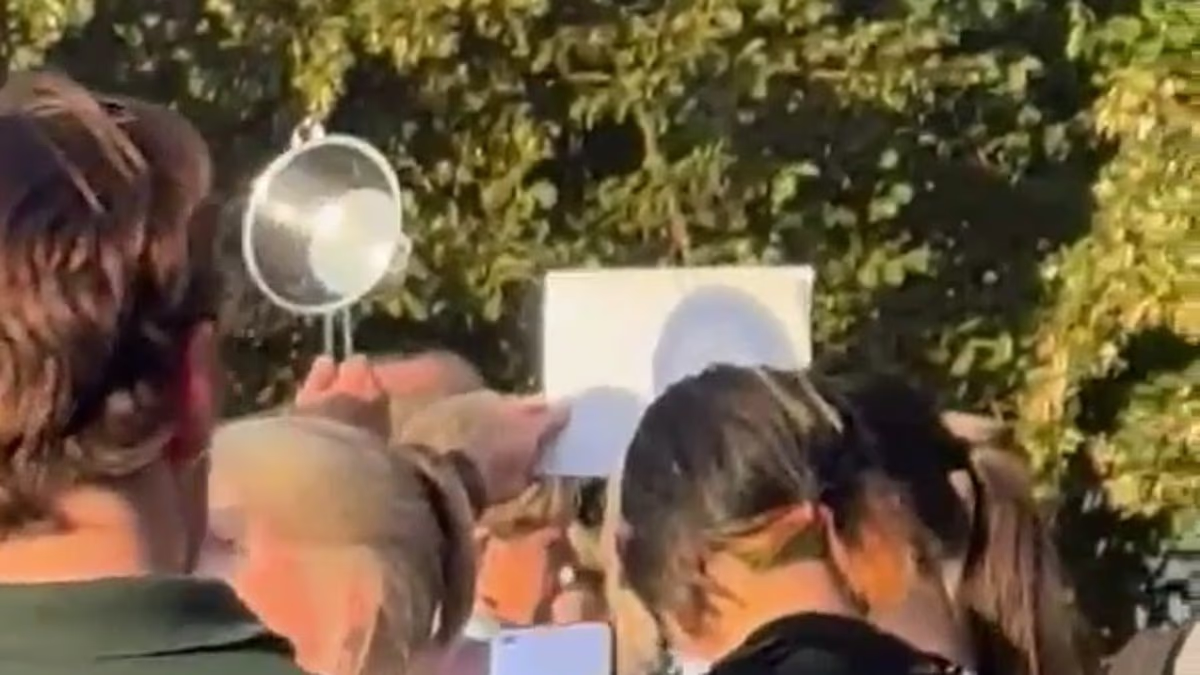
One video shows an elderly gentleman in a packed park in London holding up a small colander with his back to the sun with a piece of paper behind the sieve.
Around him were other spectators trying to catch the eclipse with colanders and other homemade forms of viewing, like a pinhole eclipse viewer.
While it may look amusing, the trick provided a clever and safe way to watch the eclipse indirectly, provided viewers kept their backs to the sun and only looked at the projected images.
An elderly gentleman was seen holding up a small colander with his back to the sun with a piece of paper behind the sieve to try watch the solar eclipse

He was not alone as other members of the public used a colander to observe a partial solar eclipse from Brockwell Park in South London

A person uses a colander to observe a partial solar eclipse against a wall in Storrington, west Sussex

Arsenal fans are seen using cardboard and a colander to try and see the solar eclipse prior to the pre-season friendly match between Arsenal FC and Como Calcio at Emirates Stadium
Dr Megan Argo, an astrophysicist from the University of Lancashire, told the Daily Mail: ‘The safest way for the public to enjoy the eclipse is to view it indirectly.
‘Standing beneath a leafy tree creates hundreds of tiny images of the Sun on the ground, which gradually change into crescents as the eclipse progresses.
‘The same effect works with a kitchen colander or a simple homemade pinhole camera.’
The simplest way to have safely watched the natural phenomenon would be to use a pair of ‘eclipse glasses’ with very dark lenses to block out most of the sun’s harmful light.
However, many glasses sold out days in advance of the eclipse, causing frantic queues as spectators dashed to get the last few remaining pairs and created snaking queues.
The partial eclipse began shortly after 6pm in parts of the UK, with maximum coverage occurring at roughly 7.05pm to 7.13pm depending on location.
The moon gradually moved away from the sun and the spectacle ended shortly after 8pm.
The extraordinary event also prompted warnings of disruption, with huge crowds travelling to prime viewing spots and concerns that distracted motorists could cause accidents as drivers turned their attention towards the skies.

A man watches the solar eclipse through a colander in Regents Park, London, the first total solar eclipse visible over mainland Europe since 1999

A woman uses a colander to view the partial solar eclipse at Parliament Hill in London yesterday
Aside from being incredible to look at, eclipses are also known to create no shortage of strange events.
The unexpected darkness may have disrupted the internal clocks of many animals – including pets – leading to confusion and anxiety.
Those who missed last night’s spectacle face a long wait for another like it, with the next comparably deep eclipse visible from the UK not until 2050.
The next total solar eclipse won’t be visible from Britain until 2090.
