


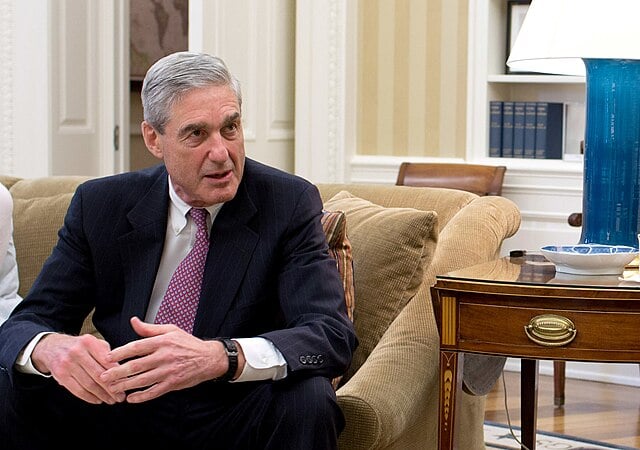
Robert Mueller, one of the most consequential figures in modern American law enforcement, has died at the age of 81. His family confirmed the news in a statement on Friday night, asking that their privacy be respected. No cause of death was immediately given. Mueller is survived by his wife of nearly 60 years, Ann Cabell Standish, their two daughters and three grandchildren.
Before Mueller became synonymous with the investigation that dominated Washington for two years, he had already built one of the most distinguished careers in the history of American public service.
Born in 1944, he studied politics at Princeton before joining the Marines and deploying to Vietnam in 1968. As a platoon lieutenant he was wounded twice in combat and returned home decorated with the Bronze Star for valour and a Purple Heart. He later studied law at the University of Virginia, graduating in 1973, and spent the following decades rising through the ranks of federal law enforcement.
In August 2001 the Senate unanimously confirmed him as director of the FBI — a position he assumed just days before the September 11 attacks reshaped the nation’s security landscape. Mueller is widely credited with transforming the bureau from a traditional law enforcement agency into a modern counterterrorism organisation capable of responding to the threats that emerged in the aftermath of those attacks. He served under both Republican president George W Bush and Democrat Barack Obama, remaining in post for over a decade until 2013.
Four years after his retirement, Mueller was appointed special counsel to lead an investigation into alleged Russian interference in the 2016 presidential election and whether Donald Trump’s campaign had any involvement. The inquiry ran from May 2017 to March 2019 and produced a 448-page report that found Russia had interfered in the election in what it described as a sweeping and systematic fashion, but did not establish that members of the Trump campaign had conspired or coordinated with those efforts. The report stated that while it did not conclude the president had committed a crime, it equally did not exonerate him.
The investigation resulted in indictments and plea agreements involving senior Trump campaign figures including former campaign manager Paul Manafort and national security adviser Michael Flynn. Trump repeatedly denounced the inquiry as a witch hunt and a hoax throughout its duration.
Following news of Mueller’s death, Trump wrote on Truth Social that he was glad Mueller had died and could no longer hurt innocent people. The remarks stood in sharp contrast to the tributes paid by those who worked alongside Mueller throughout his career.
Former FBI director James Comey, whose own dismissal by Trump had triggered the appointment of Mueller as special counsel, described him as a great American and said he had been fortunate to learn from him. A spokesman for Mueller’s former law firm WilmerHale called him an extraordinary leader and public servant of the greatest integrity.
In a rare 2021 interview, Mueller reflected on why he had accepted such a politically exposed assignment, saying he had found tremendous enjoyment in public service throughout his life and that he found it hard to turn down a challenging task.
