


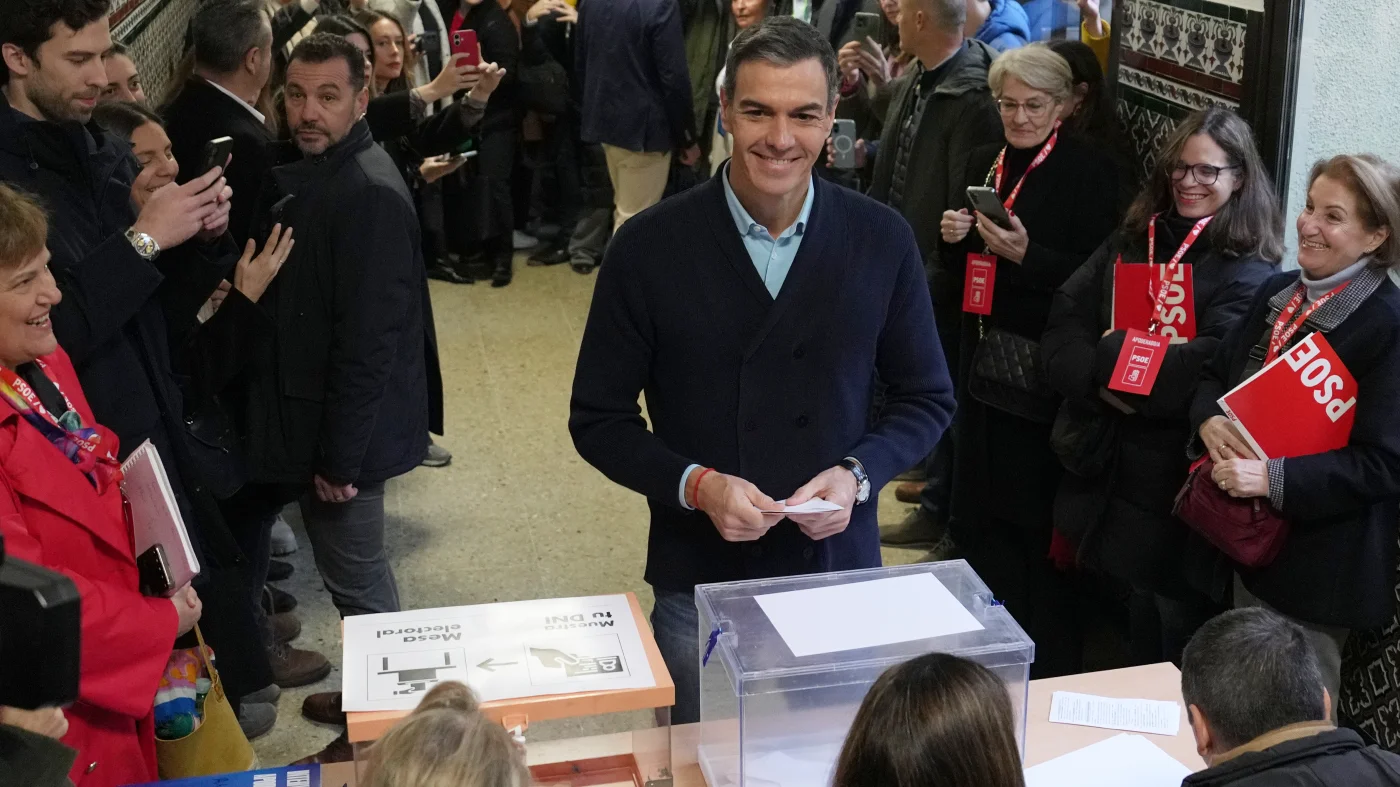
Spain’s general election has become a closely fought contest between Prime Minister Pedro Sánchez’s Socialists and the conservative Partido Popular, with the far-right Vox party positioned to determine who can form the next government.
Alberto Núñez Feijóo, the Partido Popular leader, is ahead in the polls, but neither of the two main parties is expected to win an overall majority. That could make Santiago Abascal, Vox’s leader, a potential kingmaker.
If Vox entered a national government, it would be the first time the far right had held such a role in Spain since the end of the country’s dictatorship in 1975.
Mr Sánchez, who is seeking re-election after eight years in power, has presented himself as a defender of progressive policies and urged left-wing voters to unite against Vox.
The right has portrayed the prime minister as authoritarian and called on its supporters to remove him from office. It also wants to reverse parts of his agenda on taxation, employment reform, housing and abortion.
“After 8 years in power Pedro Sánchez is quite unpopular,” Maria Ramirez, deputy managing editor of the online news site el diario, said.
But she said the prime minister should not be ruled out, describing him as “a good strategist”. His route to victory, she added, was likely to depend on mobilising his support base on the left.
Mr Sánchez has received praise overseas for his progressive politics and his willingness to stand up to Donald Trump, but his government has faced repeated crises at home over the past year.
The snap election was called after widespread protests over the cost of housing. Anger intensified in late September when an 87-year-old woman was evicted from her rented flat in Madrid.
Mr Sánchez swiftly drew up emergency measures to tackle the housing crisis, but Congress rejected them, prompting him to call the election.
The campaign has exposed deep divisions in a country where political polarisation is increasingly shaping the debate. Maria del Mar Romero, an educator specialising in gender equality, said she was concerned about the possible consequences of Vox entering government.
“We have never seen so much polarization,” she said, warning that after targeting what Vox calls “the moors” — undocumented immigrants from Africa — the party could turn its attention to women’s and LGBTQ rights.
Gustavo Garrote, an architect from Seville, said he blamed Mr Sánchez for Spain’s economic difficulties and believed the middle class was disappearing. Although he is technically considered middle class, he said he felt poor and struggled to make ends meet.
“I believe these are the most important elections since the beginning of democracy in Spain,” he said, adding that he wanted Mr Sánchez to leave office.
Polling stations are due to close at 8pm local time, when exit polls will be released. Final results are expected within hours.
