


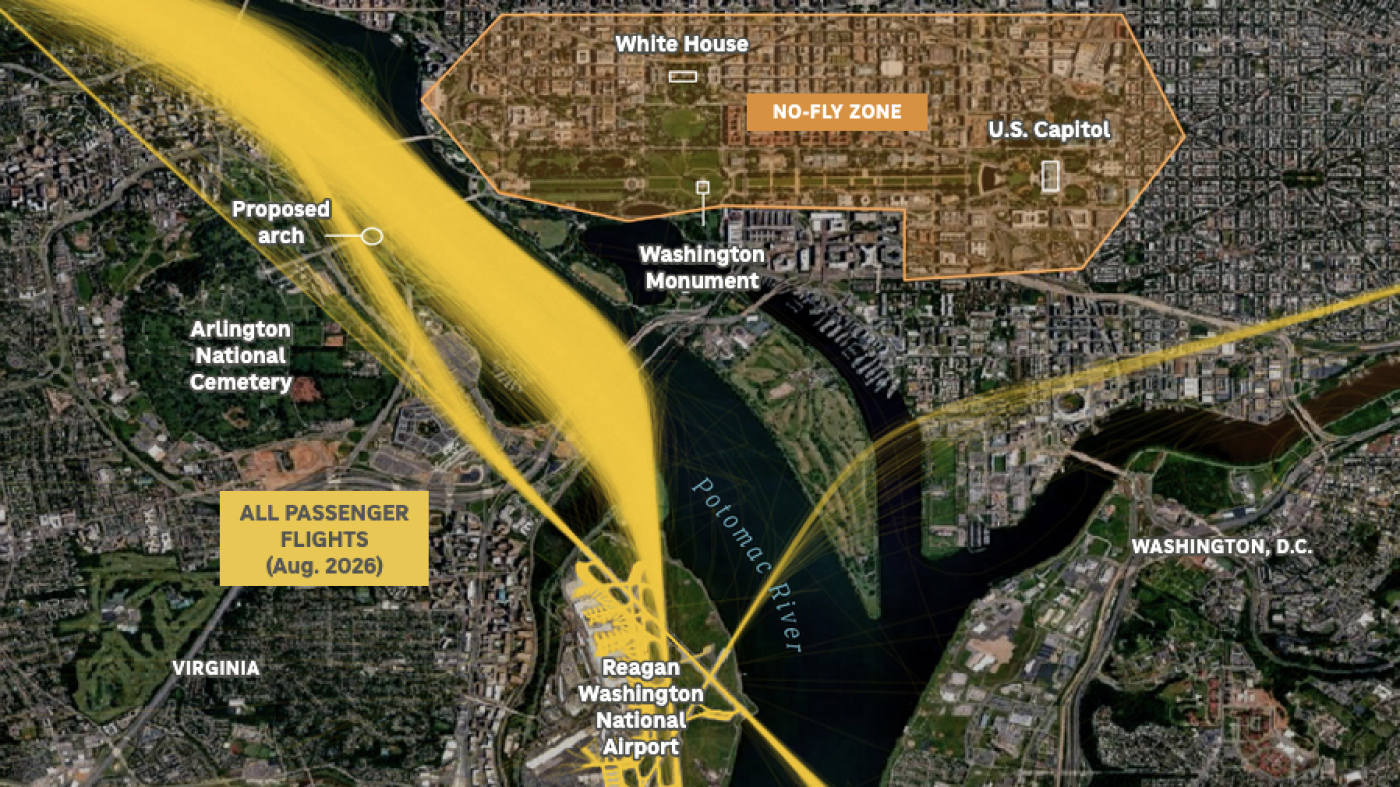
Donald Trump’s proposed 250-foot arch near Ronald Reagan Washington National Airport could add another hazard to one of the most congested and complicated airspaces in the United States, aviation safety experts have warned.
The structure is planned for Memorial Circle, a traffic island on the bridge between Washington DC and Arlington, Virginia. It would stand roughly two nautical miles from the airport’s main runway, over which aircraft pass throughout the day.
The Federal Aviation Administration has said in a preliminary assessment that the arch would probably not create a problem if it were fitted with flashing red obstruction lights, as on the 555-foot Washington Monument. A fuller aeronautical study is still under way and could result in the structure being formally classed as a hazard.
FAA officials have also been assessing the cranes required to build it, which could reach 320 feet. No timetable has been given for the conclusion of either review.
Three aviation specialists who examined the proposal said the arch itself was unlikely to pose a serious threat to most passenger aircraft. But they warned that it would introduce another variable into an already pressured environment, particularly for helicopters and aircraft landing at the airport.
“It’s a small airport with one runway, nestled in a metropolitan area that’s surrounded by prohibited airspace,” said Jeff Guzzetti, a retired accident investigator with the National Transportation Safety Board and the FAA.
The concerns come after a January 2025 collision between an American Airlines regional jet and an Army Black Hawk helicopter near Washington National Airport in which 67 people died. The crash prompted new restrictions on helicopter operations, but experts say the area remains vulnerable to the effects of heavy traffic and limited room for error.
Why the approach to Washington National is unusually difficult
Washington National was designed to handle about 15 million passengers a year but now serves close to 25 million. Because the airport is federally owned, Congress controls the number of flights, and lawmakers have historically sought to preserve links with their home districts.
Tom Lintner, who spent three decades working in aviation safety at the FAA, said the increasing density of traffic left air traffic controllers with less time to respond when conditions changed.
“As the traffic gets denser and denser, you may find controllers having to make transmissions every five, six, seven seconds,” he said. “There reaches a point where there aren’t enough seconds left to make the right decision.”
The greatest concern for fixed-wing aircraft centres on the approach to Runway 19, known as the “River Visual”. Pilots follow the Potomac at low altitude before making a sharp turn to line up with the runway, while avoiding restricted airspace around the White House and the US Capitol.
Jeff Guzzetti said aircraft could be only about 60 seconds from landing when passing the proposed site. The arch would be a few hundred yards from the flight path and would be clearly visible to pilots, but the approach could become more difficult in poor conditions or if a flight deviated from its intended altitude.
Some airlines require special training for pilots using the airport, while the approach has been designated “captain-only” by some carriers. Pilots must be able to see the river during the manoeuvre, meaning they would also see the structure.
Shawn Pruchnicki, a former airline pilot and accident investigator who now teaches aviation safety at Ohio State University, said the proposal was “inherently dangerous”. He said a plane flying lower than intended in strong winds could be blown towards the arch.
“If everything is working perfectly, I don’t see that it would be a significant problem,” he said. “However, we all know, at all airports, things go wrong all the time.”
Helicopters could face a greater risk because they operate at lower altitudes. Lintner said some fly below 500 feet and, in certain areas, as low as 200 feet — beneath the height of the proposed arch.
“The last thing this area needs” was further complication for helicopter traffic, he said.
Questions over the FAA review
The FAA’s formal study is intended to establish whether the arch or its construction equipment would have an adverse effect on the national airspace. Under federal rules, the agency must be notified about structures more than 200 feet high or objects within a specified slope near airport runways.
The agency can recommend warning lights, changes to the design or other safety measures. It may also determine that a structure represents a hazard, although such a finding is not legally binding because the FAA does not control land use.
Some aviation specialists and lawmakers have questioned whether the agency could face political pressure to approve a project backed by the president. Lintner said the FAA’s dual responsibility for operating the air traffic control system and regulating aviation safety raised questions about independent oversight.
“Nobody’s watching the watchers,” he said. “In other words, anybody who says, ‘Wait a minute, how do we know that’s safe?’ The answer is, ‘Well, the FAA decided it’s safe.’ But did they? What’s the checks and balances?”
Guzzetti said the safest option would be not to construct the arch. He also said that, if it went ahead, the structure should have red warning lights, be clearly marked on aviation charts and be monitored for reports from pilots or members of the public about aircraft coming too close.
Virginia Congressman Don Beyer, a Democrat whose district includes the area, said aircraft passed over the proposed site every 45 to 60 seconds during the day and into the evening.
“Just imagine the disaster that could happen with all of these airplanes coming right across a 250-foot-high arch,” he said.
Two Democratic senators from Virginia have introduced a bill that would limit hourly arrivals and reduce flights over four years from 2028, citing an overburdened runway and unsustainable traffic levels. They said there had been numerous near misses in the airspace since the 2025 collision.
The airport’s difficulties were highlighted again in August when a military helicopter carrying President Trump briefly flew too close to a passenger jet departing Washington National. Investigators found that construction at the White House ballroom had contributed to radio problems which prevented controllers from hearing a warning about the helicopter’s departure.
Critics say the proposed arch would add to those existing risks, as well as affecting Arlington National Cemetery and nearby historic sites. Trump initially described the structure as being for himself but has since presented it as a tribute to the United States’ 250th anniversary.
The White House has said the arch will become “one of the most iconic landmarks not only in Washington, D.C., but throughout the world”. It has not responded to questions about the safety concerns raised by aviation specialists.
Preliminary excavation work is expected to begin soon, although the project has not received final approval from the National Capital Planning Commission. Preservation experts say the review has been rushed, while a lawsuit argues that congressional authorisation is required before construction can proceed.
The White House has said it is continuing to seek final approval from all applicable bodies. The FAA’s public consultation on the aviation review ended on September 3, but the remaining timetable is unclear.
