


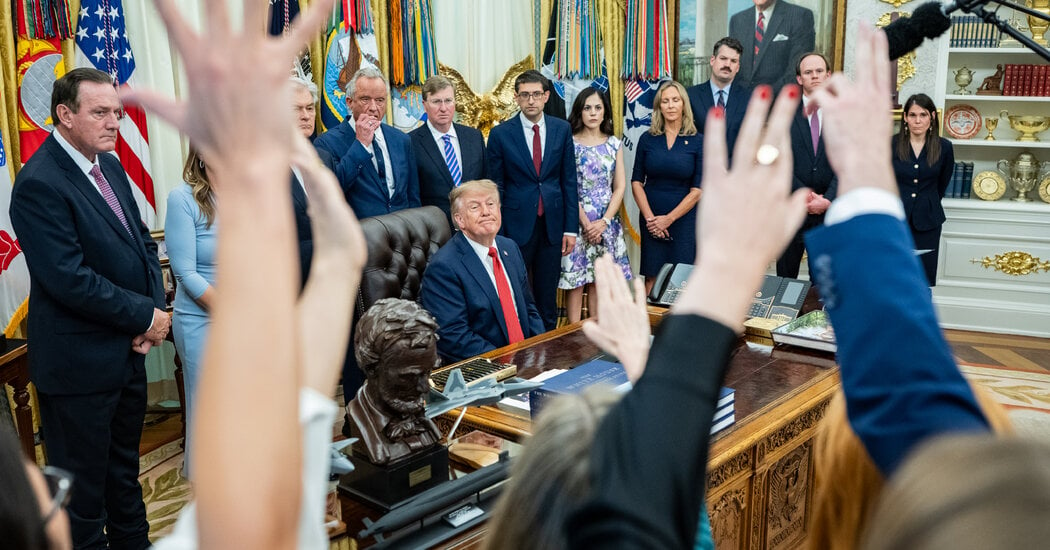
Donald Trump’s ban on journalists from CNN, MS NOW and Politico has moved forward at the White House, escalating the US president’s long-running confrontation with the news media.
The decision, announced by Mr Trump on Friday, came after he criticised coverage by the three organisations. It reportedly caught some White House officials by surprise and was made while his chief of staff was out of town.
Mr Trump suggested the outlets could regain access if their reporting improved. “Maybe they can get better and we’d like to have them in,” he said, appearing to make access conditional on more favourable coverage.
He added: “There’s something wrong with a country that can allow people to write purposely negative stories. Now, if they want to write them, that’s fine, but I don’t have to let them into my — into the people’s house.”
First Amendment experts and civil rights organisations said the ban appeared to be unconstitutional because it would penalise news organisations over the content of their reporting.
The move came as Mr Trump faced mounting political difficulties, with former officials and civil rights groups accusing him of trying to change the subject by using the power of government against those who question him.
Sarah Matthews, who served as a deputy press secretary during Mr Trump’s first term, said: “He thinks that he can bully anyone or any entity into doing whatever he wants and he’s seen it work out for himself with the entire Republican Party bending the knee to him. He is facing pushback from the courts, the Fed, people in his own party, and he’s lashing out.”
Mr Trump has previously attacked the media and used lawsuits against critical coverage, but his administration has also taken a series of wider measures against institutions and groups viewed as hostile to him.
Funding has been stripped from public television and radio, while the Pentagon fired the editor and publisher of Stars and Stripes, a traditionally independent newspaper. Journalists at the organisation said they had been removed because they reported on worsening conditions aboard a Navy aircraft carrier deployed to the Middle East.
The administration has also sought to revoke the licences of broadcasters that air negative coverage or commentary about Mr Trump, while moving against the tax status of liberal groups, online speech and visas for people whose views he dislikes.
Derrick Johnson, president of the NAACP, said the press restrictions were an attempt to divert attention from issues damaging to Mr Trump, including soaring petrol prices, the Epstein files and a weakening economy.
“The only thing that is favorable to him is the public believing his lies — and that is only possible if he controls the narrative,” Mr Johnson said.
The White House did not respond to requests for comment.
Polling has found that a majority of American adults believe Mr Trump has not paid enough attention to the country’s most important problems. His attacks on dissent and the media have also failed to settle concerns among voters and Republicans facing significant losses in the November elections.
Douglas Heye, a former communications director for the Republican National Committee, said Mr Trump’s anger was becoming increasingly visible. He pointed to the president’s threat to cancel a planned 257 million dollar renovation of the Kennedy Center after a federal judge blocked an attempt to put Mr Trump’s name on the institution’s exterior.
Images taken through the windows of Air Force One later showed Mr Trump examining a poster bearing the words “Kennedy Center DEMOLISHED”, prompting speculation that he might destroy an institution he could not attach his name to.
Mr Heye said many Republicans wanted Mr Trump to concentrate instead on policies addressing the economic pressures faced by their supporters.
“He certainly uses brash tactics to take over news cycles. I would argue that quite often these are unhelpful to him,” he said. “We are 45 days ahead from the election and what are we talking about this week and going into next week? Nothing about Donald Trump’s plan to lower prices.”
