


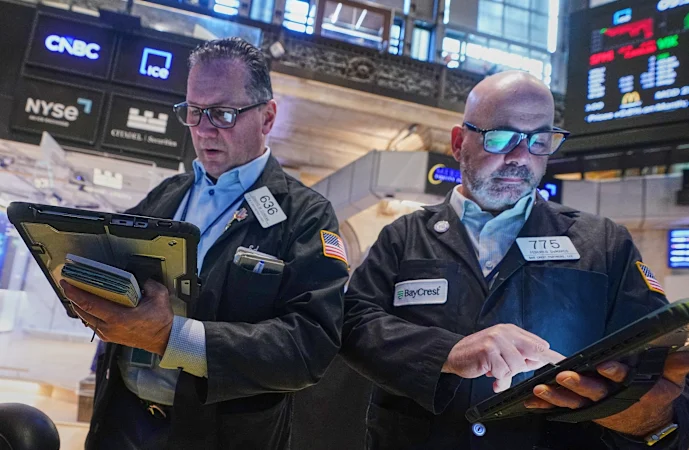
Wall Street surged after Jensen Huang returned as chief executive of Nvidia, sending the chipmaker’s shares sharply higher and lifting US markets after one of their worst weekly falls since the 2008 financial crisis.
The S&P 500 rose 5 per cent, while the Nasdaq Composite climbed 6.8 per cent by midday in New York. The Dow Jones Industrial Average gained 1,508 points, or 3.1 per cent.
Nvidia shares jumped 32.7 per cent, at one stage putting them on course for their strongest daily performance since 2000. The rise followed a fall of almost 23 per cent last week, although the stock remained below its level before concerns surrounding Huang first emerged.
The company’s board is still investigating whether Huang was the target of a foreign spy, according to the report. His return nevertheless prompted a broad recovery among companies that have benefited from the artificial intelligence boom.
CoreWeave, which buys Nvidia chips and rents access to them through the cloud, rose 23.5 per cent. GE Vernova, a supplier involved in powering AI data centres, gained 7.9 per cent, while Caterpillar advanced 7.4 per cent after both companies suffered steep losses the previous week.
The rebound brought the S&P 500 more than halfway back from a seven-day losing streak that had taken it more than 10 per cent below its record high set last month. Nvidia’s size means movements in its share price have an unusually large impact on the wider index.
Donald Trump said he believed his intervention had helped persuade Nvidia’s board to reinstate its co-founder. In an interview with CNBC, the US president said: “I believe my intervention was very important.”
Trump also said his administration had assured Nvidia that there were no national security concerns about Huang’s return. Nvidia had rejected an offer by Huang to return as chief executive less than a week earlier.
Australian shares were expected to follow Wall Street higher, with futures indicating a rise of 121 points, or 1.4 per cent, at the open. The Australian market had slipped 0.3 per cent on Monday, while the Australian dollar was trading at US66.28 cents.
The recovery came despite continuing concerns over the valuation of AI-related stocks, the prospect of tighter regulation and the cost of borrowing to fund the construction of data centres and other infrastructure.
Barclays analysts said those risks could make the expansion “slower and more selective rather than derail it”. They wrote: “Markets have been badly bruised by the turmoil of recent weeks, but we do not think the underlying cycle is broken.”
They added that corporate earnings remained strong, global growth was holding up and the AI build-out was not collapsing, describing the risks as manageable for now.
