


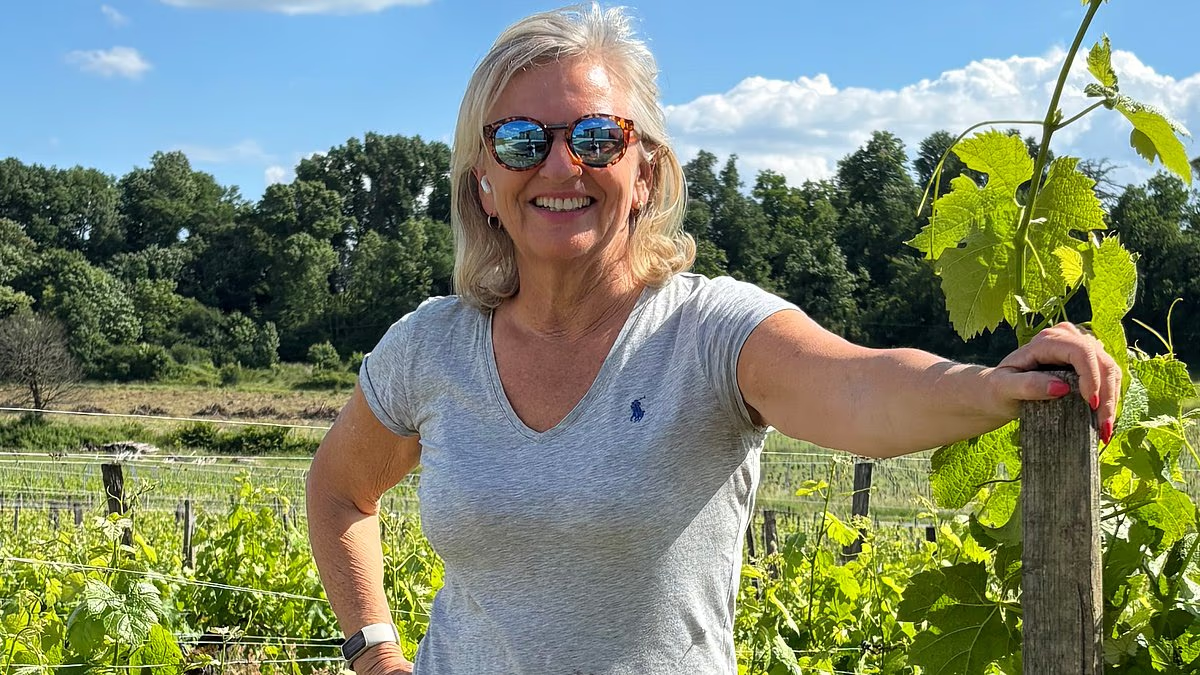
When Sally Evans tells people she bought a vineyard in Bordeaux in her 50s, she’s well aware of how it sounds.
‘I know, it does sound mad when you say it,’ the 64-year-old laughs.
It certainly wasn’t part of some carefully mapped-out lifelong ambition. Until the age of 52, Sally knew relatively little about wine. She’d spent years working as a marketing director for a large consulting company, raised two sons and lived what she describes as a ‘pretty normal life’: job, home, children.
Then, seemingly all at once, the structures around which that life had been built began to disappear.
A single mother, Sally had already stepped away from her demanding corporate career when her younger son was 14. Having returned to work when he was just two months old, she admits there was ‘a bit of mum guilt’ involved.
‘I thought, he’s going to leave home and I won’t have spent any time with him,’ she says. So she spent the next few years at home with her son. Then came university.
‘Suddenly, all the anchors started falling away,’ she remembers. ‘My mum was in a home, my second child was about to leave, and I started thinking about the next chapter.’
For many women, it’s a familiar crossroads. Children leave home, careers that once felt all-consuming begin to lose their pull and, perhaps for the first time in decades, the question becomes not what everybody else needs, but: what do I actually want?
New research suggests Sally is far from alone in feeling that her best years needn’t be behind her. According to RBC Wealth Management’s Longevity Research Report, which was conducted in participation with YouGov, 72 per cent of Britons aged 45 to 75 say they feel younger than their actual age – by nine years on average – while 65 per cent feel optimistic about the future.
When Sally Evans tells people she bought a vineyard in Bordeaux in her 50s, she’s well aware of how it sounds
Women are particularly positive about what later life could hold. More than half, 55 per cent, describe this stage as empowering, compared with 44 per cent of men, while 52 per cent see it as full of possibility. Half of women say they enjoy taking on new challenges and 54 per cent believe personal growth remains important.
Sally is almost a case study for the phenomenon.
‘I thought: for the first time, I can live where I like. I can do pretty much what I like within reason,’ she says.
Her first decision was considerably less dramatic than buying a vineyard: she wanted to get her brain working again.
Having lived in France for decades while remaining, in her words, ‘quite ignorant about wine’, Sally signed up for a Wine & Spirit Education Trust course.
‘I thought I’d start with something fun, something I’d always meant to do,’ she says. ‘I did level one, then level two, and thought, this is interesting.’
As she studied, another idea began forming.
Rather than asking herself what job she should do next, Sally wrote down the things she had repeatedly loved throughout her life: hospitality, teaching and learning, meeting people, renovation. She’d even run a pub in the Cotswolds in an earlier chapter of her life.
‘The great thing about doing it in your 50s is that you’ve done stuff,’ she says. ‘You’ve been through stuff, you’ve enjoyed stuff. Some things have been more successful than others. You have all these things that bring you joy that perhaps you can now bring together for the next chapter.’
And so came the vineyard.
‘Everyone told me: don’t make wine’
Sally had never even visited Bordeaux before deciding to look for a property there.
‘I thought: where do they make great wine? Bordeaux, apparently,’ she laughs.
She found an estate agent and set some firm criteria. She wanted to be within easy reach of Bordeaux and its airport, in a respected appellation, with a house she could renovate and, crucially, only a small amount of land.
In March 2015, aged 53, she bought three hectares of vines surrounding a collection of dilapidated buildings in the village of Saillans, on Bordeaux’s Right Bank. It would eventually become Château George 7, the boutique winery she runs today, producing small-batch red and white wines.

In March 2015, aged 53, Sally bought three hectares of vines in Bordeaux
The romantic version of this story would have Sally immediately rolling up her sleeves and producing her first vintage. The reality was considerably more cautious.
‘I really didn’t want to be taking huge risks at this time of life,’ she says.
She initially allowed the previous owner to continue farming the vines while she renovated the cottage, studied wine, helped neighbouring producers and learned how the industry worked.
‘I always had a backup plan for each stage,’ she explains. ‘Some people don’t like a backup plan. Arnold Schwarzenegger says you should never have a plan B. Well, spoiler alert: I’m not Arnold Schwarzenegger.’
In fact, one Bordeaux property consultant gave her particularly emphatic advice: ‘Don’t make wine.’
Rather than putting her off, it had the opposite effect.
‘The fact that somebody who knew what he was talking about told me not to do it and I still really wanted to proved that I really wanted to.’
After a further two years of studying, Sally had gained a diploma in wine. More importantly, she’d had time to work out what she could bring to this completely unfamiliar industry – and where she needed help.
‘I approached it like any other business,’ she explains. ‘What do I know how to do?’
The answer was marketing, hospitality and business. What she didn’t have was decades of knowledge of Bordeaux winemaking, climate and terroir, so she hired two consultants who did.
‘I think you build your confidence over time with the learnings over time,’ she says.
The dream – with a financial reality check

Sally started with three 500-litre French oak barrels
If Sally’s story has you browsing French property listings over your morning coffee, there is one decidedly unromantic part of the fantasy: money.
RBC’s research found that three-quarters of 45 to 75-year-olds see feeling financially secure as a key priority, second only to staying healthy. And while women are more likely than men to see later life as full of possibility, just 55 per cent feel confident making financial decisions for the future, compared with 67 per cent of men.
For Sally, protecting the financial security she had already built was non-negotiable. She funded the initial purchase from shares and savings and deliberately started small.
‘I was very clear that I did not want to take out a loan,’ she says. ‘I wanted to cut my cloth according to my means.’
When people encouraged her to buy a grander house or a bigger vineyard, she resisted.
‘I thought, there’s one of me. I’ve got a lovely cottage. We’re very aware at this age that perhaps our big earning years are behind us. It was absolutely clear to me that I would not put my financial future at risk.’
Even the winery grew incrementally. She started with three 500-litre French oak barrels, later bought another three and invested in equipment only as the business demanded it.
Her caution paid off.
Her first proper vintage came in 2018 and, while it was still ageing, a wine critic who worked for Robert Parker tasted it and awarded it 91 points out of 100. A British importer picked it up, too.
‘I didn’t know whether it was any good,’ she admits. ‘My consultants told me it was good, but I didn’t know what a nine-month-old wine should taste like when it wasn’t meant to be drunk for three years.’
By the time her first bottles were ready in 2020, Sally already had both a strong critic’s score and a UK importer. She now sells her wine internationally, including in Britain, Japan and the US.
The highs, the lows and the hailstorms
Today, Château George 7 is a working three-hectare vineyard and wine tourism destination, producing award-winning reds and whites. The former tractor barn Sally converted into a tasting room now welcomes visitors for private tastings and lunches overlooking the vines.
And yes, there are moments when life here sounds every bit as idyllic as you’d imagine. Sally can drink her own wine, look out over her vines with a cup of tea as the sun comes up and welcome visitors for tastings and lunches.
But somebody also has to wash the glasses.
‘That’s pretty unglamorous,’ she laughs. There’s labelling bottles, packing orders, climbing ladders to retrieve stock and ‘collecting dead vine stumps in the vines’ with a wheelbarrow, too.

Sally converted the former tractor barn into a tasting room
And nature is an unforgiving boss. In June 2024, hail devastated Sally’s crop.
‘There are moments where you think, what am I doing here?’ she says. ‘I can’t control this hail and it’s ruined the crop.’
This summer, the wildfires brought another reminder of that. They have been devastating for those affected, with some losing homes or livelihoods and others forced to leave because of the threat. The fire service took every precaution to keep people safe, and life is now returning to normal.
‘The smoke was scary, especially at first,’ Sally says. ‘I had some here for several days, but it wasn’t as thick as downtown Bordeaux.’ The smoke hasn’t affected the vines, and Sally is hopeful for cooler temperatures and some rain. ‘Looking forward to a good vintage 2026.’
Ironically, relinquishing control has been one of the biggest adjustments after corporate life.
‘I used to work in a very fast-paced environment where it was: get the PowerPoint done, get it over there. Here, you are working according to the seasons and the calendar. If you miss an opportunity to do something in spring, you’ve got to wait a year. You can’t rush it.’
What she can control is how she spends her time.
‘I designed this so that I can be the mistress of my own time,’ she says. ‘I do not want to be dancing to someone else’s tune. Everything here has to be done with fun and joy because otherwise, why am I doing this?’
That may be the biggest difference between Sally’s old definition of success and her new one.
‘In your 30s and 40s, especially in the corporate world, it’s the bigger mortgage, the slightly bigger house, the next job, the recognition, the money, trying to get work-life balance, which always seems just out of grasp,’ she says.
‘At this point, it’s not about buying more stuff. It’s not about having a bigger house. It’s about going out and sitting with a cup of tea in the morning as the sun’s coming up and just enjoying being here.’
It’s never too late to start over
There have been sacrifices. Sally moved away from close friends and now lives far from her sons – one is in Hong Kong and the other in London – although she has built a new community around her in Bordeaux.
Her sons, meanwhile, have gone from wondering what on earth their mother was doing to requesting bottles for work dinners.
‘At the beginning, I think they thought, “Oh God, Mum, what is she up to now?”’ she laughs. ‘Now I get a WhatsApp saying, “Mum, could you send some wine to the leadership meeting, please?”’
And she is far from finished.
At 64, Sally is experimenting with another wine and has planted a garden so she can host large lunches outside.
If she had been presented with the finished picture at 52, she suspects she might never have started.
‘If someone had said, “You’re going to move somewhere you don’t know anybody, start making wine when you don’t know how to make it, make award-winning wines and open an award-winning wine tourism centre”, I think I probably would have run a mile.’
Instead, she built the dream one decision at a time.
‘When you go into the unknown, you have to start somewhere,’ she says. ‘Each stage was going a little bit further and a little bit further.’
It’s perhaps why the finding that more than one in five of 45- to 75-year-olds with a current life goal believe they’ve left it too late to start something new feels particularly poignant.

‘I’m 64 now and I have so much more energy than I had before,’ says Sally
Sally has a rather different perspective.
‘Age is not a problem. It really isn’t,’ she says. ‘Especially in the wine industry. Ageing is seen as good. Good wines age.’
And if this is supposed to be the period when she starts slowing down, nobody appears to have told her.
‘I’m 64 now and I have so much more energy than I had before,’ she says. ‘I’ve still got loads of ideas.’
So, after all the mud, hail, financial calculations, bottle labelling and hard work, is owning a vineyard in Bordeaux really the dream it appears to be?
‘It is a dream,’ Sally says. ‘It’s my dream. Other people might think it was a nightmare. But that’s what’s been so fantastic. I’ve constructed it according to what I wanted to do.
‘You’re not doing it to prove anything to anybody else at this point. You’ve got to do it for yourself.’
