


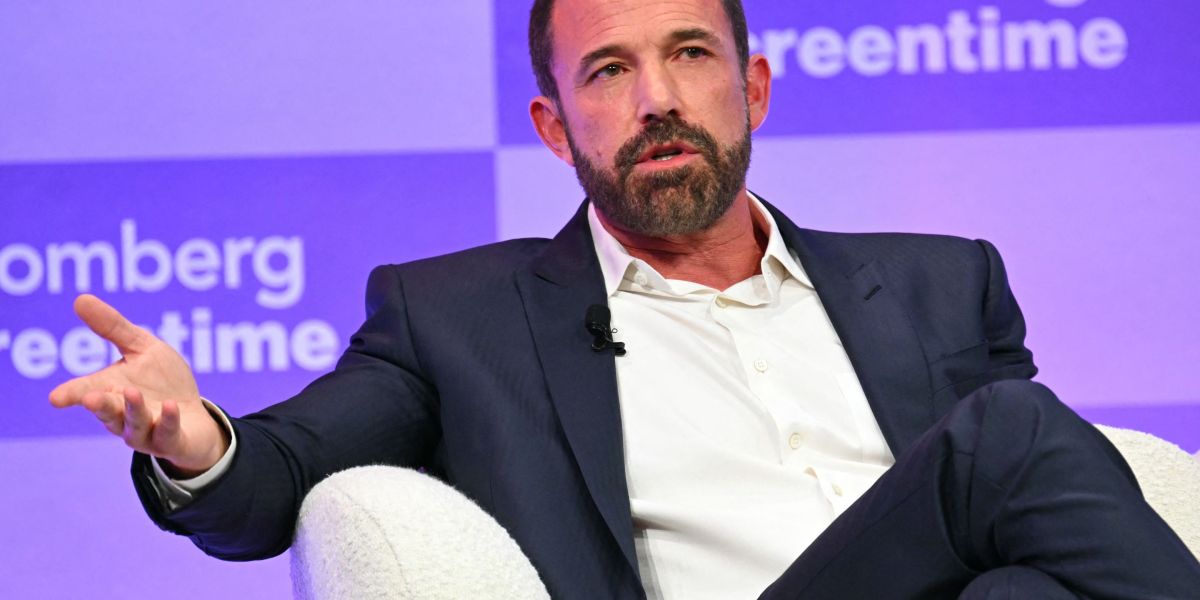
Ben Affleck has dismissed fears about AI job losses as largely “propaganda”, arguing that the technology is better understood as a tool than an existential threat to humanity.
The actor and screenwriter, who co-founded the AI filmmaking company InterPositive in 2022, said people often become less fearful once they use the technology and see how it works. His comments were made in an interview with Bloomberg.
“[Once] it moves from this nebulous, abstract, terrifying alien—‘It’s going to kill us all, we’re paperclips, and it’s going to wipe out half of white-collar jobs, all this propaganda’—and they actually see what it is, it’s like another form of computing that does tools and is a technological advancement,” Affleck said.
InterPositive was reportedly acquired by Netflix earlier this year for $587 million. Affleck has been among the more prominent supporters of using AI in the film industry.
He was less willing to explain precisely how the technology had been used in his new film, Animals. Affleck said revealing too much about the production process could damage the illusion on which cinema depends.
“I’m a little bit hesitant to point out what they are or even talk about it because in my business, we’re trying to foster the illusion of reality,” he said.
“It’s like if you went to a magic show and the magician walked out and said, just before I start, I want you to know there’s another bunny under here, this guy’s a plant—it sort of ruins it.”
Ben Affleck raises concerns over AI in education
Affleck said his reservations about AI were strongest when considering its effect on children and education. He warned that over-reliance on the technology could lead to what he called “learned helplessness”.
“When I worry about AI, I worry about my kids in school, I worry about the 30% rise in the number of As given out at colleges in the last three years,” he said. “I worry about learned helplessness. I worry about responsible use.”
He said the technology was not being used in Hollywood simply to cut costs or replace workers, claiming that productions using AI could employ the same number of people, or even more.
That view comes as employment in the wider motion picture and video production industry has fallen. Between 2016 and 2026, the sector lost 49,000 jobs, a decline of 21%, according to Labor Department data.
Hollywood figures call for engagement with AI
Other prominent figures in the film industry have also argued that Hollywood must engage with AI, while stressing the need for safeguards and protections for artists.
James Cameron, the director of The Terminator, joined the board of AI company Stability AI in 2024. Actor Natasha Lyonne has co-founded Asteria Film Co., an artist-led animation and film studio seeking to develop copyright-friendly generative AI for film and other creative work.
Lyonne has said the industry should help shape the technology rather than simply resist it. “We need human beings in AI so that the tools don’t run us,” she said.
Matthew McConaughey has similarly argued that Hollywood cannot stand aside as AI develops. He has reportedly filed trademarks covering his image and signature expressions, seeking to make it harder for companies or individuals to simulate him without permission.
“Don’t deny it,” McConaughey said in a conversation with Timothée Chalamet. “It’s not enough to sit on the sidelines and make the moral plea that this is wrong. That’s not going to last.”
